Coaching
Technical
The Loop: Advanced Coaching Elements
Rowden Fullen (1970’s)
Long-arm Loop
Long pre-swing usually knee high or higher and beginning a couple of feet behind the right leg (for a right-handed player). The right shoulder is dropped prior to contact and there is strong body rotation and knee lift, the weight being brought forward from the back to the front foot for speed and power. The wrist may be adducted (dropped) throughout the stroke but remains constant and is not used in the stroke. The left elbow can begin the shot to bring in good rotation and to use both sides of the body and thus guard against injury to the back. This loop is often played from a little deeper position.
Use area – In the fast modern game counter to just about any shot, another loop, topspin drive, long push or chop, any ball that comes off the end of the table and especially one which carries a little deeper or which has more power to it. A good way of turning defence into attack or slowing down attackers when used as a counter from the mid-area, due to the excess spin and power either forcing the opponent back or reducing him to a more passive blocking game. A useful weapon for getting the defender well away from the table and often wide, because of the ease of applying sidespin. The wrist is not used in the stroke as the prime force is exerted through body rotation and from the shoulder. The long, trailing bat arm is accelerated through the shot and the free arm is utilized as a counter-lever and balance-assist to aid rotational speed. However the shot is often played with a dropped wrist (adducted) as sidespin can easily be initiated when the racket is brought round the outside of the ball instead of over the top. In the case of sidespin the racket will normally start behind the body and is best played against a ball that is a little wide of the outside knee.
Slow Loop
Knee high or lower pre-swing, with the racket starting close to the right knee (for a right-hander). Short arm and use of the wrist, the dropped wrist (adducted) is abducted at impact, the dropping ball (taken late) is played from the top shoulder of the racket down the full length of the blade. The body should be shifted forward under the ball and the prime racket angle will be upwards emphasizing spin rather than speed. There will be pronounced knee lift, limited rotation and transfer of weight and a rocking action of the shoulders.
Use area — Against choppers, blockers or short to the penholder’s backhand. Primarily used against the slower ball to open up attacking possibilities or as a weapon to pry open the defensive or mid-field game. It is more difficult than the fast loop to block or to counter-loop (Magnus effect) and is particularly effective against the heavy spin choppers. The slower ball will be taken at a later timing point as it drops and closer to the body, with the body weight being shifted under the ball. Beware trying to use too much in every situation in the faster modern game as good attackers have time to move across and kill the loop with their forehand wing. It is rather more important with this loop that players work much on achieving good length, either very short just over the net or very long (up to the base line) and also that they are able to drive or kill at the earliest opportunity. This will obviously mean that after each loop that the racket is kept up ready for the smash in the standard recovery position and does not drop back below table level.
Short-arm Loop
Short pre-swing with the racket starting close to the right knee or higher (right handed players). Good body rotation and knee lift, with dropped right shoulder and weight coming forward from right to left foot. Power and spin are primarily achieved by rotation and the speed of forearm fold. The elbow of the short free arm should be used as a counter-lever to accelerate angular velocity.
Use area — Against block, drive or loop or even push or chop. Can be fast or slow depending on which timing points are used and is particularly useful against the shorter ball which does not come through too deep. It is important to use the free- arm elbow to initiate the stroke as short-arm rotation from a standing position puts much stress on the lower back muscles. Many women use this loop and are not as strong in the back as men — it is therefore even more crucial that they have good technique from the start. The shot can be played with a dropped wrist, straightened and abducted at the moment of contact, though the prime spin will be achieved by the speed at which the bat-arm elbow is folded over. This loop is particularly useful for close to the table players as it enables quick recovery.
Coaches — When coaching loop pay especial attention to the free-arm side of the body — very few players use it effectively. Also watch where the racket starts. Many players don’t get effective topspin because they commence the stroke too far behind the body. To achieve topspin then requires two distinctly separate movements!
Backhand Loop
In the modern game this is usually initiated from the left hip (right-handed player), with the right shoulder forward. There will be a little knee lift, a little body rotation and fast forearm extension. It is this forearm extension and use of the wrist which give maximum spin. The wrist often commences in an adducted position (dropped) and is straightened and abducted at contact. The balance of pressure between the thumb and forefinger on the racket is important. There will be more body rotation and knee lift if the shot is played from a deeper position.
Use area — Virtually against any ball, topspin, drive, block or backspin. Particularly effective when used at an early timing point or if the player can mix this in from a drive or block situation, perhaps even changing direction at the same time.
Backhand Slow Loop
Still best initiated as they did back in the 1970’s from between the legs as per Klampar. In this case the ball is taken at a later timing point with the racket head dropped. There will be pronounced knee lift and the right shoulder will start in a forward position. Rotation is very limited as the main emphasis is upwards. Spin will be achieved primarily by strong abduction of the wrist and fast extension of the forearm and the pressure of the thumb on the racket is important.
Use area — Mainly against the backspin ball and often this loop is thrown up high into the backhand corner where it is more difficult for the opponent to control. Many players have difficulty in reading just how much spin there is from the backhand side and have problems in controlling the backhand loop.
Looping: History and Theory
Rowden Fullen (1970’s)
A drive or even a topspin drive becomes a loop when the spin content is intended to have more effect than the forward speed content. This concept of intention is useful when analysing many strokes in the game. Without the loop ‘intention’ players would proceed to strive after faster and flatter drives which at one time they indeed did. A fair proportion of players would still in fact be well advised to do just that and should not pursue the loop intention too far. (For example older, stiffer players, good flat-hit players, those who prefer thinner or less spinny rubbers and loop-happy juniors who have not yet mastered the basic skills.)
As well as intention one must remember purpose. Many players continue spinning long after they have achieved the goal of getting the ball up high enough to kill. Surely the idea when playing table tennis is to win the point – the loop should not necessarily be regarded as a point-winner, but rather as another weapon in your arsenal, another tool to create openings.
Intention is also a useful criterion for another reason. Five players starting off with the same intention will probably end up with five different types of performance. The effort to impart extra spin may well result in an important element of sidespin or an increased degree of forward speed or even equalizing the proportions so that we end up with merely a very strong and sure drive. If these accidental effects can be made intentional, then the loop practice has indeed been worthwhile.
We should also however bear in mind that for many players looping skills can only be acquired at such high cost in effort, time for practice and loss of other skills, that there are better ways of creating openings and winning points.
THE DEVELOPMENT AND THEORY OF LOOP — 20 THINKING POINTS.
- Why is topspin needed at all in attack? Because it gives the ball a downward curving flight path while maintaining directional control.
- What is good about a downward curving flight path? It is much more certain that the ball will hit the table because its final approach is nearer to the vertical instead of almost horizontal as in the flat drive.
- The gyroscopic effect of the spin gives strong directional control, thus more and more power can be fed into the stroke without greatly reducing accuracy.
- It cannot be avoided that maximum power means loss of accuracy. The effort involved in producing the maximum is so involved that attention to accuracy suffers. Skilled or semi-skilled, every player in the world has his or her accuracy barrier.
- Due to the nature of the execution of the stroke in comparison with the drive (more lift) it is easy to use many more timing points and thus much more variation.
- Because human nature is careless, the coach tries at all times to raise the accuracy factor, by emphasizing smooth muscle movements to reduce effort and topspin control to reduce error as more power is fed in.
- A beginner’s drive may be taught as a slow roll with absence of effort. An intermediate level drive calls for definite forward effort through the ball and correspondingly more topspin to restore the degree of control. However an advanced drive needs crisp forward speed on each ball with no loss of accuracy even when fast footwork is required between each stroke.
- The next stage is the point-winning drive in which the effect is usually achieved by forward effort with topspin as an accessory. Other effective winners are produced by unpredictability, by irregular changes of direction. On the whole the more pronounced the directional change, the more careful the player must be with the power input.
- In tournaments and matches the player faces a host of variations which are even more immediately effective than his carefully coached, controlled drives — the flat hits, punch strokes, forcing blocks and sidespin drives. However under 4. each of these has its accuracy barrier – they are safe if used with good judgement but all have their limits.
- At this stage coaching becomes sensitive. In the three-horned dilemma, power, accuracy, variation, each limits the other. Who knows what resources the player has in him to raise his barriers and to increase his boundaries? Perhaps the player does, perhaps his trainer, perhaps another coach.
- In the search to raise the limits, a pioneer found that by applying maximum effort to the topspin department and letting the forward effort look after itself the effect was very profitable.
- How does this first generation loop respond to 4.? Maximum effort tends to less accuracy, but increased topspin tends to more accuracy. Since the effect is great the equation cannot be faulted! This means the loop has less directional accuracy and less length accuracy but more ‘hit the table’ accuracy (due to the violent down-curve).
- Many players trying to copy the great loop players did not produce a true topspin when applying maximum effort – the result became a strong topspin plus sidespin loop or an aggressive loop-drive. Once again control was lessened, but effect was increased — the second generation loop had arrived!
- The first stage loop scored mainly on its unfamiliarity as regards length and bounce (the coaches and players of the 60’s could see what was happening but no-one thought to investigate why - it was of course a perfect example of the Magnus effect in action), but had relatively little forward penetration. Could the maximum spin effect be linked with near maximum forward effect? It could — by really skilled players. Accurate control suffered once again but the penetration effect was increased and the third generation loop was born. An unpredictable battery of power loops, sidespin loops, dummy loops and short-bounce loops is now the common currency of top-class players worldwide.
- These third level loops by their domination need no longer be used only against the backspin ball — they can in skilled hands be used in response to any ball that comes over the net.
- The only criterion basically is that the player’s racket angle should correspond to the trajectory of the incoming ball.
- The drastic degree of effort and the fineness of touch needed in producing the good loops exact their own penalty — bad loops are just terrible and so many players persist in using them when they should be counting the lost points. Others get so carried away with looping that they cannot finish an easy point with a normal drive or smash.
- So how should you play matches against loop players? If you are fast enough you can keep them under such pressure that they have little time to play good spin, especially if you keep changing length and direction. Or alternatively you can go the other way and give them very little pace, with continuous light and angled attack mixed with very short balls. If they are not really top-class performers even let them loop — you will win on their mistakes.
- One of the most successful answers is the block, which can be executed in a variety of forms, topspin or forcing block, chop, stop or sidespin block, soft touch block. Do not neglect training to hit through the loop at an early timing point (especially in the women’s game) — this is a technique which can pay big dividends.
- Finally of course there are the various material combinations which often cause loop players problems. The long pimple defender who chops with such aggression and length that it’s next to impossible to loop two or three balls in succession. Or the skilful short pimple blocker who uses the looper’s own spin on the return ball.
Thinking Points on the Forehand (Drive and Topspin)
Rowden Fullen (1970’s)
- Eyes follow ball on to the racket (unless ball is contacted in front of the body).
- Head still throughout the stroke.
- Aim to contact the ball on the correct part of the racket for the type of drive or topspin you intend to use.
- Contact the ball at the correct timing point on the stroke’s arc.
- Rotation of the shoulders and/or slight rocking action.
- Both elbows equidistant from sides.
- Shot played in part from the elbow through and up (not all shoulder).
- Fast arm action (forearm fold).
- Punch shoulder through the stroke.
- Good pre-swing (shoulder back quickly).
- Pre-swing long enough and quick enough to gain the benefits of elastic energy.
- Limited follow-through.
- Central recovery (both body and racket).
- Recovery path standard.
- Trailing wrist (extended) closed a little on contact.
- Marginal abduction of the racket hand (depending on the topspin element and which type of topspin).
- Counter action of free arm elbow – ensure whole body action, not a one-sided stroke.
- Bat and free hand equal tension – reasonably loose.
- Free hand level or slightly lower than the racket and following bat arm wrist (not higher).
- Rotation from the waist.
- Head, bat and ball all close together on contact.( More important with drive than when playing topspin).
- Back bent, humped, shoulders forward.
- Legs bent prior to contact.
- Weight on the right foot prior to contact.
- Left knee lower than the right prior to contact.
- Push off the right foot.
- Right foot at a right angle to where the ball is going.
- Corkscrew action up and forwards.
- Straightening of the right leg as the left twists.
- The heel raise identical from the left foot to the right.
- Left toes pointing to where the ball is going.
- Transfer of weight from the right to left foot.
- Equalize the weight after the stroke.
- Aim at smooth, relaxed power input at all times.
Coaching and Playing Points
Rowden Fullen (1970s)
COACHING POINTS.
- Directed training and directed development will always achieve better results.
- Always have style development in mind.
- Together with technical skills develop tactical awareness – while carrying out exercises bring in tactics by varying table placement, length, angles, ball speed and spin and timing.
- Look at grips – does the player have a forehand or backhand bias?
- Does your player know the secret of elastic energy?
- Movement is the key to the future.
- Evaluate balance and recovery.
- The essence of all stroke-play is the instant of impact between the ball and the racket. Does your player feel the ball?
- Consciousness – what is the degree of awareness of oneself, one’s own feelings and what is happening around? Assess your player.
- Total concentration — table tennis is a switch on/switch off game, 100% focus when the ball is in play, relax and switch off when out of play. How does your player cope?
- There is no room for feelings, especially anger. A relaxed calmness will pave the way to being in control, clear headed and able to think at all times. This does not mean that there is no place for controlled aggression – there is always a time to fight and many of the great players have total unshakeable determination. Evaluate your player.
- Feel one’s strokes, feel the ball at impact — flat and brush strokes are the essence of table tennis. Assess your player.
- The ability to keep track of the game, to know where you are winning and losing points, aware of serve/receive ratios, where opponents are weak or strong and the capability to take the initiative and adapt to changing circumstances are the mark of a champion. How does your player measure up?
PLAYING POINTS.
- ‘Stare’ at the ball — focus 100% all the time.
- Be aware that the time to assess the spin on the ball is about 5 –15 cms. before the bounce on your side.
- Be conscious of balance and the movement of the feet.
- Be aware of recovery, the end of one stroke is the start of the next.
- Be aware of contact points and differing timing, what happens and how to use these aspects.
- Be conscious of placement of the ball.
- Be ready to take the initiative in attack.
- Be aware of the use of spin and no spin.
- Be aware of adjustments in playing the stroke, less or more force or back-swing, timing, angle of the racket and where on the racket you contact the ball.
- Be aware of the method of applying force, use of the wrist, movement of the fingers etc.
- Have the desire to vary pace, spin and placement and know the different ways to do this.
- Use your own strengths to the best advantage. Be aware of how you win points. Play to your strengths.
- Block out all thoughts that are not relevant to your training/match/tournament.
- Think of every training session in a positive manner and do not allow anything to interrupt your training focus.
- Visualize success.
- Cultivate a desire to achieve, to put up a good show and behave well at all times. Be competitive but a good sportsman.
- Cultivate a positive approach to your sport, industrious but always ready to listen and to try new things.
Stroke Correction Techniques
Rowden Fullen (1970’s)
Technique is important. If your player has stepped outside the bounds of good technique then it is most unlikely that he or she will reach the highest levels. It is a cruel fact that weakness is always exposed once you arrive at the top levels.
When working with a young player it is important that you look at stroke production from a scientific viewpoint. Only in this way can you pinpoint exactly where the problem lies. It is also useful to have guidelines which are applicable at all levels of stroke-play and to each individual stroke.
STANCE
Feet should be shoulder width or a little wider, knees bent, back arched, shoulders slightly forward (all important for balance and efficient movement). Always relate stance to the line of play (where the ball is coming from), not to the table or the opponent. Always face the line of play, with both the body and the feet.
Stance should be the best position of advantage with reference to the opponent — start to build in tactics early in the player’s career. The majority of modern players will use a square stance, (facing where the ball is coming from), it saves time, especially close to the table. Once players drop back from the table side-to-square is used a little more as it aids power production particularly on the forehand side.
BODY ACTION
Here we are talking about use of leg power, rotation of the waist and shoulders (sometimes a little rocking action of the shoulders), fast arm movement, especially forearm and forearm fold. Bear in mind that the crouch with head forward extends the range of the stroke and economizes on movement.
LENGTH
This is the distance the bat travels. With beginners a short stroke is the priority and particularly close to the table. (Less to go wrong if short). Try to have a longer pre-swing and limit movement after contact with the ball. Longer strokes with very young players can also lead to injuries.
TIMING
‘Peak’ or 1/2 centimetres before is the most efficient for control. (Peak is the highest point after the bounce on your side of the table). Many coaches in Europe see peak as being relatively late, later than in fact it is — Asians see peak as being earlier than we do.
Peak gives the biggest target area and allows the player the best chance of hitting the ball down on the other side of the table. If players let the ball drop when small (a natural tendency with the ball coming at the face) this can easily become a habit leading to running away from the table whenever under pressure. This of course gives the opponent a better chance to use the angles. By adopting peak when young the player’s natural tendencies have the opportunity to emerge and he/she will have more options when older. It will be of prime importance later on, particularly with drive players (this includes the majority of girl players), to be fully aware that with this type of play there is an extremely narrow ‘window’ from the point of view of timing.
TABLE POSITION
What we are talking about here is the exact contact of the ball in relationship to the table. Is it over the table, at the end of the table or back from the table? For the beginner we must again look at this in terms of control — usually this is best over the table but with the ball coming through (not too short).
FREE ARM
This is particularly valuable as an aid to rotation (especially on the forehand side). Lack of use of the free arm limits movement and often leads to a forehand stroke where only one half of the body is used with the risk of subsequent injury. Also the free arm aids balance and orientation. For the beginner this latter is often useful in helping him or her to have some idea of where the ball is in relation to the body.
BAT ARM
The optimum for control is the 90 degree angle at the elbow, with no wrist at first and only a slightly open or closed blade. The elbows should be about a hand’s width from the sides and both hands equally relaxed. The stroke is to be initiated from the elbow as well as the shoulder (but with no wrist in the initial stages). Bear in mind at a more advanced level the arm consists of the three joints, shoulder, elbow and wrist — the last two move much faster than the shoulder and will be used much more at top level (e.g. flick, fast forearm fold). Also the 90 degree angle of the elbow can be extended to 120 degrees or even straight to give a longer lever and more power.
FIRST 7 REFERENCE POINTS
These first seven reference points form the machinery by which the player hits the ball and will give the best control. As early as possible the beginner should learn to control the rally as a whole and not just the individual shots. This of course involves movement while retaining good balance which is indeed the cornerstone of our sport.
Be particularly aware of the theory of conservation of angular momentum. The centre of gravity of the arm (elbow area) will cover a certain distance in a given time period. Because the distance is a constant, if the arm is shortened, it must move at a higher speed to cover the same length. This principle is of vital importance in the short arm loop.
RECOVERY POSITIONS
Play the ball and recover always is one of the most important principles in table tennis. Every time you and your opponent strike the ball, the angles of play will alter. After you have played your stroke there must be a continuing, on-going assessment from you of the total angle available to the opponent — you must then move into the most advantageous position to cover this angle. Do not forget also recovery of the racket after each shot.
Recovery fastens the first seven reference points together and gives control of the table.
ANTICIPATION
This gives control of your opponent. After you have played the ball focus on the opponent. Watch him or her moving into position, look at the body, the stance, above all watch the racket at that point in time when the player is committed, 4/5 centimetres before contact with the ball. This should give you enough edge that you are already moving before the ball even crosses the net. The ability to read what your opponent is going to do will give you a big advantage. If you train your young players from the very start to play their own stroke and then to watch what the opponent is doing they will soon learn to anticipate without thinking.
China Training
Rowden Fullen (1980’s)
China-training or multi-ball came originally from Asia, where it has long been used as a natural part of the training method. Not only is it used by Asian coaches but also by the players themselves and is in fact often utilized as an alternative in the place of normal training.
Multi-ball is an excellent training method for both new beginners and elite players and can be employed over a large number of areas, to improve technique and tactics, to develop footwork or to help solve problems in weaker parts of the player’s game. It is of especial value in that the method can be used in an infinite number of different ways and it is very easy to think up and evolve new exercises to suit the needs of your particular player.
STABILIZATION
Where the player trains one stroke, for example opening against backspin on the backhand. Here the coach can examine the technique and its effectiveness quickly as the player executes a large number of strokes in a short time period.
COORDINATION
Where the player switches between backhand or forehand or topspin and backspin and must adjust to different placement, spin or speed. Such exercises can be regular or irregular.
FOOTWORK
Exercises can be aimed at short or long movement, in and out or side to side. The coach can determine just how long the movement should be and whether regular, part regular or completely random.
TEMPO
Where the player operates at a rather higher speed than in a normal game and is compelled to adapt his or her techniques, movement and balance under constant pressure. (A pressure which can be adjusted, increased or decreased at will by the trainer).
TACTICS
Where the player is called upon to change the game from control to attack or from spin to hit and to adapt to differing situations.
MATCH-PLAY
Where the multi-ball is put into a match play situation — for example short push to the player’s forehand, which he pushes or flicks long, return looped to the corners.
SPECIFIC EXAMPLES OF EXERCISES
- Regular switch play — One ball to each corner with topspin, even tempo, low bounce. The same with backspin.
- Irregular switch play — One ball to the backhand corner, one to the middle or to any part of the forehand side. One or two balls to each corner.
- Tempo training — The ‘Falkenberg’ with a fourth ball to the middle. Feed at a little higher tempo than the player would encounter in a game so that he or she must adjust the technique to the higher pace. Study the movement and balance, the aim being to increase the strength and movement abilities of your player. Ensure that the technique doesn’t suffer under the increased stress. Take up and feed the four balls then allow your player the time to return to the ready position before re-commencing the next group of four balls.
- Technique training — Backhand loop against backspin – pay particular attention to the player’s technique and give him or her time to re-assume the ready position before continuing. It is important that this type of exercise is not operated at too high a speed.
- With two players — the coach feeds a backspin ball to player 1 who loops. Player 2 drives through the loop.
- Match training — Short backspin to forehand, long backspin to backhand, long topspin to forehand. Ensure that the player returns to the ready position between strokes and take care that the feeder does not feed too fast, especially between balls of different tempo. As a general guide the player’s ball should bounce on your side as you feed the next one. After regular exercises build in random movements as the player improves.
- Defence training — Feed from a distance, perhaps 2 – 2½ metres back and it may be necessary to feed from a lower position to achieve the correct trajectory. Give the player time and vary the spin from heavy backspin to float.
- Smash training — Feeder stands well back and lobs up high balls with varied topspin to different table areas. Train player to smash from differing areas but especially at an earlier timing point.
- Control training — Feeder drives hard or topspins and player controls with various blocks and occasionally counters. Player should try to control to different table areas and return to the ready position after each stroke. Always also be prepared to ‘force’ or counter-hit hard and early on the suitable ball.
- Footwork patterns — 1 – 5 balls to the crossover and one to the forehand or backhand. Important that the player has good balance at all times. It is physically hard to be played into the crossover all the time but the player must try to move the feet first, then play the ball.
THOUGHTS FOR THE FEEDER
- Take the ball quite early, not too high or the trajectory can be flat and unnatural.
- Drop the ball down or throw it slightly backwards.
- For a higher tempo you can hit the ball directly out of the hand.
- Take 4/6 balls in the hand at a time so you can have an even rhythm.
- Be relaxed.
- Try to work calmly and methodically. The priority is that the balls come over the net in a natural way, at whatever speed you work.
- Let the player know the time interval if you are feeding series of say five balls then a short pause. It is often good to work in series for example in footwork exercises. In a technical learning situation however the player often learns better if you feed continuously for a given period.
- Stand closer to the net to play short balls.
- During speed or movement exercises if you miss one point proceed to the next, then the player doesn’t lose the rhythm.
- Use China-training to improve your player’s placement, ability to play straight balls or to the crossover or out to the angles. Many players have too much diagonal play.
- Bear in mind that China-training takes much more concentration than a normal session and should not be operated for the same time period. The player strikes many more balls in a much shorter time.
- One-to-one training of this kind gives excellent opportunities to talk ‘table tennis’ to your player.
- Feeders can use both forehand and backhand. It’s also particularly useful to use different rubbers from time to time to train your player against defence or pimples.
- One big advantage for the trainer is that he has an excellent opportunity to study his player’s technique and to see any problems first-hand.
- Have an extra racket for China-training as the rubbers will wear very quickly!
Requirements for Table Tennis
Rowden Fullen (2002)
- Condition
- Speed
- Control of speed
- Flexibility
- Strength
- Feeling
- Technique
- Mental toughness
- Adaptability
- Willpower
Evolution of the Player
Rowden 2011
Technical development
– The 9 Stages
STAGE 1
1. Athlete will be able to produce and explain a proper grip, including pressure points (‘a’ grip, as different grips will lead to differing styles).
2. Athlete will be able to demonstrate an appropriate ready position (different ready positions will also lead to differing styles of play).
3. Athlete will be able to execute the following basic strokes with correct form, directional control, and with an 80% success rate when fed by coach:
• Backhand push and forehand push against backspin
• Backhand and forehand blocks against topspin
• Backhand and forehand drives against topspin
• Backhand and forehand topspins against backspin
4. Athlete will demonstrate an understanding of the basic elements of all strokes:
• How to strike the ball - Friction versus force type of ball contact
• When to strike the ball - The proper timing for each of the basic strokes
• Where to strike the ball – The correct contact point on the ball for each of
the basic strokes
5. Athlete will learn basic backspin and topspin theory. This includes:
• How spin affects the flight of the ball
• Where to strike the ball to produce each spin
• The concept of going with or against the spin
6. Athlete will understand the following basic theories:
• The role that racket acceleration plays in all strokes
• The role of the back-swing in helping with stroke/timing/power and when
this is less necessary.
7. Athlete will learn basic serves as he/she learns each stroke.
a. Example: Backhand push = learn a backhand backspin serve
STAGE 2
8. Athlete will be able to produce correct 1 and 2-step footwork in both directions while executing correct strokes.
9. Athlete will be able to produce mixed stroke combinations against both backspin and topspin, using all of the basic strokes with a success rate of 80%.
10. Athlete will be able to successfully complete simple consistency drills with a partner.
11. Athlete will be introduced to the concept of inside and outside ball contact to control the direction of the ball.
12. Athlete will be able to change his/her point of contact on the ball to correct for the change between topspin and backspin ball feeds.
13. Athlete will be introduced to the concept of using the lower body to produce power and spin, where this is appropriate.
STAGE 3
14. Athlete will be introduced to the concept of producing topspin at different speeds (gearing) by controlling the amount of body use and the speed of arm.
15. Athlete will learn and be able to produce the modified service grips.
16. Athlete will focus on developing the necessary hand skills to produce heavy spin services.
17. Athlete will be introduced to the concept of stopping, using or returning the spin on the opponent’s serve when returning serves.
18. Athlete will learn the relationship between racket acceleration and going with or against the spin on the opponent’s strokes.
19. Athlete will be able to produce both forehand and backhand drop shots, flicks, and pushes against short serves.
20. Athlete will be able to produce and explain the effect of sidespin on the ball.
21. Athlete will be introduced to the concept of applying and redirecting power against an opponent.
22. Athlete will be introduced to the concept of relaxation and use of the stomach in generating maximum power.
23. Athlete will be able to produce both backhand and forehand loops against both topspin and backspin ball feeds.
24. Athlete will be able to practise (with a partner) using the five ball sequencing system. This consists of practice focusing on one of the first five strokes of the game:
• 1st. – Serve
• 2nd. – Serve Return
• 3rd. – 3rd. Ball Attack
• 4th. – 4th. Ball Defence or Counter Attack
• 5th. – 5th. Ball Attack
STAGE 4
25. Athlete, working with the coach, will begin developing his or her own personal style of play. This will be accomplished by examining:
• The characteristics of the styles of play currently used at World Level.
• His/her own strengths and weaknesses and which style of play he/she best matches up with.
• What style of play would he/she most enjoy playing?
26. Athlete will learn basic strategy consisting of the four ways to win a point. These include:
• Power
• Deceiving the opponent, varying speed, spin, height, and placement to force
errors
• Special Techniques – combination rackets, special serves, or unique shots
• Time Pressure – playing faster than your opponent is comfortable playing
27. Practice will focus on developing patterns of play which best suit the style of play of the athlete.
28. Athlete will develop effective techniques from close, mid, and far distance from the table with the bulk of the practice focusing on the ideal distance from the table for the athlete’s style.
29. Crossover footwork will be introduced and practised during this stage if the style requires.
STAGE 5
30. Athlete will develop the advance stroke techniques necessary to complete his/her own style of play.
31. Athlete will be able to make the necessary grip adjustments during play to enhance specialised strokes.
32. Drills will focus on consistency and learning the new skills.
33. Athlete will focus on improving his/her serve and receive game focusing on the correct serve placements and patterns for his/her style.
34. Athlete will focus on improving his/her footwork focusing on the movements necessary for his/her style.
35. Athlete’s training will continue to focus on the development of his/her strongest strokes (main weapons)
STAGE 6
36. Practice during this stage focuses on adding the advanced techniques into the Athlete’s style of play using the 5-Point System of training.
37. The athlete should now have the technical skills necessary to implement any of the four basic ways to win a point against any opponent’s style of play.
38. The Athlete’s main technical development should now be complete.
STAGE 7
39. Practice during this stage focuses on specific tactics against different styles of play and at various stages of the match.
40. Drills during this stage become more and more random, forcing the Athlete to begin to concentrate more on what the opponent is doing.
STAGE 8
41. Practice during this stage focuses on making small technical changes that have been proven necessary through intensive match play.
STAGE 9
42. Practice during this stage focuses on preparing the Athlete to 'Peak' for major competitions.
Physical Training
Athletes should:
STAGE 1
1. Be introduced to a program of basic exercises that become part of their warm-up program. These exercises need to be age appropriate and are designed to prepare the athlete for future training.
STAGE 2
2. Be introduced to simple movement exercises that help develop the needed foot skills necessary for the sport.
STAGE 3
3. Begin a program of general physical training that consists of age appropriate exercises without added weights.
4. Begin a program of aerobic training through on-the-table movement drills.
STAGE 4
5. Understand the need for and begin a program of regular physical testing.
6. Incorporate a program of circuit training (without added weights) designed to improve anaerobic fitness.
STAGE 5
7. Begin a program of supervised age appropriate weight training to develop the needed strength base required for the sport.
8. Understand the role of strength training, aerobic training, and anaerobic training within their planned training cycles.
STAGE 6
9. Understand the need for and incorporate a regular program of flexibility training in their overall training program.
10. Incorporate Power Training (Plyometrics) into their training cycles.
STAGE 7
11. Be able to help the coach in designing their own fitness program that incorporates the principles of periodisation.
STAGE 8
12. Be able to design their own year-round fitness program that fits into their overall long and short-term goals for the sport.
Injury Prevention
Athletes should:
STAGE 1
1. Demonstrate an understanding of the role that proper warm-ups, stretching, and cooling down play in injury prevention.
STAGE 2
2. Understand the concept of R.I.C.E. when treating injuries.
• R – Rest
• I – Ice
• C – Compression
• E – Elevation
STAGE 3
3. Understand the 5 levels of pain, what treatment to seek and how much play is safe at each level.
• Level One - Discomfort or mild pain that goes away with warm-up.
• Level Two - Mild pain during play which goes away within 24 hours.
• Level Three - Mild to moderate pain during play that continues after 48 hours.
• Level Four - Moderate pain that continues during play and is not helped by warm-ups.
• Level Five - Moderate to severe pain that alters table tennis technique.
STAGE 4
4. Understand that strength training is important in both injury prevention and improving performance
Goal Setting
Athletes should:
STAGE 1
1. Establish written technical performance-based goals and share them with coaches and parents. These goals should be reviewed regularly. The purpose of these goals is to have the Athlete concentrate on technical/tactical development not competitive development. Example: To execute 8 out of 10 forehand drives, against topspin placed alternately from the middle of the table to the wide forehand of the player.
STAGE 2
2. Set realistic but challenging competitive goals and separate them into:
• Long-term 5 years
• Intermediate 2-4 years
• Short-term 1 year
These goals should include ranking levels and specific tournament results.
STAGE 3
3. Be able to develop specific objectives necessary to achieve the short-term goals. These include:
• Technique
• Strategy and tactics
• Physical training and fitness levels
• Sports psychology
4. Be able to demonstrate that he/she is developing intrinsic motivation during training and matches. This includes:
• Showing consistent intensity during practice
• Showing dedication to physical and psychological training
• Moving towards independence as a player
• Becoming more involved in the planning of his/her own training
Periodisation
Athletes should:
STAGE 1
1. Demonstrate an understanding of the training cycle principle
2. Work with their coaches to develop the yearly competition schedule and to establish which events they wish to 'peak' for.
3. Demonstrate an understanding of the different phases of the training cycle. These include:
• Preparation
• Pre-competitive
• Competitive
• Active Rest
STAGE 2
4. Work with their coaches to develop specific training cycle plans for these 'peak' events. These plans should include:
• Goal Setting
• Initial Evaluation
• Technical Training
• Development of an aerobic base
• General and specific table tennis anaerobic training
• Strength training
• Power training
• Psychological skills training
STAGE 3
5. Be able to shorten their training cycles, which will allow for more 'peak' tournaments during the year.
Sports Psychology
Athletes should:
STAGE 1
1. Be introduced to the importance of keeping competition in the proper perspective.
2. Be able to use imagery to rehearse or to change technique before or during play.
STAGE 2
3. Develop a ritual before every serve or serve return that will enhance relaxation and concentration.
4. Be able to use imagery to correct incorrect strokes during practice or competition.
STAGE 3
5. Develop a confident physical appearance during practice and competition.
6. Understand the body/mind relationship and how one can affect the other.
7. Understand how important the role that positive self-talk plays in reducing stress, enhancing self-image, and allowing the body to perform at its highest level.
STAGE 4
8. Understand how damaging negative self-talk can be to performance and the enjoyment of the game.
STAGE 5
9. Be able to concentrate on court and develop mental techniques to help develop the skill
10. Understand that they must concentrate only on the things that they have control over.
STAGE 6
11. Understand the level of arousal that they need to train or compete at to reach their highest level and develop techniques to deal with under or over arousal issues.
12. Understand how to recognize negative mental scripts and actively change these into positive scripts through active rehearsal.
Nutrition
Athletes should:
STAGE 1
1. Understand the importance as well as practise proper hydration at all times during and after practice and competition.
STAGE 2
2. Understand how to make healthy food choices from all the nutrient groups in the food pyramid.
STAGE 3
3. Understand the importance of maintaining the optimal body weight
STAGE 4
4. Understand how to eat properly before, during, and after competition
5. Understand the negative consequences of drug use in life and sport.
STAGE 5
6. Understand how to make good nutritional choices when travelling both domestically and internationally
Media Skills
Athletes should:
STAGE 1
1. Always be friendly and cooperative with reporters.
2. Always speak positively about opponents.
3. Always make sure that sponsors’ logos and products are visible.
STAGE 2
4. Always dress appropriately for all interview or public situations
5. Maintain good posture and make eye contact with fans or press.
STAGE 3
6. Be able to speak clearly and slowly when speaking in public.
7. Make an effort to show their personality when giving interviews or speaking in public.
8. Be aware that they do not need to answer any personal questions that they feel uncomfortable in answering.
Sportsmanship
Athletes should:
STAGE 1
1. Understand that honesty and integrity on the court are more important to one’s life than winning.
STAGE 4
2. Demonstrate proper on court etiquette before, during and at the conclusion of the match.
3. Always take responsibility for their actions.
STAGE 5
4. Know the rules of the sport and how to properly deal with difficult on court situations.
STAGE 9
5. Appreciate the benefits that you receive from table tennis and be willing to give back to the sport.
Multi-ball: High level training
Rowden 2011
Purpose
The main aim of the following sample exercises is the improvement of adaptive intelligence by reading the play in an intense ‘short burst’ situation where the player puts in maximum input working in short exercise sequences of 6 to 8 balls. The short exercise sequences are repeated between 8 to 10 times, with a 10 second gap between each sequence, then the player will have a break of several minutes. This ‘short exercise’ intense system has been used in Asia for many years and also for the last 7 to 8 years in Germany. (If it is difficult to remember 6 to 8 balls in a row, run the sequence first with 3 or 4 then build in the second half).
Table tennis is all about controlling the play (which means being consistent) until you can win the point by some form of change (more power or spin, better placement or angles, softer, shorter ball etc). These combinations of change whether in speed, spin or placement are the way our game is going to develop. This aspect of change must be executed by you first before the opponent can do it
As coaches will see the exercises incorporate movement in and out and side to side, also changes in placement on the table, spin, speed and length. The idea of course is to simulate the game situation as much as possible. It is also of course possible and indeed necessary for coaches/trainers to devise their own exercises so that they cater more accurately for the needs of the individual players they are involved with.
Multi-ball training has been proven to be a functional practice instrument, which enables the player to work on his/her strokes in a manner which is closest to the requirements he/she faces in competition later on. Speed training by using multi-ball is theoretically and experimentally backed up by Weigelt´s studies in Germany. (See ‘Speed equals coordination’ in ‘Coaching – Technical’ on this website)
A)
1. Long backspin to the FH
2. Short backspin to the FH
3. Long backspin to the BH
4. Short topspin to the BH
5. Long topspin to the BH
6. Long topspin to the FH
7. High ball to smash
B)
1. Long backspin to the BH (Player uses BH)
2. Long backspin to the BH (Player uses FH)
3. Long topspin to the middle
4. Long backspin to the FH
5. Long topspin to the FH
6. Long topspin to the BH
7. Short float to the middle
8. High ball to smash
C)
1. Long backspin to the FH
2. Long topspin to the BH
3. Long topspin to the middle
4. Long backspin to the middle
5. Long topspin to the FH
6. Short float to the middle
7. Long topspin to the middle
8. High ball to smash
D)
1. Long backspin to the BH
2. Long backspin to the FH
3. Long backspin to the BH
4. Short backspin to the middle
5. Long topspin to the FH
6. Long topspin to the BH
7. Short backspin to the FH
8. High ball to kill
One Leg or Two:
Kenneth Riggberger (2006)
Kenneth Riggberger has coached many top athletes, including Henrik Dagård, European decathlon Silver Medallist in 1994. In his archives he has data in respect of physical tests on men’s and women’s teams over 24 different sports. However more recently for the last few years he has taken on two young female athletes, Malin Andersson (17 years old) and Elinor Widh (20). The results he has achieved have astounded top coaches in Sweden and turned traditional methods on their heads. After only two training sessions per week both girls took medals in the Senior Swedish Athletics Championships in javelin, Elinor gold and Malin bronze and a measure of their performance is that Carolina Klűft could only manage 5th place!
He advocates less training, as little as twice per week and that strength exercises for the legs be done only on one leg. It’s interesting to say the least that these two young girls after several short years training in the Riggberger method have been proved to have a much higher leg strength level (and by a large margin) than any of the top women athletes in Sweden. In fact only Johann Wissman, the runner and one of the country’s most highly trained athletes compares favourably with them.
Riggberger believes in the vital importance of building base strength first and in less training with higher intensity. Many athletes in his opinion train too hard without the core of real strength and as a result spend too much time injured. In stamina events one can train more when the recovery phase is shorter and it is possible to be much stronger without going up a great deal in weight.
He believes too that in the case of many racket sports that the power from one leg in movement is vital together with balance. Both movement and stroke-play are often executed from a position where the loading is on one leg or the other, not both. As a matter of interest Elinor is also in the National Squad for badminton in Sweden.
His method is the quick vertical jump on one leg with gradually increasing weight on the shoulders. How fast and explosively his girls can jump up and down with the weight (up to 50 kilos) doesn’t only look easy, it produces unbelievable results. He advocates increasing the loading gradually, using high intensity and not using more than 5 repetitions. There appears to be very little difference in leg strength between men and women, taking into account body weight. This type of training leads to extreme loading on the muscles in a short time. In a comparison with Elinor and Johann results were achieved as follows (Johann weighs 15 kilos more):
• Elinor – 20.4 watt/kilo
• Johann – 20.3 watt/kilo
Player - Focus Points
Rowden August 2017
● Read the play. Play your shot, watch the opponent’s body action and preparation for his/her return and you should know 6 to 8 inches before he/she hits the ball where it is coming and with what speed and spin. Make this a habit till it’s automatic.
● Have two/three alternatives (in stroke play, service return etc.) to each situation you face on the table. You will meet many differing opponents with many differing strategies. One solution will not always work. Many players neglect using the opponent’s speed/power.
● Make sure you especially have alternatives in short receive, drop short, flick and push long with heavy spin and no spin.
● Have alternatives in receive of long serve too; control, block, speed, spin, timing, placement, and slower returns.
● To achieve full potential be alert to the dangers of stagnation. Never be satisfied with your level, always look forward, never be afraid to try new things.
● Never look inwards when you compete, never doubt, instead look outwards and study the opponent’s face. You will know when you’re going to win.
● Every player, however highly ranked has weaknesses, it’s just a matter of finding where they are.
● Our sport is all about CHANGE in all its forms and knowing when and how to apply this. Absorb the following:
1. If you fall behind – think change.
2. If there is a stalemate – think change.
3. If you’re well ahead and the opponent starts coming back – think change.
4. If the game is close and on a knife-edge – think change.
5. In the critical final points – think change.
● Also study the phases of the game, change may be required at the beginning, in the middle or at the end of a game.
● Think of change in all its FORMS – power, speed, spin, timing, angles, rhythm, placement, straight and body balls, trajectory, control, slow balls and consider that often change may consist of not just one aspect but in fact a combination of two or more.
● Each player is different, with differing strengths and qualities. So don’t copy, be you and develop you. Listen to your body and be creative.
● With the plastic ball the following assume greater importance:
o Symmetrical play, equally strong on BH and FH
o Precision in placement, length and angles
o Unpredictability and diverse patterns
o Use of length and the whole table
o Use of sidespin
Player Evaluation
Rowden Fullen (1970's)
In any evaluation of how effectively a player performs it is necessary to conduct an in-depth examination of a number of factors.
• Attacking and control strokes, what are percentage and type?
• FH and BH strokes, percentage and type, plus table area and coverage.
• Looking at over-the-table, at the end of the table and back from the table strokes, what are the percentage and type in each area?
• What are percentage and type of strokes taken at early, ’peak’ and late timing?
• Use of pace, slow, medium or fast: percentage and type of stroke at each speed.
• Use of long, short and angled strokes, percentage and type of stroke in each area.
• Spin, use of topspin, backspin, sidespin and float: percentage and type of stroke with each spin.
Effect of technical execution on strokes and further development
GRIP -- Does this change from one stroke to another and does it affect performance?
LIMITATIONS -- are strokes executed in such a manner that the player is limited either in what he or she can do now or in how he or she will be able to develop in the future? Is footwork being developed in such a way that it does not limit present or future performance?
TACTICAL LEVELS
• SERVE/RECEIVE -- Is the player in control in these areas and able to keep the play ‘tight’ when necessary?
• ‘MIDFIELD’ -- Is the player proficient in this area and does he or she control and exploit the play?
• SWITCH-PLAY -- Is the player able to break out from a control play situation and get on to the attack? Is he or she capable of switching from drive play to topspin or vice versa and of doing this fluently and at different stages in the game?
• ERROR RATE -- Is the player safe in his or her game or are there unforced errors? What percentage are we talking about?
• RECOVERY ABILITY AND TIME SCALE -- Does the player have good recovery in all aspects and under pressure and is he or she looking for the next ‘angle of play’ after each stroke?
• FORTÉS -- Just how does the player win points? Does he or she have one or two strong fortés which opponents have problems coping with?
• SET PIECES -- How does the player use set pieces, serve and 3rd ball, receive and 4th ball?
• ADAPTABILITY -- Can the player change his or her game to cope with different opponents and playing styles? Can he or she handle differing materials and rubber combinations?
• RECOVERY -- What are the player’s recovery rates, physical, mental and tactical, when put under pressure?
POINTERS TOWARDS STYLE
Proportion of --
• Through and chop strokes to topspin.
• Spin to drive strokes.
• Push to other strokes.
• Switch-play strokes.
• Forehand to backhand.
• Neutral strokes, just keeping the ball in play.
• Attack to control or defence.
• Short, over the table strokes to those from a deeper position.
• And classification of strokes (attacking, ‘brush’, through, neutral, forehand and backhand), played over the table.
TECHNICAL BREAKDOWN
• Points won and lost as per table areas.
• Points won and lost as per stroke-play.
• Points won and lost in serve and receive areas.
• Points won and lost with set pieces.
• Points won and lost with power.
• Points won and lost with control play.
• Points won and lost with spin.
• Points won and lost with deception.
• Points won and lost in short play.
• Points won and lost in the middle game.
• Points won and lost against material combinations.
• Points won and lost with tactics.
• Points won and lost in relation to the length of the rally (early or late in the rally).
• Points won and lost when the player changes direction, spin or speed.
• Points won or lost when the opponent changes direction, spin or speed.
• When, where and how the player is outmanoeuvred.
PERFORMANCE ASSESSMENT CARD
It is a simple matter to draw up an assessment card where you can plot the number of points won or lost on both the BH and FH side and see as a result the patterns that emerge from this exercise.
ATTACK
• Loop
• Topspin
• Drive
CONTROL
• Push
• Block
DEFENCE
• Chop
• Float
SERVE/REC
• Serve
• 3rd Ball
• Receive
• 2nd Ball
UNFORCED ERRORS
• Over the table
• Back from the table
• Others
SERVE/RECEIVE ASSESSMENT
In the same way you can assess how effective your player’s serve and receive are functioning in match-play and where points are won or lost and on which wing.
SERVE
• Short
• Half-long
• Long
RECEIVE
• FH Push
• FH Drop
• FH Flick
• BH Push
• BH Drop
• BH Flick
COMMENTS
Simplicity
Rowden July 2019
• How you play should be simple to learn
• How you play should be simple to execute, without complicated moves
• How you play should be totally effective
• How you play should be applicable to differing situations
• How you play should be specifically appropriate to you
• How you play should be appropriate to current science
• How you play should be technically correct (this will work more often than not and there will be less margin for error)
• How you play should be under your mental control
• If you have a specialty use and develop this
• Each one-to-one sport is mental
• Confidence is created by proper training
• Relax and breathe, with calm the chance of success is always greater
• Be prepared, total body preparation
• Be aware of the opponent and your surroundings
• Be aware of your own body and how you react under pressure
• Be aware of how others see you
• Live in your own sporting bubble
• Life is a process of change, always embrace change when the game is tough
Speed equals coordination. Author / Translator: Gunter Straub
Stefan Weigelt
Stefan Weigelt wrote his Doctoral thesis on ‘Motor speed in Sport’.
His main proposition is bold: He states that basically speed is coordination. Some coaches might be shocked by this statement because – at least in Germany – speed and co-ordination are conceptualized as two different animals. Speed usually is seen as a component of physical fitness and very often theoretically separated from coordination which is assigned to motor fitness.
Metaphorically speaking Stefan Weigelt wants to loosen the link between speed and strength on the one hand. And on the other hand speed is moved closer to the idea of a well-timed movement sequence. In fact Weigelt shows that the inner structure of speed is significantly different from other components of physical fitness such as strength or endurance. He confirms this hypothesis by measuring arm velocity within the field of table tennis. Young table tennis players, who took their sport very seriously, were observed under two different conditions: They were told to produce a forehand topspin as quickly as possible in shadow practice (i.e. just by imitating this stroke without hitting a ball) and at another time in multi-ball training.
One could suppose that in shadow practice there’s no need to care about ball flight and the right contact point. Therefore one could guess that arm velocity is much higher while doing shadow practice than in doing multi-ball training. But for almost all subjects the opposite is true: when playing multi-ball acceleration was much higher than when just imitating a stroke. It seems that the athlete needs the “feeding” of an incoming ball and the arm movement of the coach feeding it. For the player both these stimuli can function as points of orientation. In addition strokes were video taped and later on the technique was analysed. Weigelt found out that the shadow version of a forehand topspin was performed quite differently compared to the multi-ball version of this type of stroke.
This speaks for itself. Multi-ball training has been proven to be a functional practice instrument because it´s rather difficult for technical mistakes to slip in. Multi-ball training enables the player to work on his strokes in a manner which is close to the requirement which faces him in competition later on. Thus, speed training by using multi-ball is theoretically and experimentally backed up by Weigelt´s study. In German table tennis it is said that the rapidness of a shot can be trained by hitting 6 to 8 balls explosively in a row with a rest after the sequence has been done.
Shadow practice is on the other hand the ‘poor relation’ of this study so to speak. The usefulness of shadow practice as a means of increasing one´s velocity or improving one´s technique has to be questioned – at least in regard to high-performance sport (Weigelt 1995). Weigelt´s finding encourages me to think further. A shadow movement might be also ‘affected’ when an elastic rubber band or a light dumbbell is used for imitating topspin. So these classic methods of training motor speed seem to be somewhat less than perfect – methods based on resistance training in order to enhance motor speed by increasing explosive strength. In conclusion imitating strokes by the use of dumbbells and rubber bands has to be blacklisted too.
Let’s transfer this fundamental idea to leg velocity. The best instrument to practise rapid leg movement seems to be quick footwork drills with multi-ball. Sprinting on its own or leg movement without a ball (e.g. sidesteps or agility runs) are not bad in principle. But when we follow the logic so far explained these training forms are a number-two choice. They cannot function as an appropriate alternative to footwork practice with multi-ball. I even would be quite cautious in using weighted rackets and weight vests in order to practise speed in spite of the fact that both tools could be used in multi-ball training. Indeed a player might feel inspired by Weigelt´s work to make contrasting experiences by using their ordinary bat and a weighted racket in an alternating mode. The scientist from Germany tested this special method of alternative training by means of elementary wrist movements. He found positive results but the improvement observed wasn´t very lasting and the amount of enhancement was not higher than the advance arising from conventional speed training (without additional loads).
Although Stefan Weigelt concentrates on the coordinative aspects of speed, this does not mean that muscular strength has no impact on motor speed. In 1980 a man named Dietmar Schmidtbleicher wrote his dissertation about the relationship of maximum power and motor speed. By doing this he was taking up a cudgel for the fight against the common myth that strength training makes you slow. Schmidtbleicher´s study includes two more interesting results: Power does even make sense for an athlete who only has to quickly overcome small amounts of resistance. And: Power training (with heavy weights) does improve one´s velocity more efficiently than explosive strength training (with smaller loads). Thus, people who work on their maximum power seem to be right on their way to enhance motor speed. But after all we mustn’t forget that we have to incorporate this strength enhancement accurately into the dynamics of arm and leg movement while training at the table.
Considering this close connection of power and speed another question comes to my mind: Wouldn´t it be better to work with higher intensity while reducing the number of repetitions when we think of speed training in our clubs? Klaus Wirth and his colleagues recommend sets of 10 to 12 reps for those table tennis players who want to work on their power (2006). I guess creativity is in demand when we look at our training facilities. Uncommon exercises are needed, for example pull-ups, dips at the parallel bars or donkey calf raises (with a partner at the back). And exercises which are somewhat old-fashioned must be revised or made more difficult (e.g. push-ups with legs higher than the upper body or one-legged squats). So what is left in my basket at the end of this article? Well, it remains the idea that motor speed in our sport should not be trained by just imitating table tennis-specific arm or leg movements (with or without elastic or dumbbells) but ought to be trained by methods which have been proven as scientifically valid – that is multi-ball practice + power training.
The Way the Chinese use Multi-ball
Rowden 2011
There are a number of ways in which Chinese coaches use multi-ball which in fact highlight some of the common principles inherent in their coaching tradition. Below are a number of the more common and frequently used exercises.
One
The coach feeds a short, backspin ball to the player's forehand. The player moves in and pushes the ball directly back to the coach; the coach then pushes deep anywhere on the table, with the expectation of a forehand attack from the player.
Objective: One of the most common elements in the Chinese approach is found here, requiring the player to first move in, play over the table, then recover to his/her standard position in relation to the table to respond to the opponent's shot. This in and out movement is seen more often than any other footwork pattern so two aspects are stressed here: initiating the attack and using the FH more.
Two
The coach feeds medium speed topspin shots all over the table, placed in a precise manner to promote quick movement and to execute forehand attacking shots on every occasion whenever this is possible.
Objective: Sustaining offensive play throughout the point is one of the distinguishing qualities of the Chinese offensive player. This multi-ball drill simulates a topspin rally of many shots. The ball feed is at exactly the right quality to test the player's movement and to create a forehand offensive shot repeatedly whenever possible. The coach is very attentive to the quality of the player's movement and shot quality; anything not up to the required standard is immediately commented upon.
Three
The coach feeds short balls with various spins short and near the net, expecting the player to move in quickly and to attack strongly.
Objective: Always looking for opportunities to play aggressively is the hallmark of much Chinese play. This drill builds both skill and confidence in initiating offensive play in a short play situation, even in circumstances where most other players would not assess the opportunities as being possibly advantageous. Again we see the importance of moving quickly into the table.
Four
An interesting variation is used here. The coach is assisted by another player playing on the coach's side of the table. The coach feeds a ball short to the player's forehand, the player pushes back to the coach, the coach pushes deep and fast to the player’s BH court.
The player is expected to recover back from the table after the initial short receive and to play a forehand attacking shot down the line. The coach’s assistant returns this shot strongly to the player's forehand court and the two players play strong forehands cross court until a miss occurs.
Objective: This is a very demanding drill, requiring exceptionally quick footwork coupled with producing quality offensive shots against both backspin and topspin. Again the exercise focuses on the power of the FH>
This three person context is the most frequently used option by the Chinese coaches in multi-ball training. A large number of variations are used with it, including many backhand-oriented patterns that require the player to respond to the coach's assistant player's strong forehand shots. Despite the presence of two players, the coach keeps his focus on the training player, with no regard for the assisting player.
Five
With this approach, multiple balls (2 to 5) are used per “point,” to simulate a specific pattern of play during one point. The coach will take the required number of balls in his hand and create the desired shot sequence for the player to respond to, feeding one after the other until completed. Because the coach is feeding balls from his hand, the coach's feeding level for creating the specific shot to respond to, in terms of ball speed, spin, and placement, is very high.
Objective: It is clear from closely observing this exercise performed by expert coaches that there are numerous patterns they drill repeatedly with players.
Many table tennis observers have noted that top Chinese players seem prepared for every situation they encounter. The source of this preparation can be found in the correct application of multi-ball. One of the prime aims of this type of training in modern times is the development and improvement of adaptive intelligence and the ability to assess the quality of the incoming ball and therefore what the player can do with it.
Technical 2
Movement Patterns
Rowden Fullen (Late 1990’s)
The ultimate style of the player will dictate which type of movement patterns he or she should use. Close to the table blockers will use many one-step movements or small jump steps. Strong loop players will inevitably use the cross-step to reach the wide ball and defenders should train at moving in and out. However with the modern game both close and deep, movements which retain squareness are preferable. Movement is one of the most critical parts of any young player’s development and yet very few countries in Europe work constructively with footwork patterns at an early age. It is particularly important that you establish a pattern with a young player that can grow with the player, (can a sidestep pattern be easily developed into a cross-step?). It is also a priority in the ‘modern’ game, where we have limited time that footwork is economical, one big step is preferable to many small ones.
ONE-STEP IN OR OUT
The one-step in or out is important for depth play close to the table, especially to the short balls and to make room to use the forehand from the middle. For the right-hander note that the prime mobility function is on the right foot (the left may be sometimes be pulled in after). This gives better coverage of the table with the forehand for the next stroke and is why you see many top players using forehand push from the backhand court. Care not to put the foot too far under the table, you must retain upper body mobility. If you watch young players especially girls, many often change feet, sometimes right, sometimes left under the table.
ONE-STEP SIDEWAYS
This can be either short or long and is important for balls on the forehand wing. It’s also important that you think body turn as you move, so that you are in a position to feed power into the forehand stroke. If you just reach you have very limited capacity for power or spin. In the case of wider movement to the forehand side, the left foot will be dragged after — the pattern can therefore be easily developed into a cross-step.
TWO (THREE) STEPS SIDEWAYS
Especially in the girls’ game you will often have a two or three step pattern to the forehand side, either left/right or a small movement of the right then left/right. Again it is important that you turn the body as you move. Girls often play closer to the table and like to face the play. Also consider two additional aspects. Extra steps are not to be encouraged in modern table tennis (economy first). When establishing patterns with a young player try to avoid sometimes commencing sequences with the left foot and sometimes the right. This pattern is not suitable for girls who play a strong loop game.
JUMP STEP (SHORT OR LONG)
The small jump step, where you adjust position with a little hop and where both feet are in the air at the same time, is one of the most frequently used steps in table tennis. A long jump step is used mostly by Asian men players. They turn the right foot and bring it back at the same time pulling the left over and jumping to the forehand side. The body will turn prior to contact with the ball, which can occur with both feet still in the air.
CROSS-STEP
Many trainers in Europe still don’t seem to be aware of the necessity of crossing the legs to reach the wide ball. Coaches from as diverse cultures as France, Poland, England and Sweden all tell me the same - ‘Face the play, never cross the legs.’ The Chinese coaches however say — ‘If you know a way to reach the wide ball quickly, without crossing the legs, please share the secret, we would like to know.’ It should be quite obvious in the case of the really wide ball that players have very little choice — if you have just played a forehand from the backhand corner and the opponent blocks you wide out to the forehand how else can you move? The mechanics of the cross-step are that the right foot will turn first, so that the left can be brought quickly over and across. Quite often in match play, a one-step short or long is converted to a cross-step as necessary. If you study film of players at world level as diverse as Gatien and Deng Yaping you will see that they all use the cross-step.
PIVOT STEP
This occurs when you wish to play a forehand stroke from the backhand corner. There are two different ways to accomplish this. Some players bring the right foot round behind the left and then adjust the left. Others move the left first a little out and then bring the right round after.
POSTURAL
Movement of the trunk, the upper body. Although not strictly a movement pattern we must also consider such movements, where the player with limited time and sometimes not much other alternative, bends the body sideways or backwards to play a forehand stroke (sometimes combined with a one-step short).
MANIPULATIVE
Movement of the arm, hand or fingers. Particularly useful when changing direction and disguising where you intend to play.
Critical Features of the Forehand Topspin
Rowden Fullen (1990’s)
MOVEMENT OF THE ARM -- SKILL BREAKDOWN
| The amount of backswing | 1 |
| The speed of the backswing | 1 |
| The length and plane of the arm | 1 |
| The power and impetus from the shoulder | 2 |
| The speed of the forearm fold | 2 |
| The angle and use of the wrist | 2 |
| The contact point in terms of time and place | 3 |
| The angle of the racket at contact | 3 |
| The optimum area of contact on the racket | 3 |
| The follow through of the arm | 4 |
MOVEMENT OF THE LEGS -- SKILL BREAKDOWN
| Flexion of both legs but especially left knee (for a right-hander) | 1 |
| Strong extension of the right knee | 1 |
ROTATION OF THE BODY -- SKILL BREAKDOWN
| Rotate right side of body backwards (for right-hander) in preparation | 1 |
| Start rotation with left elbow (for right-hander) | 2 |
| Strong rotation of the body, both hips and shoulders (Use hip area more, centre of gravity) | 2 |
| Stomach muscles, tensed at the start of the movement, relax 5 - 10 contimetres before ball contact | 2 |
SYNTHESIS OF THE WHOLE MOVEMENT
- Begin and end with balance.
- Begin and end with recovery.
PARTS OF THE SKILL -- BREAKDOWN
| 1.Backswing or recovery | |
| 2.Force producing movements | |
| 3.Critical impact instant | |
| 4.Follow through |
Table Tennis without Glue or Boosters
2008 — 2009
Coaches
R. Prause
Players will try to use the whole table more and tactical placement of the ball will be used more often in the rallies and will become more important. With less speed and spin on the ball the player will compensate with placement.
N. Cegnar
Men play on average 40% of balls from a distance, women only about 15%. As it is more difficult to play from a distance without glue this will be a bigger handicap for the men. Without glue there will be better control in return of serve and in active and passive play near the table, which women mostly do. Against defenders it is now more difficult for attackers to win points by smashing. It is necessary to prepare special fitness programmes to help the players meet the new demands.
A. Petkevich
Without glue players like Samsonov have better control in passive play and in return of serve and can create very good counter-attacks. It’s only with topspin that some problems are present.
Players
M. Freitas
We have to work much more on fitness. I had especially big problems playing topspin from a distance. Now I have to be in a perfect position if I want to hit the ball properly. This is why I have to improve my footwork significantly.
S. Paovic
For me it is now easier to control the ball when returning the service, I have better short play and can create heavy backspin on the long push. However I still find it difficult to find the right angle of the racket when blocking.
J. Hadacova
I have had heavy muscle inflammation due to changes in my stroke technique. Now I have to go to the gym more often as I will need more power to perform as I did before. I see that girls playing with pimples now have some advantage as the ball is slower and with less rotation. When they stay close they have more time and better control in the block strokes.
S. Grujic
Players with better technical abilities will find solutions for their game more easily. There is now less speed and rotation in the game, all my colleagues share this opinion.
L. Pistej
Without gluing I have a problem with my topspin; I have to execute my swing in a more upwards direction.
L. Blasczyk
I immediately had muscle inflammation as I was using techniques, which I wasn’t used to. I saw that the ball trajectory is quite different than with the speed glue and is much more even. The player has to start the topspin stroke much lower and execute it more upwards and less forwards. When the ball has a different trajectory or bounces unexpectedly, then you try often to change your stroke in a very short time and try to change direction abruptly this brings the danger of injury. When a player has a good first, slow topspin attack it is now extremely difficult to do much with this ball.
P. Korbel
We need to be much more athletic. You have to be perfectly positioned when hitting each ball and use much more power in the strokes. There is not so big a difference when you play up to the table but this increases as you get further away. Without glue there is no difference when playing short, but when you try to force the block the ball ends up in the net. It’s much safer to give the ball some rotation than just to hit it.
Y. Zmudenko
I have to focus much more on precise technique in stroke-play.
T. Apolonia
The technique of the strokes will change and as the game is already slower we have to play closer to the table. It is more difficult to play topspin from a distance but I have less difficulty in controlling the ball when the opponent attacks first.
V. Samsonov
The game is slower and with less rotation on the ball. It is more difficult to hit the ball hard and you always have to be in a perfect position. If you are just a bit late the ball is in the net. Footwork is even more important than before.
Z. Primorac
Most players complain they have to change their habits and technique and that the risk of injury is much greater.
Ver. Pavlovich
I have to change many details in my stroke technique and footwork. The biggest problem is to perform a good topspin attack.
Summary of Main Points
Almost all the men and some of the women emphasise the difficulty of playing topspin and especially back from the table. It would appear that to play several successive topspin balls in a row is now more difficult as this requires a different position (closer to the table), a different stroke (more upwards and less forwards) and a bigger power input. Hitting the ball with full power results in more errors while at 80% input it would appear that the ball is on the table all the time. Safer play would seem to be better. Players also emphasise the importance of better technique and better footwork, the days of reaching for the ball and letting the bat do the work are over. These factors obviously have a much bigger impact on the men’s game and the women’s game will in most cases (because of styles of play and distance from the table) be less affected. However even the women complain of the lack of quality in their first attacking stroke.
Some coaches feel that players will try to use the whole table to more effect and tactical placement of the ball will be used more often in the rallies and will become more important. With less speed and spin on the ball the player will compensate with placement. Placement, use of angles and long and short balls have always been part of the women’s game at top level but perhaps these will now be used to a greater extent in the men’s game too.
There is also the feeling that without glue there is rather better control in return of serve, in short play, and in active and passive play near the table, which women mostly do. Some players feel they can create more backspin in the pushing situation over the table. Players also mention the ease of counter-attacking and of controlling the opponent’s attack (as opposed to counter-topspin from a deeper position) except in the case of the much slower loop ball (this is probably coming through with much less pace and dropping sharply). The point is made that girls playing with pimples now have some advantage as the ball is slower and with less rotation. When they stay close they have more time and better control in the block strokes. The only problem appears to be when players try to play the ‘forcing’ blocks which because of less racket speed often end up in the net. But this is largely a matter of finding the right racket angle.
We also hear the view that it is now more difficult for attackers to win points by smashing against defenders. In fact Dirk Schimmelpfennig, the German Table Tennis Sports Director, considers that one of the most important training priorities in 2009 for the top German National players at all levels is to improve smash techniques. He explains that it is now necessary to learn to play using the whole body and that the FH technique depends now not only on the hitting arm but also on body rotation and if playing from back on the player’s weight being shifted forwards in the direction of the shot.
The lesser power in smashes may well also have a knock-on effect with block techniques. In the past a straightforward normal block would result in a smash from the opponent. Therefore the normal block was replaced by a variety of spin-blocks, ‘stop’ blocks or forcing blocks. Now however the normal, controlled block can be used again more often, especially in response to an opponent’s opening shot with topspin.
One area however in which everyone is in agreement, both the coaches and the players, is that the game without glue demands much higher fitness levels and that specific programmes must be developed to prepare players to cope with these new demands.
Beginner/ Intermediate Points to Remember
Rowden Fullen 2009
- Rotate the body on the FH.
- Take the playing-arm shoulder back prior to executing the FH.
- Drop the racket arm to topspin.
- Generally play the ball in front of the body on both FH and BH.
- Have bat, ball and head close together in the drive situation.
- When it is necessary to smash get the bat up first.
- Always end up square to the opponent.
- Keep the free and bat hand at approximately the same level.
- Start and finish the stroke with the racket in a central recovery position.
- Keep the bat arm elbow down between shots.
- Don’t cramp either elbow.
- Don’t move the hand/fingers too much on the racket. If you have to move something move the thumb rather than the forefinger.
- Don’t run away from the table.
- Relax the free hand.
- Relax the forearm.
- Relax the face.
- Use the legs in the spin strokes.
- Don’t reach, move.
- Limit the stroke length, especially close to the table.
- See the ball earlier, play your stroke, watch the opponent.
- Habits are difficult to change form good ones rather than bad.
- Take the ball in front of yourself when pushing.
- Take the ball earlier when pushing.
- Use the forearm when pushing, not the wrist.
- On the FH push the pressure of the forefinger is important in achieving the correct action.
- Achieve different spins with differing bat angles.
- Use differing areas of the racket to achieve different spins.
- Achieve different lengths with differing touch.
Modern Table Tennis
Biggest difference over the last 2/3 years is that the minimal speed in table tennis has increased noticeably.
Ready position square
Many still have left foot forward on FH or right on BH. Balls to the middle then cause problems. It is same if you keep the shoulder forward you then create a weakness. If you move in (say to the short ball) it’s important that you move back in the same movement.
Finish all strokes square
It is vital that players stay more square and are ready for the next stroke. Distance from the table is now nearer, it's harder to win points from back with the big ball (due to lesser spin and no glue assist). Even defenders chop and move forward to be ready for the shorter ball.
Movement
Now one big step not several small, speed of the essence. Most players are standing wider so that less movement is needed.
Backhand from Middle
BH from middle is now common, many top men are following the women and using their tactics, using the BH much more from the middle, both against the serve and in the rallies. (Maze, Bentsen, Schlager, Cioti, Crisnan, Kreanga, Chuan, Chen Qi, Boll)
Table Manufacture
Nearly all tables now have a composite surface and are not made fully of wood. As a result the ball doesn’t bounce and tends to slide it is therefore very difficult to judge the ‘peak’ of the bounce and this particularly affects the women’s game as they drive more than spin and in consequence need to take the ball at the top of the bounce latest, or preferably 2/3 centimetres before.
The big ball and glue (or boosters)
or in future pre-glued rubbers It’s much more difficult to play float or no spin balls with a glued up racket. Spin tends to give some measure of control to the shot. The fast loop glue players tend to have problems against defenders who can float well and servers who use long, fast float serves or serve or play short with topspin. The float ball tends to just spring off the racket.
Stroke Analysis
Rowden Fullen (1990’s)
In trying to learn a new skill we must endeavour to be as systematic as possible. Try to break down and isolate the different areas of the stroke — in this way it’s much easier to single out which aspects are causing problems.
- Preparation — the stance, the position of the feet and the body, the back-swing. Look at the preparation particularly in terms of results and economy. Are we achieving the required effect, but are there extra, unnecessary movements in the build-up? Is there enough movement so that we utilize elastic energy to the full? Modern table tennis is such a fast sport both in terms of reaction time and movement that there is just no time for superfluous components and balance at all times is a priority. The content and method of training of players assume rather more importance than we may have initially thought, especially in the formative years. It is vital that the ‘automatic’ reflexes, the conditioned responses, that the player has to work so hard to build up, cover as large a series of actions as possible. In this way it is easier for the player to establish a valid pattern and to have the capability to adapt to new situations as they arise.
- The instant of contact – the use of the body and legs, length and position of the bat arm, the timing and the angle of the racket. Are we achieving maximum effect from the contact and are we combining the movements of the legs, body and arms and in the right way? Are we applying the force in the right way and in the right direction?
- Follow-through – the length, trajectory, use of body, transfer of weight. Do we retain balance at all times, is there enough follow-through to achieve good effect with the stroke or does the manner of follow-through limit stroke effect and development or even recovery to the next ball?
- Recovery – to the ready position, position of playing arm, balance, coordination. Does the player react to the next angle of play? Is he or she always ready to play the next shot? Are the feet and racket well placed for the next ball? Recovery is what links one stroke to the next and gives control of the table.
Prime Themes
Rowden Fullen (1990’s)
- Short play and midfield, the objective should be variation not safety, to create openings so that you can win the point.
- Fast recovery and balance at all times, always ready to play the next ball.
- No easy balls to the opponent — be unpredictable.
- Each player should have a forté, a way to win points.
- Good movement is the key to the future.
- Spin can unlock many doors, but how you use it is important.
- Even at the highest level change of speed will create many openings.
- Power, be ready to use it when you have the chance.
- Always calm and in control.
Line of Play
Rowden Fullen (1970’s)

Just what is ‘the line of play’? We have been talking about this in our coaching courses right back to the 1960s or even earlier. It’s not a phrase that many coaches in Europe or the Asian countries use for example (more often than not it’s ‘the opponent’ or ‘the incoming/outgoing ball’). How many aspiring coaches or players in England can explain just what ‘the line of play’ is? Certainly in my experience there are not many players who understand just what the phrase means.
Early in the 1970s I was taking a coaching course and one of the older trainees happened to be a professor of physics working with the Ministry of Defence in the area of ballistics and the trajectory of naval projectiles. He immediately took me up on this magic expression ‘the line of play’. As he said, you can’t really use this phrase, it’s not precise or specific enough and will only confuse players. The immediate problem is that there exist at any one moment many ‘lines of play’. Your outgoing line of play becomes your opponent’s incoming one.
Which ‘line of play’ are we talking about? Should we be square to the opponent’s outgoing one, (i.e. our incoming one) or square to our outgoing line of play? Differing lines of play will in fact apply in different circumstances. You the coach may understand, but does the player? Even square to the opponent is not really precise enough, you can face the opponent’s body but he can contact the ball with his racket some distance away from the torso. The most precise description would be square to ‘the incoming/outgoing ball’ or even better, square to the ‘point of contact between the opponent’s racket and the ball’.
What we must of course bear in mind is that ‘lines of play’ can refer to totally different things. ‘To take the serve stand square to the line of play’ would mean stand square to the incoming ball. ‘Finish your stroke square to the line of play’ would of course mean finish square to the outgoing ball!
This is the reason why for many years I have used the phrase ‘square to the incoming ball’ or ‘square to the outgoing ball’ which I feel is rather simpler for any young player to understand, when we are talking about close to the table play.
It is interesting to note however in all of this that (after the serve or receive) quite a few of the top women actually stand ‘square to the table’ when in a close position. If you watch European women such as Pota (former junior champion) or Steff, European number 2 this fact is patently obvious; the same even applies to Asian top 10 world players such as Guo Yan. So are their coaches doing a terrible job and don’t know what they are doing? Extremely unlikely as these players have over the years been very successful.
The answer is quite simple. In most cases women play more down the middle of the table and don’t use extreme angles. If you play like this then ‘square to the table’ and ‘square to the incoming/outgoing ball’ are in actual fact very much the same. Even playing strokes on the diagonals will often entail being square to the table.
This perhaps underlines the fact that we cannot just coach in ‘theory’ and that what we are involved in always has practical applications. These practical aspects are often best observed by watching the world’s best players in action, which is something we don’t usually have the chance to do in many European countries.
One final observation - many of the world’s top men, especially the juniors and those at the younger end of the scale are adopting a squarer stance!
Technique and Improvisation
Rowden Fullen (2005)
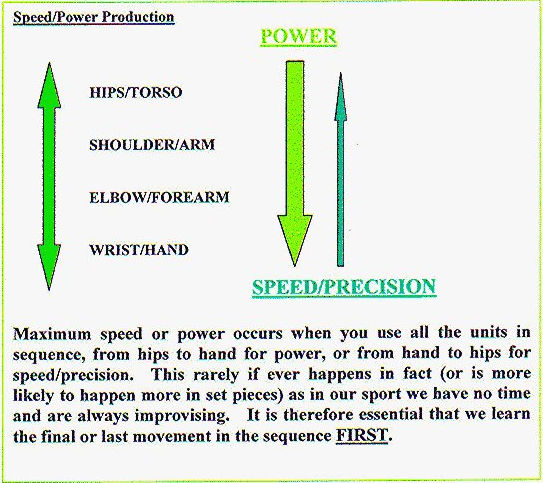
If you watch top performers in the major events, Worlds, Olympics, Europeans etc. how often do you see players almost falling over, hitting the ball at full stretch or bending backwards at impossible angles to make the return. Our sport of table tennis is now faster than it ever was and the bigger ball has brought even the men closer to the table than ever before. There is just no time to go through the full gamut of preparatory movements to play each shot. More and more, players are having to improvise, to try not just to get the ball back (because at top level this is not enough), but to make a ‘winner’ from a difficult if not impossible position.
Often in fact it is only in the ‘set pieces’, the serve and receive for example, that you have the time to stay with your technique, for these are the few situations where you have a measure of control. Even here however risk-taking is prevalent with players coming round ‘blind’ to use the forehand from the backhand corner to try to win the point direct or to gain an advantage. In fact many national coaches worldwide are realizing the need to revise the risk-taking policy of their National Teams. This is moving up the scale from a medium risk approach to the higher risk areas. It is no longer an option to play safe however good your game may be.
It is often no longer possible now to play in measured fashion, to set the feet and begin the stroke through the hips and torso rotation. Many top players, even the men, stand closer to the table and quite square. As a result a response to the increased speed of the game is more often than not, an attempt to get the torso out of the way and at the same time commence the return stroke from what is usually the wrong end of the sequence. This occurs particularly with the power strokes and many such shots are initiated from the hand/wrist rather than the hips and body.
One of the reasons why it is possible to do this is that players are facing increased speed. Our game of table tennis is faster than ever before, much faster than 10 years ago, faster than 5 years ago. Most players even in the men’s game are standing closer to the table and taking the ball earlier. To retreat is more often than not a recipe for disaster. But all of this means that players are facing increased pace from a closer-to-table position. They often don’t need to initiate, rather they need to respond — reaction not action. Instead of feeding in spin and power they are using the speed already on the ball.
So many top performers are playing like this that we must really train in the same way and encourage our players to work at increased speeds and to bring more improvisation to the training hall. Virtually all movement patterns are now reduced to one big step rather than for example a number of smaller steps purely because of the speed of the modern game and the lack of time. We may well find over the next few years that extemporization will take over from a stable technical base in many coaching areas.
One final point that we must emphasize in all our training sessions is the importance of the initial strong attack in today’s game. It is the first player who gets in with a good ball who forces the opponent to react and who puts them under real pressure. Action is always preferable to reaction.
High Level Performance (Summary)
Rowden 2011
The 7 essential aspects of top-level table tennis:
• Receive of Serve
• First 3 Balls
• Opening
• Effective Pushing over the Table
• Control of the Rally
• Ball Placement, the Special Areas
• The Specialty
THE FUNDAMENTAL QUALITY OF A PLAYER IS REVEALED BY THE WAY HE/SHE HANDLES THE SAFE PLAY PRIOR TO MAKING THE ‘OPENING’.
High Level Performance
Rowden 2011
High-performance athletes are able to assess the quality of a shot much more effectively than lesser players and also can more easily predict the advantage or disadvantage arising from a ball which just has been hit by an opponent. This major difference between players of different skill-levels is applicable significantly to the first three strokes of a rally.
• The return of serve is the most important shot in table tennis. Statistics confirm the assumption that the quality of the return is significant in influencing whether a top player will advance to the final stages of the world championships or will fail in the earlier rounds ie. whether the player is exceptional or just good.
Be aware of the implications. Consider the up-and-coming young player who might be set the task by his coach of practising hundreds of serves. This player would almost certainly be better off asking his coach to halve the practise time on serve in order to have more time to practise the more important receive of serve. Serve-return-drills are the single most important training area targeted by the top players in the world.
• Another aspect we should stress is the great significance of the first three shots in any rally. There is hard data which confirms that about 54 percent of all faults occur while serving, returning or playing the third ball or have their ‘source’ in this stage at the very beginning of a rally.
• Topspin against push is also an area which requires attention. Studies of top players show that the efficiency of attacking a push ball is poor compared to ‘open’ techniques against block, counter and topspin. Many players perhaps get into certain habits and think as follows: ‘The main thing is that I am the one who attacks first (even if it´s not the right ball and of poor quality). Action first must be my priority!’ What of course they should be thinking is: ‘Effective action and only effective action must be my priority!’
• Likewise, it´s quite interesting that (not flicking but) pushing is quantitatively seen more often in the first three shots of the rally. There is perhaps a strong argument for training the backspin aspect more frequently and systematically so as to stop the opponent getting in.
• Let us now look at the next skill: top players select effective/different techniques when they are not able to win the point quickly and early in the rally. They are able to keep control of the rally until they see an opportunity to change something which will give them an advantage.
But getting the advantage should not entail a risky return. Quite the opposite. Athletes participating in the final levels of a world championship often rather tend to play risk-free. Playing safe is accomplished by ball placement until the player can manoeuvre some advantage. The player keeps his adversary on the backhand or reacts in a ‘non-forceful’ manner, i.e., he/she returns the ball with enough pace or good enough placement so the opponent has no chance to play power.
The real quality of a player is in the way he/she handles the safe play prior to creating openings.
• Studying ball placement gives further interesting results. More than half of all immediate shot connections (back and forth) are played either repeatedly backhand to backhand or cross-court backhand to backhand followed by an ‘opening’ down the line. Moreover high-quality shots from the opponent (which give him/her an advantage) are mainly returned by using quite risky placement. In many cases a good shot by the opponent is returned to his/her forehand – and not to the backhand.
• Furthermore, analysis shows that strokes which are non-textbook as well as special placements are highly efficient. By the term ‘non-textbook strokes’ we mean shots like a backhand stop- or sidespin-block, a forehand soft block or fade. The notion of ‘special placement’ means playing the ball long into the opponent’s forehand or deep backhand, placing the ball at the crossover point between forehand and backhand (the ‘area of indecision’) or playing against the direction of the opponent’s movement (where the player is moving from).
One thing is clear that observing how the opponent prepares for the stroke and the change of position during a rally has to be integrated into the player’s training sooner rather than later.
Long-term Athlete Development
Rowden August 2012
LTAD is basically a model which looks at an in-depth and long-term approach to maximising the potential of an individual and helping him/her to tailor the developmental program to suit the stages of physical and mental growth. It is also intended to encourage and motivate the athlete to be involved lifelong in his/her sport. The model is split into a number of stages taking the child from simple, generic movements to more complex, sport specific skills and building a pathway.
So LTAD is a sports framework that is based on human growth and development. It is about adopting an athlete-centred approach to development. There are critical periods in the life of a young person at which time the effects of training can be maximised. Young people should in fact be exposed to specific types of training during periods of rapid growth and the type of training should change with the pattern of growth.
For most sports a five stage framework can be utilised:
• FUNdamental – basic movement literacy, boys 6 – 9, girls 5 -- 8
• Skills – building technique, boys 9 – 12, girls 8 -- 11
• Training to train – building the engine, boys 12 – 16, girls 11 -- 15
• Training to compete – optimising the engine, boys 16 – 18, girls 15 -- 17
• Training to win – maximising the engine, boys 18+, girls 17+
In the final stage of athletic preparation the emphasis will be on specialisation and performance enhancement. All the basics will be fully established and the focus shifts totally to the optimisation of performance. Athletes will be trained to peak for specific competitions and major events. Therefore all aspects of training will be individualised and tailored not only to the athlete but to the specific event. There will be either double, triple or multiple periodisation, depending on the events being trained for. Training even at this advanced stage will continue to develop strength, core body strength and maintain suppleness.
At all times it should be appreciated that LTAD is an approach to athlete development that puts the athlete, rather than the system, at its centre. It can provide a means of developing an integrated, systematic methodology which will ensure that all athletes are able to achieve their full potential and help foster long-term involvement. The principle need in sport is to identify and address the inconsistencies in how young players are developed and to encourage the widespread adoption of agreed good practices. There is also a clear need to address the lack of training culture in sport in many countries in Europe. Unfortunately at the moment many players who achieve international recognition do so in spite of the system rather than because of it – this has to change. Other talented players are unable to access the support and coaching required to enable them reach their full potential and are lost to the sport at the higher levels.
Currently many young sports persons undertake a large amount of training and competition but is this always in the right direction? Often there is rarely a single plan for their sporting development and conflicts and overplaying can easily arise without the appropriate guidance. For this reason efforts should be made to manage the individual player’s sporting, academic and social commitments in order to achieve balance. This is particularly important for talented players who may be accessing coaching via a number of differing sources. There must be one overall controlling and directing figure in whom the athlete has complete trust and to whom the athlete can refer at any time.
National Coaches often seem to forget that most of the player’s development is in his/her own club and not on a few training camps. Any National Coach, who does not control the player’s development, does not have control over all the aspects that go into creating success and doesn’t have the input time with the players, cannot hope to produce world-class performers. Winning against other countries and in major events will therefore be, not because of the system, but in spite of the system. Also however if groups work against the system can they succeed? As Jacques de Molay, Grand Master of the Templars stated around 700 years ago: ‘Success will only be achieved if everyone works together. Small groups without uniformity of purpose or the agreement of a clearly defined target will fail’.
It is necessary too that the controlling and directing figure, whoever this may be, has the appropriate in-depth experience in the development of a variety of styles and also the ability and knowledge to set the right standards during the early stages of development. If the critical periods in the life of a young person, at which time the effects of training can be maximised, are not utilised to the full, then this can significantly reduce the performer’s chances of ever reaching full potential.
We must talent-spot and select a small number of players in the expectation that almost all will succeed: find the talent, polish it and turn it into gold. The old methods of mass participation and mass failure must be consigned to the scrapheap. If the overall system does not allow or cater for the athlete-centred approach then the likelihood of producing high-level performers, who will achieve their maximum, will be severely limited or will rarely if ever happen.
Modern Cross-step
Rowden Fullen (2005)
Obviously there are times when most players have to use a cross-step to reach extreme balls, for example when they have played a forehand from the backhand corner and the opponent angles them out to their forehand side.
There are however a number of different approaches and possibilities which players can adopt. A number of top women players (Ni Xialan for example) feel that they never need to use the cross-step, as they stand close to the table at all times and have good enough tactical play that opponents have difficulty in catching them out with extreme angles. Most women do in fact stand closer to the table and prefer to face the play at all times — many even continue to play square when they back away from the table.
Other players use the older two step crossing movement as in diagram A, where they bring the left foot across the right then extend the right to ensure a stable position with good balance to both play the wide ball and recover well for the next shot. The only problem with this is that our sport is so fast in these modern times that many players will just not have the time to do this.
Diagram A
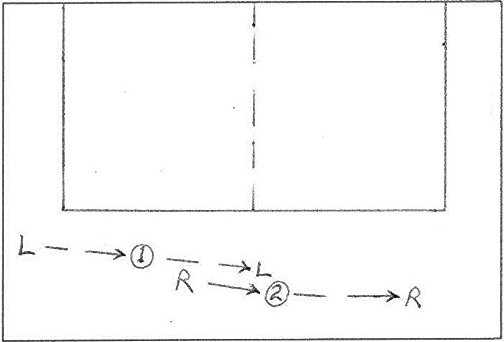
Is there another alternative? There is and it’s one used by many Asian and especially pen-hold players as in diagram B. Cross over with the left foot in a one-step movement and then use the left foot as a pivot, striking the ball as you rotate the upper torso and bringing the right leg round at the same time.
This may lead to a slightly worse recovery position on the next shot, but it’s relatively easy to play one backhand if the opponent plays back into the body and this in fact is what many top players do. This whole action is in line with modern table tennis strategy, where the thinking is to economize on movement and strike the ball first, rather than paying too much attention to getting the feet in the right position.
Diagram B
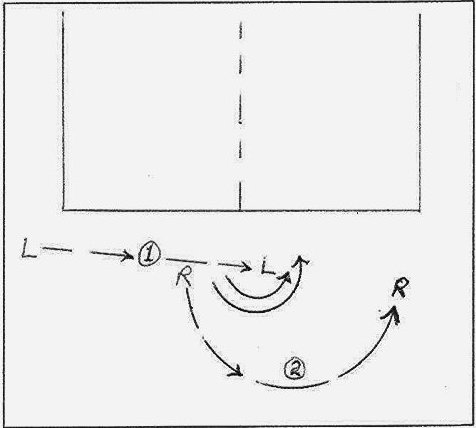
Modern Techniques -- Tips
Rowden October 2017
Playing Systems and Tactics
Playing Systems
● A playing system can be active or passive, or a blend of both
● At the top level individual active systems are clearly dominant
● Offensive players can still be very different in their individual playing systems
● The current tendency towards more speed will continue
● The playing system of a player demonstrates both his/her understanding of the game and of the way in which he/she individually performs to best effect
Tactics
● Tactical understanding is often visible early in a player’s career
● In table tennis tactics are essential
● With the speed of today’s game and the small margins at top level tactical intuition becomes more important
● Tactical ability is determined by the technical ability and mental strength of the player
● It is vital that the player has enough alternatives to apply and execute the necessary tactics
Technique and Science
Technique
● The more efficient my stroke and footwork technique, the more physical energy I can save.
● The more techniques I can master, the better I am prepared to meet new and different challenges from the opposition
● Table tennis is developing from long movements away from the table, to short movements closer to the table
● Having the perfect technique doesn’t make you the best player. The technique must be effective and work for you
● Technique is even more important with the plastic ball
Science
● To improve technically, you must understand and acknowledge the problem, identify it and find a solution
● The most time-consuming aspect is the adaptation of the solution to you and your personal game. We are all individuals
● You need alternatives, probably at least three to deal with every situation you face in the game
● Not only do you need to look at techniques in serve/receive, strokes and movement, you need to examine distance
● Every top player reaches the higher levels not through technique but by his/her individuality
Serve and Receive
Serve
● The serve is a formidable weapon; use it in this way
● Have total focus with each serve action
● Think in this manner. Which serve gives me an advantage –
o against my current opponent?
o for my next stroke?
● If you miss a serve, breathe deeply and think:
o Don’t lose your nerve now
o What do I need to do differently?
● When it’s 15 – 15, serve as if it’s 3 – 3. Adopt this mindset
Receive
● Be totally ready and prepared for any serve
● If you don’t return 2 serves in a row, stop, think and change something
● Before assuming your receive position breathe deeply
● If you can’t receive short serves effectively and with differing alternatives you can’t play at any level
● Long, fast serves are dangerous!
Flick and Block
Flick
● If you flick well over the whole width of the table, you have a clear tactical advantage
● With the plastic ball the flick is more important than ever
● To flick at the right moment often means a direct point
● To use the BH flick over three quarters of the table width is a modern tactic which works
● Train to flick at differing speeds and different timing points, from early to very late
Block
● Blocking is an important part of the modern game with the plastic ball
● The block enables you to throw back the opponent’s speed, spin and power
● There are many different blocking actions; soft, forcing, sidespin, stop and chop-blocks.
● You should experiment to discover which types of block suit your game tactically
● Good blocking opens up many attacking opportunities
Push and Chop
Push
● The push is a vital stroke in table tennis, both in a receive situation and as a link shot in rallies
● It is vital to be able to use all variations of push: short, dead drop ball, long, fast early timed float push and heavy backspin from early to even late timing
● The push is underestimated in top table tennis
● It is most important to be able to push consistently
● If you don’t push well you must have a very good flick and be able to use this all over the table
Chop
● Many attacking players cannot assess backspin defence correctly
● Choppers prefer to meet the hard, fast loop
● The flat drive or slow spin will often create problems for defenders
● Slow roll shots or sidespin win points against even good choppers
● Beware defenders who topspin or hit, especially on both wings
Topspin
Forehand
● You won’t get far at top level without being able to play topspin
● You need fast legs for FH topspin, footwork is everything in preparing for this stroke
● At higher levels you need to be able to vary topspin from slow roll to heavy spin and also incorporate sidespin into the equation
● Modern players take the FH topspin ball in front of themselves
● Good FH topspin creates many openings to win points
Backhand
● Backhand topspin is a point winner
● BH topspin down the line or into the body creates openings
● Because of the use of wrist and forearm in the BH topspin and the ease of playing ‘round’ the ball, it is often very difficult to read the direction and spin of this stroke
● BH topspin is a potent weapon v long backspin serves/shots to this wing
● You also have the option on this wing of playing the ‘inside out’ and ‘hooked’ BH topspins
Smash and Drive
Smash
● If you don’t enjoy smashing, you don’t enjoy anything
● If you can smash well you will have a clear advantage
● If you can smash at early timing or kill the rising ball you will win points much more easily
● Should you ever miss a smash, this should be a complete surprise
● If you can smash with your backhand, this will immediately take your game to a different level
Drive
● The drive stroke is now more important with the plastic ball
● The drive is a crucial and staple element in women’s play
● The timing of the modern drive should be early, or on the rise but before ‘peak’
● The drive can also be used off-the table with power in the women’s game (even as a substitute for the spin ball)
● The backhand drive can be very effective as it’s much more difficult to read
Alternatives
Serve/Receive
● The ability to serve short and wide using side-spin
● The ability in short receive to drop short, push long and fast with float and backspin and flick hard and soft with early and late timing
● The ability to serve deep and fast with varied spins, float, side-spin with chop or topspin to both wings and to the crossover
● The ability to vary long receives, block (including chop and side-spin options) and drive, topspin or even chop
● The ability to constantly vary serves, no two the same and to use all the opponent’s half of the table
Rallies
● The ability to change placement and use the opponent’s half of the table to the full
● The ability to change speed, long and short, hard and soft
● The ability to change spin with both timing and varying power input
● The ability to play the angles and to play straight down the lines
● The ability to play slower balls
Mental Strength/Nerves and Concentration/Willpower
Mental Strength/Nerves
● Nerves before any match are normal
● Down 0 – 4? Nothing is decided, think, change something and focus harder
● 10 – 10 in the final set? This should be 5 – 5 in your head
● You miss the serve at 15 – 15, look ahead and focus
● 5 – 0 up and opponent gets back to 5 – 5! Change something and relish the contest. There’s an exciting end-game ahead!
Concentration/Willpower
● Thinking about past and future, what has happened or will happen is of little help and can demotivate
● Think only about the here and now and focus one point at a time
● Talk and think to yourself. Immediate mental analysis after a rally is of value
● Do not allow things you cannot control (luck, bad umpiring decisions, poor playing conditions etc) upset your concentration. Only focus on what you can control
● During a time of absolute concentration you perform ‘in the zone’, more like an observer rather than a player in action
Physical Elements
Endurance
● If you don’t train endurance, running, swimming, cycling, you don’t understand anything about modern table tennis
● General endurance is a prerequisite for high-level performance
● You must improve either general endurance or your efficiency of movement
● The future of table tennis is more speed. This demands improvement in physical aspects
● Shorter training sessions but more often and with more intensity are the way forward. This is also in keeping with the shorter more intense games in our sport
Power
● Training in strength aspects when young will avoid pain and setbacks when older
● Nothing works without strength and this is more important with the plastic ball
● Balance is crucial in the development of strength and the stability of the spine vital. There should be equal development of the non-playing side
● Powerful legs are the basis for any top athlete
● Non-specific strength development is not needed for the playing arm as this impacts negatively on touch and fine control
Speed
● Use resistance bands for quick twitch muscle development
● Multi-ball increases overall speed and reactions
● Work at relaxed, interconnecting stroke play. When one stroke flows into the next this saves energy and makes the whole event faster.
● In order to lead into the next shot the path and finishing position of the racket after the previous stroke is crucial
● Anticipate better, watch the opponent, not only the contact on the ball, but the preparation of the body and the movement prior to the shot
Flexibility (Agility)
● Be precise even in the service throw and learn to use the whole body in the action of service
● Serve training is a prime example of optimizing body movement and utilizing many variations with the same basic action
● Use of the free arm is more important than most players think
● Rotation is vital in shot production and maximizing power
● The legs are a crucial part in the overall agility program
Coordination
● You have to find the balance between automatic responses and controlled reactions. This balance will often determine whether you play well or poorly
● Too much conscious thinking reduces the flow of the game and the quality of the balls played
● Find time for consistency and tactical decisions
● Every irregular exercise improves anticipation and well- coordinated responses
● Always search after the optimal relationship between conscious and unconscious actions
Training
● If you don’t warm up you’ll almost always play below par
● Too much training is as bad as too little
● Much training = good performance? Not true
● Meaningful training is only possible with full concentration
● All training should be geared to your individual development. Not only is the quality of training vital but the direction. Is it leading you to where you want to go?
Training Themes
Rowden February 2021
Speed -- Emphasise 3 speeds, off the racket, through the air. and after the bounce and how to change each.
Look at how the power input and timing can change the form of the rally, the differences between using 90% power, 55% power or merely using the opponent's power to return the ball. Bear in mind we are not looking just at speed, but at lack of speed and there is a big difference in what happens with the ball between hard drive, slow roll, soft or forcing or stop and sidespin blocks.
Movement -- Examine first which is the most effective playing distance from the table for each individual player and does he or she spend most playing time in this area? If forced away from the best area does the player have the right weapons and movement patterns to return to this distance quickly and without problems. All players must be efficient in 'short and over-the-table play'. We must look at side to side patterns and also in and out, bearing in mind that movement must be economical incorporating as few steps as possible.
Opening -- Being able to open effectively and get on the attack is crucial, especially in the women's game. Players must be able to do this, both close to the net and in 'over-the-table' play, as well as at the end and when back some distance. Having the capability especially to open effectively against backspin and in differing ways is a game-changer; flick, fast and slow topspin, slow roll, sidespin loop, hard, early-ball drive or flat hit. Statistics taken at World Championships have shown women are much more comfortable in fast play and make more mistakes when trying to open.
Length -- This is critical in the modern game and with the plastic ball. A ball that bounces mid-table is easy for the opponent to attack, a ball that hits the table in the last 5 - 10 centimetres, especially if this arrives very quickly, is much more difficult. Also balls targeted at or along the side lines, cause all sorts of problems. The length criteria don't only just apply in rallies but are absolutely crucial in service. The serve which hits the end white line at speed and also with varied spin and placement, can either be a winner or open up attacking opportunities.
Placement -- There are a number of obvious targets to aim for, the opponent's crossover area, particularly from a right-hander's BH to another right-hander's body. Also the table corners and down the line shots. Bear in mind to use the table effectively when meeting left-handers. Above all look at the major benefits of changing pace and length, hard and soft, short and long. If most of your play is either very short or very long, you will certainly pressure your opponent.
Spin -- This is of course less effective with the plastic ball; the small ball as tested by the Chinese National Team achieved at maximum around 150 revolutions per second. This has just about halved with the plastic ball, but also in addition the new ball loses spin much more rapidly through the air due to the larger size and the different polymers used in construction. But all is not bad news. Tests in a number differing countries have shown that sidespin is still very effective with the plastic, whether combined with another spin in serve or with another stroke in rallies. It can be very useful for example to loop to your opponent's FH with heavy sidespin, which pulls him or her wide to the FH side, or to push very early and quickly with sidespin against a backspin ball. The BH 'banana' flick over the table can be equally effective.
Serve and 3rd Ball -- As we stated under 'Length', this is critical. Long serves should be both very fast and very long, in the last 5 -- 10 centimetres of the opponent's half, with varied spin, directed at key areas, corners, crossover, with as deceptive service action as possible. The opponent should find it difficult from your action to determine whether the serve is topspin or backspin (with sidespin) or just float and equally exactly where the serve will be directed. Try also to use a very similar grip. Experiment with the high throw, with these it's difficult to see direction especially if service action is very quick. Don't neglect very fast float combined with some topspin and the shorter very wide serves off the side of the table.
Short serves should also be very short and with plastic are best directed spinning out and away from the opponent, using predominantly sidespin, to pull them out wide on BH or FH. Bear in mind that short serves to the middle are more easily attacked with the opponent's BH. Half-long serves mainly backspin and sidespin can still be effective, particularly if they 2nd bounce on the white line. Try too to shorten the service action so that there is minimal time between the movement of the racket, the contact on the ball and the contact on the table. This gives the opponent less time to evaluate what is happening.
All serves should occur with a purpose -- winning the point. You should always be ready and eager to be positive on the 3rd ball. You should also have a good idea to which part of the table your serves are normally returned and be able to attack strongly. However also train with your sparring partners to return to unexpected areas so you can handle the unforeseen situations. Bear in mind too that we are not always attacking hard. The short drop shot, the slow roll, playing against the spin, the long push, can all open up attacking opportunities. One cap does not fit all.
Receive -- The key theme here is to take the initiative away from the server and gain control of the point. One critically important aspect here is to have alternatives. Against the short serve not only the capability to flick strongly over the table, but to drop short or push long with differing spin. Against the long serve not only looping hard but at times driving, blocking (even stop or sidespin variations), rolling slow or chopping. Sidespin is particularly effective with the plastic ball.
Bear in mind too that it is easier to attack over the table with the plastic, especially with the BH wing. All players now need to be proficient in the two areas, both over and off the table.
Use the Whole Table
Rowden June 2021
Most players appreciate that with the plastic ball the science of our sport has changed.
Coaches too, readily understand the most obvious areas where changes need to be made: serve, receive, short play, more change of pace and unpredictability, with less spin power is more important, more symmetrical play and earlier timing, but above all the will to change and to execute this first. However have players and coaches registered the need to use the whole table, to do this more effectively and how to best achieve this?
Examine the following series of exercises and understand the relevance:
• Player executes between 1 to 3 strokes down the FH line then switches to the middle or diagonal, either to the body, corner or wide to the short angle, thus using alternatives.
• Player executes between 1 to 3 strokes down the BH line then switches to the middle or diagonal, either to the body, corner or wide to the short angle, thus using alternatives.
• Player executes between 1 and 3 strokes on the FH diagonal then switches to the middle, straight or to the wide short diagonal, thus using alternatives.
• Player executes between 1 and 3 strokes on the BH diagonal then switches to the middle, straight or to the wide short diagonal, thus using alternatives.
• Player executes between 1 and 3 strokes from the FH corner to the middle, then switches straight down the line, to the diagonal corner or to the wide short angle, thus using alternatives.
• Player executes between 1 and 3 strokes from the BH corner to the middle, then switches straight down the line, to the diagonal corner or to the wide short angle, thus using alternatives.
Consider also that the player can use differing alternatives in the stroke-play within each sequence in the six exercises, for example drive, spin, varied blocks, sidespin loop and in such a way the boundaries of the rally and responses can be increased dramatically.
Bear in mind too that the player as well as varying the stroke-play can vary the speed and the length to further increase the scope of the exercises. It’s all about using the whole table area to gain an advantage; coaches also should devise more exercises, they know their own players best and are in the ideal situation to devise those most suited to their own player’s style.
Economy of Movement: the Key to Speed
Rowden Fullen (2006)
Explosive speed is an inherited characteristic and players who don’t have it are rather limited in what they can do to train up this aspect. However there is nothing to stop any player only using those patterns which give most economy of movement. It’s elementary for example to understand that quick play requires short strokes so that you can recover for the next ball (not so short however that you fail to play ‘through’ the ball). If in our modern fast game however you are attacked hard and have no time, then you must often be satisfied with the block return. Bear in mind however that there are a considerable number of differing ways of blocking, from taking the pace off the ball, to dramatically changing the spin, to increasing the speed and also a large variety of timing points which can be used.
Racket recovery is particularly crucial and it’s vital that the racket returns to the neutral position after each stroke so that you are ready to play FH or BH on the next ball. It is equally vital that the elbow drops down after the stroke (especially the BH counter) so that the forearm is in the best possible position to move in either direction.
The ultimate style of the player will dictate which type of movement patterns he or she should use. Close to the table blockers will use many one-step movements or small jump steps. Strong loop players will inevitably use the cross-step to reach the wide ball (pivoting on the left foot for a RH player) and defenders should train at moving in and out. However with the modern game both close and deep, movements which retain a square position are preferable. Movement is one of the most critical parts of any young player’s development and yet very few countries in Europe work constructively with footwork patterns at an early age. It is particularly important that you establish a pattern with a young player that can grow with the player, (can a sidestep pattern be easily developed into a cross-step?). It is also a priority in the ‘modern’ game, where we have limited time that footwork is economical, one big step is preferable to many small ones.
Among the world’s elite (especially the Asian players) the FH is still the dominant stroke and many men players will still move more in order to bring this wing into play. (Among the top European men because of the increase in the basic minimal speed many now use the BH from the middle or even from the FH side against the serve. It will be interesting to see if this tactic, which has been common amongst the women for many years, will become the norm in the men’s game).
Perhaps here a warning should be issued to women trying to use the FH over the whole table as some top men do. The women’s game is rather faster as they stand closer to the table, hit the ball earlier and flatter. Often they have less time to move and to react between shots. Also overall their physical capabilities can be reckoned as between 15 – 30% lower than the male. These factors can make the difference between success and failure at top level when women try to emulate the men.
For a top player to execute strong topspin from FH and BH corners with FH and BH consecutively takes around 0.6 of a second. However to do the same with just the FH wing will take almost 1.0 second. This is quite a big time difference at top level. FH play over the whole table is also asymmetrical (by this we mean one-sided and unbalanced movement). Symmetrical play is clearly superior from the point of view of economy of movement, the only downside being that the BH topspin is generally less powerful than the FH.
A change to more symmetrical play requires that the BH topspin be of the same quality as the FH. This can be achieved by use of what we call the tennis BH. Here with a quarter rotation backwards, taking the ball off the left hip, leading with the right elbow and using good rotation and very fast forearm action, the stroke can be upgraded to a similar power and speed as the FH. Certainly in the future it is becoming obvious that in the light of the speed of the modern game, play will become more and more ‘symmetrical’ and that this will be the way forward.
Coaches
Coaching Development Course 1
Rowden Fullen (1990’s)
1. Introduction.
2. Table Tennis Association — structure.
3. The grip.
4. The four basic strokes.
5. Stroke correction techniques — the nine reference points.
6. The demonstration.
7. Basic strokes — chart.
8. Practical.
1. INTRODUCTION.
Table tennis coaching is very like climbing a high mountain. On the lower slopes there are grasses, streams, bushes and trees — the start of sound basic training, you must get things right here or you will encounter problems or even fall off higher up! On the mid-slopes you meet other difficulties and different terrain, rock faces, chimneys, use of ropes, pitons just as with table tennis you must look to better technique, better movement and more physical work and to develop your own personal style of play. At the very top level you meet other challenges, ice, snow, crevasses, avalanches and must utilize other equipment, crampons, ice axes, breathing equipment — with table tennis you must look more into psychology, tactics, advanced techniques, you must indeed know yourself and what you are capable of to reach the highest peaks.
Coaches face different problems at various levels. Success at the top goes back to self-sufficiency development en route but primarily to sound basic training. We see players in many countries in Europe even well on their way to the top who will have difficulty in making the grade, due to weaknesses carried over from early training. You can compensate for a weak stroke or bad movement patterns at a lower level but at the highest levels there is no hiding place. Top players will find a weakness extraordinarily quickly!
Basics are vital — this is the only time you have a clean sheet situation. The responsibility is enormous, how and what you write on this sheet can have very far reaching effects. In fact many national trainers think that only the very best coaches should handle beginners, as only coaches with great experience are able to understand the implications of what they see. Coaches and leaders at even the lowest levels should appreciate the importance of their work. If our sport does not have a stream of good beginners flowing into the base of the mountain, correctly taught and prepared, then coaches at the top will wait in vain! Not only is the introduction of basics vital but many leaders are talent scouts, in the position to be the first to encounter a unique talent, the next Waldner or Deng Yaping. Even if they are not capable of developing that potential, they should be able to recognize it and pass on the player to someone who can.
Compared to other ball sports table tennis is a multi-skills game. It has not only fast speed over a short distance but also the type of spin involvement you don’t find in other ball sports. Bear in mind with the young player that table tennis is not an easy sport to learn and to be highly proficient takes years rather than months. With the young beginner reactions and coordination may still be underdeveloped, but often you get some indication of a rare talent when you see early natural use of advanced strokes or early spatial awareness.
Above all when coaching players you must understand that there is not and never can be a ‘national style’ of play, which we should all aim towards. Each player is an individual and different and should be directed towards his or her own individual style of play. And even when we have stressed the importance of basics, we should perhaps emphasize even more that none of us can ever be dogmatic about technique. It is not how the player plays the stroke that is vital but whether he or she observes the underlying principles and whether it is effective! There is absolutely no use in having a stroke that looks nice, is technically perfect, but has no effect.
Take for example three of the world’s best players, Gatien, Waldner and Saive. They all play their topspin differently. Gatien has fast rotation with the elbow close to the body, Waldner has slow rotation but with a fast wrist and Saive uses his legs much more than the other two. But the underlying principles still apply — they all use the arm, legs and rotate the bodies, even if in a different way and at different speeds.
The concept of individual flair, the idea that players can have different techniques within the underlying principle is one of crucial importance in allowing them to arrive at and to create their own personal style. You cannot force a player into a style of your choosing — if you insist that your player is going to be another Waldner it is unlikely he will develop as well as he could have done. It is important that you allow each player’s own natural idiosyncrasies and abilities to have a proper place in his or her development.
It is vital also that all coaches look to maintain the interest of players at all levels. We are in competition with many other sports and activities in this modern world and we must all develop the skills and coaching techniques both to develop players and to keep their interest. Make sure they are enjoying themselves, use fun games and competition, players love to compete, try to harness the competitive instinct, which is so important if you are going to be a successful player.
2. THE TABLE TENNIS ASSOCIATION — STRUCTURE.
How is the Association managed, who are the officers, who does what and what are their areas of responsibility?
Coaching and selection, who is in charge?
Developing coaches and trainer education, who is in charge? Where, when and how often are courses and follow up seminars or work-shops? How does one progress?
Training camps — National, Regional, District. Who organizes and who is in charge of liaison between the various levels?
National Centre — How does one get in? Are the players compelled to attend perhaps under threat of being left out of the National squad? Once in are the players restricted in activities (which tournaments they can attend etc)? Are players still catered for if they have good coaching and development outside of the centre?
Player training — what is the pyramidal system up to the National centre? Do we have regional training, county training groups? Do we have specialized squads, 11 and 13 years or all girls so we can concentrate on specific areas of development? Do we have bigger clubs which act as a focal point for a large area and run camps for that area?
Tournaments/Leagues — Do we have competition at differing levels? Tournaments and even leagues for non-ranked players, regular events for very young players, 7, 8 and 9 years old?
3. THE GRIP.
Almost all players are biased however slightly in favour of one wing or the other because of the grip and are correspondingly weaker in certain table areas.
Basically there are 4 grips but there can be a number of variations in each category, high or low on the handle for example.
1. Western or ‘shakehands’ grip.
2. Hammer.
3. Chinese pen-hold fingers curled.
4. Japanese pen-hold fingers spread.
The grip should be ideal in terms of efficiency. Is it functional, does it work?
* Do not be dogmatic.
* If possible the same grip B.H. and F.H. (explain thumb and forefinger movement and the action on the tendons in the hand and wrist).
* Relaxed (too tight can cause problems with the stall angle and can inhibit use of the wrist).
* Racket should be an extension of the arm (a slightly raised angle is an aid to control on the forehand).
* Fingers not in the way (grip efficient for the individual).
4. THE FOUR BASIC STROKES.
If coaching a player from beginner level it is most important to lay sound foundations from the first. The basic strokes are best taught in the following order.
1. Forehand drive.
2. Backhand drive.
3. Backhand push.
4. Forehand push.
With this order we follow the psychological principle that whatever the player learns first, he or she will fall back on automatically in times of greatest stress. If you learn to drive first for example when the match is close you are much more liable to be positive and to attack.
In each stroke there should be a progression, from long line, to short line, to consistency, to length variation (long and short), to accuracy and target practice. Remember there is a need to achieve control first, it is hard to be satisfied and to enjoy play without some measure of control. If some of your beginners have played a little go back to basics and start again correctly. It is also wise to eliminate advanced techniques which may be natural to the player but which get in the way of learning the basics (late timed topspin for example). These will not be lost but will be much more easily developed once a sound foundation is laid.
Stroke production –
* Uniformity — identical repetition.
* Accuracy — repeat to defined spot or direction.
* Length — to be able to play consistently long.
* Dexterity — to adapt to varied balls, nets, edges.
* Coordination — use of body, legs, arm, wrist, fingers.
* Pace variation — change speed with the same action.
5. STROKE CORRECTION TECHNIQUES (The nine reference points).
Technique is important. If your player has stepped outside the bounds of good technique then it is most unlikely that he or she will reach the highest levels. It is a cruel fact that weakness is always exposed once you arrive at the top.
When working with a young player it is important that you look at stroke production from a scientific viewpoint — only in this way can you pinpoint exactly where the problem lies. It is also useful to have guidelines which are applicable at all levels of stroke play and to each individual stroke.
Stance — Feet should be shoulder width or a little wider, knees bent, back arched, shoulders slightly forward (all important for balance and efficient movement). Always relate stance to the line of play (where the ball is coming from), not to the table or the opponent. Always face the line of play, with both the body and the feet.
Stance should be the best position of advantage with reference to the opponent — start to build in tactics early in the player’s career. The majority of modern players will use a square stance, (facing where the ball is coming from), it saves time, especially close to the table. Once players drop back from the table side-to-square is used a little more as it aids power production particularly on the forehand side.
Body Action — Here we are talking about use of leg power, rotation of the waist and shoulders (sometimes a little rocking action of the shoulders), fast arm movement, especially forearm and forearm fold. Bear in mind the crouch with the head forward extends the range of the stroke and economizes on movement.
Length — This is the distance the bat travels. With beginners a short stroke is the priority and particularly close to the table. (Less to go wrong if the stroke is short). Try to have a little longer pre-swing and limit movement after contact with the ball. Longer strokes with very young players can also lead to injuries.
Timing — ‘Peak’ or 1/2 centimetres before is the most efficient for control. (‘Peak’ is the highest point after the bounce on your side of the table). Many coaches in Europe see peak as being relatively late, later than it in fact is — Asians see peak as being earlier than we do.
Peak gives the biggest target area and allows the player the best chance of hitting the ball down on the other side of the table. If players let the ball drop when small (a natural tendency with the ball coming at the face) this can easily become a habit leading to running away from the table whenever under pressure. This of course gives the opponent a better chance to use the angles. By adopting peak when young the player’s natural tendencies have the opportunity to emerge and he/she will have more options when older.
Table Position — What we are talking about here is the exact contact of the ball in relationship to the table. Is it over the table, at the end of the table or back from the table? For the beginner we must again look at this in terms of control — usually this is best over the table but with the ball coming through (not too short).
Free Arm — This is particularly valuable as an aid to rotation (especially on the forehand side). Lack of use of the free arm limits movement and often leads to a forehand stroke where only one half of the body is used with the risk of subsequent injury. Also the free arm aids balance and orientation. For the beginner this latter is often useful in helping him or her to have some idea of where the ball is in relation to the body.
Bat Arm — The optimum for control is the 90 degree angle at the elbow, with no wrist at first and only a slightly open or closed blade. The elbows should be about a hand’s width from the sides and both hands equally relaxed. The stroke to be initiated from the elbow as well as the shoulder (but with no wrist in the initial stages). Bear in mind at a more advanced level the arm consists of the three joints, shoulder, elbow and wrist — the last two move much faster than the shoulder and will be used much more at top level (e.g. flick, fast forearm fold). Also the 90 degree angle of the elbow can be extended to 120 degrees or even straight to give a longer lever and more power.
These first seven reference points form the machinery by which the player hits the ball and will give the best control. As early as possible the beginner should learn to control the rally as a whole and not just individual shots. This of course involves movement while retaining good balance which is indeed the cornerstone of our sport.
Be particularly aware of the theory of conservation of angular momentum . The centre of gravity of the arm (elbow area) will cover a certain distance in a given time period. Because the distance is a constant, if the arm is shortened, it must move at a higher speed to cover the same length. This principle is of vital importance in the short arm loop.
Recovery Positions — Play the ball and recover always is one of the most important principles in table tennis. Every time you and your opponent strike the ball, the angles of play will alter. After you have played your stroke there must be a continuing, on-going assessment from you of the total angle available to the opponent — you must then move into the most advantageous position to cover this angle. Do not forget also recovery of the racket after each shot. Recovery fastens the first seven reference points together and gives control of the table.
Anticipation — This gives control of your opponent. After you have played the ball focus on the opponent. Watch him or her moving into position, look at the body, the stance, above all watch the racket at the point in time when the other player is committed, 4/5 centimetres before contact with the ball. This should give you enough edge that you are already moving before the ball even crosses the net. The ability to read what your opponent is going to do will give you a big advantage. If you train your young players from the very start to play their own stroke and then to watch what the opponent is doing they will soon learn to anticipate without thinking.
6. THE DEMONSTRATION.
Demonstration (showing the stroke) is part of the coach’s everyday work and something you should make every effort to get right. Look at yourself sometimes (mirror or video), what do you look like when you show a stroke? Is your technique satisfactory? Also consider the pitfalls of showing a stroke to a group of youngsters.
* Are the players on the correct side of the demonstration — can they see all the action?
* Are they on the correct side in terms of distractions? (There may be other activities going on in the hall).
* Shadow the stroke first. (So the group watches the action and not the ball).
* Be professional yourself (image).
* Be enthusiastic (manner).
* Emphasize at the most three points — too much will only confuse, you can always stop the group and stress other aspects in 5/10 minutes. Not too much at one time.
* Make the exercise clear (line, diagonal etc.) Cater for left-handers, pen-hold players etc.
* Have some progression in the exercise (short, long, target, alternatives).
* Care with language. (Do they understand technical words?)
* Introduce competition regularly.
* Give the same time to each player in the group, sort out problems of incompatibility (between players, or between self and players).
* Consider different types of guidance a) verbal b) visual c) mechanical (hold and do it).
7. BASIC STROKES CHART
| FH Drive | BH Drive | BH Push | FH Push | FHTopspin | FHBlock | BHBlock | BHTopspin | |
| Stance | Side toSquare | Square | Square | Side toSquare | Side toSquare | Square | Square | Side toSquare |
| BodyAction | Rotation | None | None | Rotation Slight | Rotation Lift | Rotation Slight | None | Rotation Lift |
| Length | Short | Short | Short | Short | Medium
Long |
Short | Short | Medium
Long |
| Timing | Peak | Peak | Peak | Peak | Peak or bit after | Early | Early | Peak or bit after |
| TablePosition | Over | Over | Over | Over | End | Over | Over | End |
| FreeArm | Rotation | Balance | Balance | Rotation | Rotation | Rotation Slight | Balance | Rotation Balance |
| BatArm | Closed
Up 90° |
Closed
Up 90° |
Open
Down90° |
Open
Down90° |
Closed Up90/120° | Closed 90° |
Closed 90° |
Closed Up90/120° |
LINE OF PLAY = Where the ball is coming from
8. PRACTICAL.
1. Demonstrate the ‘shakehands’ grip. Start
with off the table exercises.
2. Bouncing the ball on the racket — F.H.,
B.H., and alternating.
3) Same as 2) but walking around the table.
4) Hitting a ball against a wall (about one
metre high) and allowing one bounce
before the next hit. Use F.H., B.H. and
then alternating.
5) Introduce a stroke. (No serving, drop the ball on the table to start).
* Start long line diagonal (more time).
* introduce consistency (how many).
* introduce accuracy (hit a target).
* introduce variation with control ( differing length).
* introduce competition (round the table, cricket).
* introduce multi-ball.
* introduce simple serving.
* introduce match play and scoring. (winning table).
OBJECTIVES 2/3 Familiarisation with the bat and ball. Acquiring feel.
OBJECTIVE 4 Positioning, sense of movement, ball sense.
OBJECTIVE 5 Correct stroke, control, consistency, accuracy, concept of mobility, competition.
BEGINNERS
Basic Strokes Chart
— Look back to the chart. Certain factors are common to all strokes. Feet shoulder-width or a little wider, knees slightly bent, shoulders down and level and head a little forward and the whole body facing the line of play. Strokes should be played with a 90 degree elbow angle and partially initiated from the elbow, both elbows a hand’s span from the sides, with the bat-arm wrist and elbow around the same height or the elbow a little lower, (not higher). There should be no wrist action initially and the ball should be played with little speed and spin.
The objective
— should be optimum ball control, while maintaining good balance and a readiness to move.
Topspin and Block
— Note the bent knees in blocking and use of the legs, the rotation with topspin and the way the legs are used to bring up the centre of gravity as you contact the ball. A 90 degree angle at the elbow for blocking control (and a little movement, if you block with a completely ‘dead’ racket the ball tends to kick up for the opponent to hit). This angle will increase for topspinning as the player drops the racket lower to play the stroke. Work in initial stages on technique and control, not spin or speed. As players get better emphasize good ball control while retaining balance and the ability to move quickly in any direction. Good movement is the key to the future.
Coaching Development Course 2
Rowden Fullen (1990’s)
- Warm-ups: stretching.
- Movement: introduction.
- Training requirements.
- Training of players.
- Development: beginners, intermediates, advanced.
- Power and levers.
- Communication.
- Be professional.
- Topspin and backspin.
- Bats and rubbers.
1. WARM—UPS: STRETCHING.
- Prevention of injury.
- Preparation — physically and mentally.
- To increase flexibility.
Players should have the attitude that warm-ups and stretching are a natural part of their sport and should feel absolutely no embarrassment over doing these. Warm-ups are an important part of preparing to play and stretching equally important in winding down after play.
Coaches should beware of excessive physical work, weight training etc., especially with young players. The bones and joints are still growing and most of the major epiphyses do not close before around 17 – 20 years (1 – 3 years earlier in the female). Before closure the strength of the fibrous capsule and the ligaments surrounding a joint are two to five times greater than the strength of the metaphyseal – epiphyseal junction (the fresh growing area at the end of the long bone).
Any exercise programme must be structured to cater for different fitness areas.
- Cardio-vascular — the heart and lungs.
- Flexibility — twisting and stretching.
- Strength — legs and (bat) arms.
- Specific areas for table tennis — back and stomach, especially in the case of female players.
- Loosening up and relaxation.
In any exercise programme also remember the differences between girls and boys — strength, speed, lung capacity, inclination of the arm, bone growth, age of bone closure, joint stress limits. Also bear in mind the social aspects — it does nothing to help girls’ confidence if they have to compete with boys in physical areas, especially if they are in a big minority, only one or two in the group.
2. MOVEMENT — INTRODUCTION.
First you achieve a level of control from a static position, then in a moving situation. (Recovery should be built into all movement patterns, both in the case of recovery of body and racket and the players should above all aim to move with good balance at all times). In the early stages aim at about 75% width (side to side) and only 25% depth (in and out).
A) Movement
- Can be footwork of one type or another.
- Postural, body action, pivoting or twisting of the trunk.
- Manipulative, bat arm, the three joints, shoulder, elbow, wrist or even fingers.
B) Types of footwork
- Close to the table (nearest foot to the ball?) Stepping or jumping.
- Away from the table (crossing legs at times). Running or jumping.
C) More than one reason for not reaching a ball.
- Physical fitness.
- Poor footwork patterns.
- Recovery.
- Anticipation.
Always bear in mind that the more you retreat from the table, the bigger the angle you have to cover and the more you will have to move.
Footwork exercises.
- Regular, set pattern, conditioned response.
- Irregular (no pattern), ball not expected.
3. Training Requirements
Technical.
Basic skills
- control
- consistency
- accuracy
- touch
Advanced skills
- kill through loop
- loop to loop
- stop block
- short play
- early ball play
Tactical.
Experience
- league play
- camps
- tournaments
- positive play
Strategy
- variation
- angles
- timing
Movement
Style development
PHYSICAL
- speed
- stamina
- strength
- flexibility
- feeling
- relaxation
PSYCHOLOGICAL
- work-rate
- will/motivation
- self control
- confidence
- concentration
- mental toughness
- clarity of mind
- competitiveness
- innovation
Glue — When to use and why.
How it affects technique and tactics.
OPTIMAL MENTAL STIMULUS
The basic principle of table tennis training.
TRAINING IS ONLY
- REPETITION IN THE RIGHT ENVIRONMENT!
- WITH THE RIGHT ATTITUDE!
4. TRAINING OF PLAYERS.
A) Basic phase One 8 - 11 years.
- All strokes even up to topspin and backspin (but without excessive spin or power). Good basic control, consistency and accuracy. Work as much as possible from drive to spin.
- Footwork — Not too wide at first and no forehand from the backhand corner. Work at establishing a base from which you can move forward with the player and on to more advanced footwork at a later date. Try to evaluate the end style so that you can judge which type of movement the player needs to develop.
- Some tactical (but keep low profile).
- Always bear in mind the vital importance of good technique with balance. Technique can be very difficult to change later on in a player’s career.
Depending on how early the player starts, the critical stages for development are usually around the following ages — Girls 8 - 12 Boys 8 - 14
FACTORS TO CONSIDER
The coordination of the player, the development of the body, the reactions, the speed of the hands and feet, the level and duration of concentration, the ability to comprehend and understand, the natural strengths and gifts (speed, movement, talent).
The facilities available, organization of time, parents’ involvement, the player’s own time, commitment and mental approach.
At this age try to keep competition at a low level and geared to the training situation. There is always the danger of ‘burning out’ players at a young age. (This happened with a number of young girls at the top in tennis some years ago).
B) Basic phase Two 11 - 17 years.
- Consider in detail the individual style of players. Where are they strong, what is their best playing position relative to the table, how much of the table should they cover with forehand, backhand, should they spin or drive, block or chop, is their movement right for their way of playing and above all are they mentally in tune with the direction they are going towards? Look also at which materials may help your players.
- Refine the movement patterns so they will suit the players’ end style and tactics.
- Keep the technical base moving forward, gradually introducing more advanced techniques.
- Develop tactical awareness and the ability to play against all different styles and materials.
- Upgrade physical levels.
- Strengthen mental areas.
- Above all teach players that development means change and if they don’t keep changing they stop moving forward and remain as they were!
- Look to the individual needs of the player.
FACTORS TO CONSIDER
Bear in mind that the growth of the player will affect technique (if they suddenly shoot up 12 - 15 centimetres perhaps they are no longer getting down enough.) Make sure there are no inhibiting factors in technique or movement or tactics, which will have a limiting effect on the player’s ultimate level of play. Keep the player moving forward, teach him or her to handle the stress of competition, to think positively at all times and above all to be flexible in the mind. Try not to take short cuts — aim to release the full potential of the player at senior level.
Consider too that many players may come to you partially developed or with major faults. The longer a player has played, the harder it is to make big changes and often you will only be able to make small adjustments here and there to make him or her more effective. However often players have never really been taught how to use their own strengths and even what works best for them. Here you can help them.
5. DEVELOPMENT.
Beginners
Control and Accuracy
- correct techniques.
- understanding of grip and stance.
- most economical body movement.
- appreciate what each part of the body does.
- arm movement alone not enough.
- no excessive movement of feet (economy of movement).
- speed and spin negligible.
- diagonal first, then straight, diagonal from the middle,lastly forehand from the backhand corner.
- same timing point ( 1 - 2 centimetres before peak),except block — early.
- learn one stroke, do not combine in same rally with others.
- slightly better, alternate same stroke, forehand and backhand but regular.
- slightly better, use earlier/later timing, shorter or longer stroke.
- slightly better, use more change of pace, slower/faster speed.
N.B. The ability to play the basic strokes (drive, block, push) with good control from a static position, characterizes the well-taught beginner.
Intermediates
Consistency at Varied Speeds
Style Development
- train regular movement, side to side, in and out, on the diagonal.
- train serve and receive.
- differing timing points.
- vary speed, slow medium, fast.
- vary spin, light, medium, heavy and also float.
- train spin/stroke alteration within the rally, push/drive, block/chop.
- train in and out movement with variation in speed and timing.
- slightly better more irregular movement.
- slightly better, more work on power/spin.
- technical advancement, looping and chopping and
different techniques. - introduction to serve and 3rd ball techniques and to
set pieces. - introduction to 2nd/4th ball techniques.
- introduction to mental development.
N.B. A good intermediate has the ability to play all the strokes normal to his or her style within a game situation (moving) and with absolute consistency.
Advanced
mental strength development.
Irregular Movement
Refining of Style
- irregularity the theme in all exercises.
- vary stroke, timing, direction, length, speed, spin and tactics.
- concentration on serve and receive.
- 2nd, 3rd, 4th ball training to be positive and attack.
- set pieces, sequence play to suit the style of the player,
- build up strengths and minimize weaknesses.
- power and pressure play.
- use of professional tools, multi-ball, robots, professional physical or mental instructors.
- physical, stamina development in accordance with the style of the player.
- teach player to assess own game and to be able to think tactics as he or she plays.
- involve player in periodization.
- train against all types of opponents.
- innovation, above all make sure the player is flexible in the mind and understands the necessity of keeping his or her game fresh and alive.
- never forget that top players are above all unpredictable in the way they play, this is one of the keys to success at top level.
N.B. The advanced player can vary his own play to cope with the demands of the game situation. He or she reads the situation and adapts.
Thinking points
- Consider the importance of the basics, accuracy, consistency and control. Top players use immense spin and speed but within a framework of control. Many young players want to play too hard and too fast.
- Think of variation within the basics, speed, spin, timing and contact points, length, angles and table areas.
- Always look at balance — with the modern game the weight is going forward all the time, there must be more emphasis on good balance and good recovery, good footwork patterns and the use of the body and the various levers.
- Control the ball, the table, the opponent but most of all yourself.
6. POWER AND LEVERS.
Power
- Travel faster.
- Spin more.
- Any combination.
Power is generated by three components –
- Acceleration such as bat speed, use of shoulder, elbow, wrist. (Rather like a motor-cycle).
- The use of elastic energy (explain how to play the strokes to make maximum use of this).
- Body weight travelling along the line of play (rather like a large truck) or uncoiling (like a spring).
Racket Swing.
- Pre-contact longer (but not too long, too long gives no room for manoeuvre, you are committed from the outset).
- Follow through short and along the line of play.
- 120 degree elbow for spin, 90 degrees for drive.
- Elbow not tucked in or too far forward (inhibits spin development).
- Peak of bounce timing (or 1 - 2 centimetres before/after). Below the table, more spin but less speed.
Mass.
- From a little back use side to square stance, with the weight coming from back to front and a little up using the legs.
- Rotation of hips and shoulders
- Rocking of the shoulders
- These last two depend on the incoming ball and the type of loop.
- Leading foot pivots pointing to where the ball is going.
Levers.
Examine the principles of rotation.
Angular velocity
- The centre of gravity of the arm (the elbow area) covers a certain distance in a given time period, this distance is constant, the Law of Conservation of Angular Momentum. If the arm is shortened it must therefore move faster to cover the same distance. This is a valuable principle to remember when coaching girls or younger, weaker players, especially when considering the value of shorter arm strokes (looping for example).
- Lever length — If a player has the strength the longer the lever, the more power it is possible to achieve (Jonyer, Hungary 1975) (also example of wheel nuts on a car and the length of the lever, much more pressure). Assess the player, age and physique and beware of too much loading on the shoulder.
- Body use in play – It is quite normal in Asia to use tensioning and relaxing of the stomach in stroke play to increase striking power. (Explain).
7. COMMUNICATION
Clarity
- get the message across, you say something, but just what do people actually see and hear?
- the pupil learns aurally, visually and physically (by feeling and doing.)
Communicate
- ask relevant questions.
- listen to answers.
- treat pupils as people.
- get tuned in (on the same wavelength).
- speak the same language.
Priorities
- nice to know.
- should know.
- must know.
Enthusiasm sells.
- it is contagious.
- gets others going (you energize others).
- is a reflection of your inner self, if you are not inspired how can you ‘sell’ to others?
Speak Show Keep it simple
You cannot motivate, you can only affect the motivation of others!
8. BE A PROFESSIONAL.
Table tennis is a multi-skilled game, different from other ball sports. It is important to cultivate the right attitudes and as soon as the player is past the beginner stage and secure in basic strokes, to handle him or her as professionally as possible.
Do not train by competition (many young players compete too much and train too little, the training hall is very important). Development sessions should be without pressure and the player should have confidence that his or her development is based on a sound training programme.
Every training session should have a purpose, working on strengths, weaknesses, movement, consistency, change of speed, angles, opening, topspin etc. Of course within every session you can have a progression, a development, introducing serve and receive, 2nd and 3rd ball or some competition. Players should have both group and individual coaching as these serve different purposes in their development. It is hard to work on mental aspects, style development, serve techniques etc. in a large group, but the player does need the variety and the inter-action of training against other players (the variation in serve for example even when every player is trying to serve the same, the small differences develop your player’s receive talents much more than receiving from even the same good player all the time).
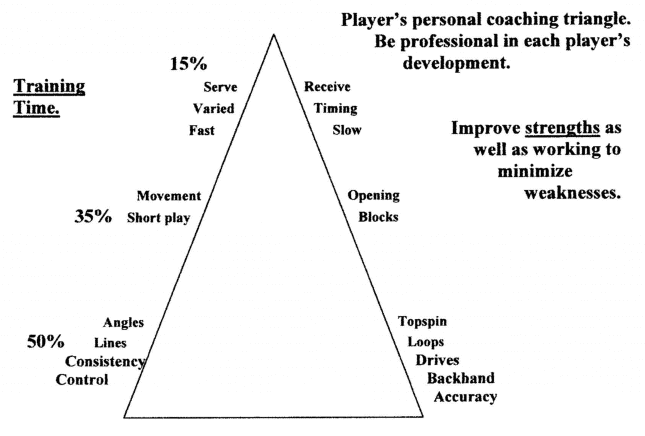
Plan also the player’s week, year, competitions and match play levels and always remember that the player needs rest and relaxation.
Example of a week.
| Mon. | Tues | Wed | Thurs | Fri | Sat | Sun |
| Rest | 2.5 | Phys. | 2.5 | Rest | 3 | Comp |
9. TOPSPIN AND BACKSPIN.
With the many varying rubbers on the market it is not always possible to rely on the stroke action. (e.g. a push against backspin may be backspin, float or topspin!).
Try to read the spin by the sound (as the ball strikes the opponent’s racket), by the flight through the air (watch for the trademark on the ball 3 — 8 centimetres before it hits the table on your side) and by the bounce (what the ball does after hitting the table).
Topspin
— Explain with diagrams, the turbulence and high pressure -on the top side of the ball, the low pressure on the bottom side. Air pressure forces the ball downwards. The topspin ball is faster through the air and dips and shoots forward after bouncing. The incoming angle is greater than the outgoing angle.
Backspin
–The backspin ball has low pressure on the top side, turbulence and high pressure below. Air pressure forces the ball upwards. The backspin ball is slower through the air, carries a little longer in flight and kicks up after bouncing. The incoming angle is less than the outgoing.
Points to consider
— Your opponent’s topspin spins towards you, his backspin away from you. When your opponent plays with your topspin the ball is returned with backspin, when he plays against your topspin he returns the ball with his topspin, (the opponent reverses the spin). However this may not apply if he or she is using long pimple or antiloop where he or she cannot or can only partially reverse the spin.
Let us look a little at spin, what it is and how it affects the ball, because we need to know a little about the basics before we can cope with playing against different rubber combinations. Most players and coaches will be aware of what is known in physics as the Magnus effect. In many countries in Europe it is taught in the first coaching stage on trainers’ courses. The important point is that both backspin and topspin cause the ball to deviate in flight. Test this for yourself. In your own training hall loop the ball hard and long with much topspin — it will dip quickly to the floor during flight then after bouncing will spin forward and run on to the end of the hall. The backspin ball will veer upwards before dropping down, will run forward only a little, then will spin back towards you and can end up spinning back past you. Not only does the type of spin affect the ball in the air but it also affects the way the ball behaves after the bounce.
- No spin — same angle in and out. (physics, angle of incidence = angle of reflection.) This rarely happens in table tennis, test for yourself by throwing a no-spin ball forward, the ball acquires topspin after bouncing because the bottom of the ball is held momentarily by the floor and the top moves forward. (If a topspin ball hits the net, the bottom of the ball is held and even more topspin is created.)
- Topspin has a smaller angle after the bounce and the ball shoots forward low and fast. However if you have a high, very slow loop with much spin, because the main impetus is down the ball will often kick up a little, then drop down very quickly. This is why this type of loop is very useful against defence players.
- Backspin has the bigger angle after the bounce, the ball slows and kicks up sometimes quite sharply. Why many players have problems against backspin is that they don’t understand this slowing-down effect, that the ball doesn’t come to them. They must move forward, lower the centre of gravity and get under the ball.
Topspin is of vital importance in modern table tennis. Without topspin it would be quite impossible to hit the ball as hard as we would like to. When we for example hit a ball which is below net height, gravity is not enough to bring the ball down on the other side of the table, especially if it is travelling fast. Another force is required and this is provided by topspin which causes the ball to dip sharply downwards. Thus the harder we hit, the more topspin we need to bring the ball down on the other side of the table. Our modern reverse rubbers give us great help in hitting the ball very hard from below net height, because they are capable of imparting very much topspin. This has an additional advantage in that the ball shoots off the table very fast after the bounce.
But why does spin cause the ball to deviate in flight and why do we sometimes have unusual, unpredictable effects after the bounce? This is in fact to do with the interaction of the spinning ball as it moves through the air against the flow of air molecules. (We have all felt air, when we stick our hand out of a car window moving at speed we can feel that air is rather more solid than we thought). As the ball moves through the air different areas of the surface are subject to lesser or greater resistance, the Magnus effect. Topspin forces the ball down, backspin conversely forces it up. If we take a topspin ball for example, the fast moving area at the top of the ball opposes the air flow and we get resistance or high pressure. However at the bottom, the fast moving area of the surface moves with the air flow, the air molecules speed up and you get low pressure. As a result the ball is forced downwards. At the bounce the bottom of the heavily spinning ball is held, topspin increases and the ball shoots forwards very quickly.
Sometimes the ball behaves in a different way and not as the laws tell us it should. In fact at times it can behave exactly the opposite to what we are led to believe — a topspin can jump up and a chop can skid low under certain circumstances. This is because of what occurs in the last 20 - 25 centimetres of flight, just before the ball actually strikes the table, (this is also a time when few if any players watch the ball.) A skidding chop occurs when a ball comes through low with very much backspin, (often for example when a defender takes the ball early when it is still rising) — the spin tries to make the ball rise during the last few centimetres of its travel and hit the table with a shallower angle than usual, but also the faster speed gives a lower trajectory. What ends up happening is that the ball skids through quite fast and low after bouncing. Equally a slow loop with a great deal of topspin and a high arc, will dip sharply at the end of its flight and hit the table at a steeper angle than normal. Its downward velocity is increased and it has a higher impact speed so often the ball will kick steeply upwards after bouncing before dropping sharply.
10. BATS AND RUBBERS.
Much of the advertising material which is written in the various brochures on materials is of very little use to the ordinary player and often misleading. The hardness of the wood and the make-up of the ply, how it is bonded and whether you have carbon fibre or titanium mesh layers will all affect the speed and control. Generally one ply will be more rigid and the ball will kick off the blade quicker, multi-ply will be more flexible with more control and stability. The choosing of a blade is a rather more personal matter than the rest of the equipment and it should feel right to the player. Tests in one or two countries appear to indicate that there is an ideal racket weight for the player at differing stages in his or her development and variation by even a few grams can cause a drastic loss of form.
Most rubber manufacturers use speed, spin and control ratings which are at best misleading — many of the tests they use are very simplistic and bear little or no relation to how a rubber is used in a match. Players also use the same rubber in different ways and with different feeling.
Let us examine the characteristics of the rubber as it is this which contacts the ball.
Dwell time
— This is how long the ball stays on the racket during the contact phase of a stroke, (bear in mind this is a mere fraction of a second, if you have ever chalked a ball and thrown it to a player who slow loops and tries to maintain a long contact you find that the mark on the ball is never more than one centimetre). Rubbers have different dwell times for different strokes. The ball will be held longer for a slow loop as opposed to a kill. Some players also ‘carry the ball’ longer than others even for the same stroke. A long dwell time will often benefit spinners and blockers while a short dwell time will suit defenders and hitters. The dwell time is also affected by the blade you use and how the ball comes off the racket depends much on the rubber and sponge and how quickly it penetrates through these to reach the wood layer underneath.
Resilience
— The energy stored in the rubber during the contact phase of the stroke. Some rubber and sponge combinations are much more elastic than others and will hold the ball longer on the surface at a closed racket angle. This stored energy is converted to produce spin. While elasticity levels will certainly increase we must bear in mind that the sponge cannot create energy, but only minimize energy loss. Compared to a hard bat a ‘sponge’ bat can be swung in a much flatter plane so giving the ball more forward speed and spin. The sponge helps to lift the ball over the net.
Impact behaviour
— A rubber and sponge can have differing performances at different impact speeds. At a slow speed there may be very little elasticity but you may get very good spin and speed when the ball comes into the racket with more pace. When you achieve maximum impact speed you can swing the racket harder but you will get little or no more effect. Some rubbers are said to have good gearing for spin and speed, which means they produce and maintain good effect over a wide range of impact speeds.
Throw-angle
— The angle of the flight of the ball as it comes off the racket surface in the direction the bat is travelling. Differing blades and rubbers affect the throw-angle considerably as will different strokes (the angles would be very different if you were looping for example with very tacky rubber or with antiloop). The throw-angle will also vary depending on whether the contact is on the outside of the racket or in the middle, or whether low, in the middle or high on the ball (or whether the racket is more closed or open). High throw-angle rubber generally has a higher ratio of spin than speed, compared to low throw-angle rubber. (Flexible, slower blades typically increase the angle).
Stall-angle
— The contact angle at which speed/spin of a rubber is dramatically reduced — at certain angles all rubbers will stall and not store energy (the ball will just drop off the racket, as it sometimes does when it contacts the outside edge). The stall-angle can be used effectively for dummy loops or short serves. A rubber with a wide range of stall-angles (or used with a badly matching blade) will have little or no control. A stall can also occur when the racket contact speed is too fast at a particular contact angle.
Friction
— The grip of the rubber. Under certain conditions and with certain techniques some super high friction rubbers can give less spin/speed than ones with much lower friction characteristics. Sometimes super-grippy rubbers have less spin at high speed — there is a critical level above which little or nothing is gained. Some very tacky rubbers have the characteristic of slowing the ball dramatically at low impact speeds, a function which is very useful in certain strokes. A low friction rubber has difficulty generating speed at closed racket angles. Remember always the friction of many rubbers is impact-dependent, they are more effective when the ball is coming at speed.
Sponge
— Sponge can vary from soft to hard and from about 0.4 mm to 2.5 mm and the density of the sponge contributes to the weight of the racket. The amount of spin generated by a rubber is closely related to the elasticity of the sponge (irrespective of the top sheet of rubber), below a certain critical level for a given sponge, the spin of the rubber will be considerably reduced. This can be improved through the correct use of speed glues or optimisers which will increase the resilience by up to 30%. Players who glue usually prefer soft or medium sponges.
Glue
— Adhesives and glue sheets are used to put the rubbers on the blade. Speed-glues or optimisers are used to increase the performance of the rubber in respect of spin, speed, control, throw and stall-angles. It is always recommended that you allow each coat of glue/optimiser to thoroughly dry before applying the next coat — otherwise you can get a ‘mushy’ effect which seriously affects performance when the glue is a little wet.
Properly applied speed-glues/optimisers can increase the spin and speed capabilities of the rubber by up to 30% (remember however that some additives do not work well with certain sponges, especially most hard and more dense sponges). Also the glue must be regularly ‘removed’ from the rubber sheet and the build-up must not be allowed to become too thick. All rubbers (where speed-glue is used) should be taken off the blade as soon as possible after play so that the tension is released.
One interesting characteristic of speed-glued/optimised rubber is that it has a very predictable effect over a wide range of strokes. Its ability to store energy is nearly constant over a large range of impact speeds, (in normal rubber the storage of energy bottoms out at higher speeds).
Coaching Development Course 3
Rowden Fullen (1990’s)
- Modern ready position.
- Movement patterns.
- Service.
- Receive.
- Women’s play.
- Innovation and style.
1. MODERN READY POSITION.
One of the most important aspects of modern table tennis is balance, to retain good balance at all times. The game has changed much from the hard bat days of the 1950’s when the main path of the stroke was upwards — now we play forward with more rotation and it’s harder to retain balance after the stroke. The table tennis player is very like the boxer, he must be ready to move in any direction at any time. Also now the game is much faster, the modern player has much less time and as much as possible he must face the play at all times.
The majority of players will adopt a ready position facing the line of play with the left foot a little forward. (Explain with diagrams, videos, discuss and demonstrate). This enables the forehand to be played over most of the table with a minimum of movement. There will be exceptions — many defence players will stand with the right foot a little forward as they often wish to play the backhand from the middle. Some players also stand further back and jump in to take the serve, which can sometimes place them at a disadvantage!
Consider the following aspects –
- Width — A little wider stance gives economy of movement and stability. (No problem with the wider stance in moving sideways only backwards).
- Right foot position — Closeness gives better table coverage.
- Bat position — Should be ready to play backhand or forehand, not too high and not too low.
- Legs bent — It is not possible to have an effective ‘springboard’ to move quickly from the ready position unless the legs are bent. (Girls please note).
- Free arm — Is an aid to angular velocity.
- Proficiency — Try to adopt a position which does not require 2/3 movements to take the serve. Think economy of movement with absolute readiness.
2. MOVEMENT PATTERNS.
The ultimate style of the player will dictate which type of movement patterns he or she should use. Close to the table blockers will use many one-step movements or small jump steps. Strong loop players will inevitably use the cross-step to reach the wide ball and defenders should train on moving in and out. However with the modern game both close and deep, movements which retain squareness are preferable. Movement is one of the most critical parts of any young player’s development and yet very few countries in Europe work constructively with footwork patterns at an early age. It is particularly important that you establish a pattern with a young player that can grow with the player, (can a sidestep pattern be easily developed into a cross-step?). It is also a priority in the ‘modern’ game, where we have limited time that footwork is economical, one big step is preferable to many small ones.
- One-step in or out — The one-step in or out is important for depth play close to the table, especially to the short balls and to make room to use the forehand from the middle. For the right-hander note that the prime mobility function is on the right foot (the left may be sometimes be pulled in after). This gives better coverage of the table with the forehand for the next stroke and is why you see many top players using forehand push from the backhand court. Care not to put the foot too far under the table, you must retain upper body mobility. If you watch young players especially girls, many often change feet, sometimes right, sometimes left under the table.
- One-step sideways — This can be either short or long and is important for balls on the forehand wing. It’s also important that you think body turn as you move, so that you are in a position to feed power into the forehand stroke. If you just reach you have very limited capacity for power or spin. In the case of wider movement to the forehand side, the left foot will be dragged after — the pattern can therefore be easily developed into a cross-step.
- Two (three) step sideways — Especially in the girls’ game you will often have a two or three step pattern to the forehand side, either left/right or a small movement of the right then left/right. Again it is important that you turn the body as you move. Girls often play closer to the table and like to face the play. Also consider two additional aspects. Extra steps are not to be encouraged in modern table tennis (economy first). When establishing patterns with a young player try to avoid sometimes commencing sequences with the left foot and sometimes with the right. This pattern is not suitable for girls who play a strong loop game.
- Jump step (short or long) — The small jump step, where you adjust position with a little hop and where both feet are in the air at the same time, is one of the most frequently used steps in table tennis. A long jump step is used mostly by Asian men players. They turn the right foot and bring it back at the same time pulling the left over and jumping to the forehand side. The body will turn prior to contact with the ball, which can occur with both feet still in the air.
- Cross-step — Many trainers in Europe still don’t seem to be aware of the necessity of crossing the legs to reach the wide ball. Coaches from as diverse cultures as France, Poland, England and Sweden all tell me the same – ‘Face the play, never cross the legs.’ The Chinese coaches however say — ‘ If you know a way to reach the wide ball quickly, without crossing the legs, please share the secret, we would like to know.’ It should be quite obvious in the case of the really wide ball that players have very little choice — if you have just played a forehand from the backhand corner and the opponent blocks you wide out to the forehand how else can you move? The mechanics of the cross-step are that the right foot will turn first, so that the left can be brought quickly over and across. Quite often in match play a one-step short or long is converted to a cross-step as necessary. If you study film of players at world level as diverse as Gatien and Deng Yaping you will see that they all use cross-step.
- Pivot step — This occurs when you wish to play a forehand stroke from the backhand corner. There are two different ways to accomplish this. Some players bring the right round behind the left and then adjust the left. Others move the left first a little out and then bring the right round after.
- Postural — Movement of the trunk, the upper body. Although not strictly a movement pattern we must also consider such movements, where the player with limited time and sometimes not much other alternative, bends the body sideways or backwards to play a forehand stroke (sometimes combined with a one-step short).
- Manipulative — Movement of the arm, hand or fingers. Particularly useful when changing direction and disguising where you intend to play.
3. SERVICE
Serve and the strategy of service have changed very much over the years. In the days of the old hard bat there was very little spin, now there is spin, speed and deception. Short serves are usually short or half long (with the second bounce on the white line) to tempt the opponent to push or to open with a less strong shot, whereupon the server can counter hard or open strongly. Long serves are usually very fast to the corners or the crossover point.
Examine and discuss the main serves and grips and which part of the ball to contact, where on the racket and where the ball should bounce on the table (where on the player’s own side first).
- Forehand serve from the backhand corner, backspin, sidespin, topspin, reverse, float and a mixture.
- Reverse spin, backspin, sidespin, topspin, mixed. (Discuss the different arcs used by western grip and pen-hold players.)
- Backhand serve, backspin, sidespin, topspin, float, mixed. (Reverse).
- Axe — back and side or top and sidespin or float. (Reverse).
- Others or other possibilities.
- Look also into the value and strategy of the high throw service.
Discuss 3rd ball strategy and return spin and how to use this. If you serve short, be ready for the short return, if long, expect a hard return.
Remember the serve is the one time you control what is happening, you are in the driving seat. Consider 6 aspects.
- A sound recovery position (after your serve).
- A quick recovery serve.
- A ‘short’ contact to bounce serve.
- A fast, short service action which gives less time to ‘read’ spin.
- Try to play third ball attack or gain an advantage.
- Try to play to the opponent’s weakness.
The first four are under your control, the last two partially under your opponent’s control.
A point to consider.
The acrobat can attain pinpoint accuracy through hard training, why not the table tennis player? The answer lies in the fact that table tennis is an antagonistic competition, acrobatic performance isn’t. Every stroke you make is based on correct and split-second judgement of the incoming ball, which varies in a thousand and one ways. Service however is the one exception. Much remains to be exploited in the service area in terms of spin, speed and placement of the ball.
4. RECEIVE.
This is probably one of the most under-practised of all aspects of our sport. If a serve is long for example we should always be prepared to be positive, loop drive and think placement at the same time. Also however we should think tactics too, some players especially in the women’s game want speed back so that they can smash the next ball. Sometimes you must be ready to change the speed, stop-block, slow roll. Equally if a player serves long chop you should always (girls too!) be looking to open. There is little point in pushing only to see the next ball looped past you. Quite often to return power with lack of power, or spin with lack of spin, or even just to return the server’s own spin to him or her, can be a very good tactic.
Short serves can always be dropped back very short to take the advantage away from the server. Most top players however are good in short play and in gaining advantage in this area. Try to take the ball at as early a timing point as possible, just after the bounce to give the other player little time to react. This is also a good tactic if you have to push back long, again early timing, fast return, sometimes with spin, sometimes without, (try to use the wrist as little as possible).
At top level, especially in the men’s game it is necessary to flick some balls — bear in mind you can do this at differing timing points, as the ball bounces up (very early) or drops down (quite late). This late-timed flick can often be effective as many players think you are going to push.
Above all work at the strategy of receive, training against good servers, training at returning with and against the spin and playing the opponents’ spin back to them, varying placement and length and angles. Work at doing different things with the 2nd ball so that the server cannot have an easy 3rd ball situation. Train to do enough with the 2nd ball so that you can perhaps create an advantage on the 4th ball.
5. WOMEN’S PLAY.
Let us take a close look into the training of the female player and which areas of technique, tactics and development are of vital importance in producing players who can make a real impact. Particularly let us always bear in mind the value of early programming which is so significant in a fast reaction sport such as ours.
MOVEMENT
The establishing of sound movement patterns is one of the single most important factors in determining just how far a young girl can go in her career. Generally the top women move in four different ways (depending on how you categorize these), the men often have additional patterns. What you must appreciate however is that in a match situation there is often a combination of one or more patterns at the same time. That is why it is so important to train movement in a multi-choice manner and at advanced level in a random fashion. But what is most vital of all is that you the coach are aware that you are laying the right ground patterns — that you establish the patterns that are appropriate to the player’s end style and which can grow with the player.
Diagonal play for instance wide to the backhand followed by switches to middle or forehand result in one-step short or one-step long in the case of a block/drive player or one-step and cross step in the case of a looper (or a very small player). Variation between the short and long Falkenberg will involve the pivot step followed by one-step long or the cross step (preceded perhaps by the jump-step small, the most common of all movements). Strong attacking play especially if combined with spin is usually characterized by the cross step, jump-step and the pivot step, while control/block players more commonly use the one-step short, long or back.
One other aspect well worth looking at for young girls is the knee angle of top women in play — ready position 110 degrees, one-step long to forehand 104 degrees, left leg braking after long cross step 91 degrees. Playing with straight legs and being a top player are just not compatible!
CONTROL OF SPEED
— Many women play fast and flat — it is not essential that girls play fast, what is essential is that they are able to control speed, without this it’s hard to progress in a women’s table tennis world. Each girl must find her own method and work in areas most suited to her own individual style — drive play, blocking of one sort or another, topspin, defence, rolling ‘nothing’ balls, using different rubbers , variation in placement, speed or angles.
But above all it’s important to look at the psychology of speed and power. Women who play ultra fast like to have speed back right from their own long serve. Often their effectiveness is greatly reduced if they are faced with a return of little pace. Also often they are less comfortable against short play or slow spin.
OPENING
— It is of particular importance that girls learn to open from a pushing situation as early as possible in their development. It is all too easy to win at a young age by being negative but the long-term development is slowed down. Focusing on winning in the 9 – 11 age groups should not really be an over-riding priority. The earlier the young player becomes confident in opening the quicker the next stages in development can proceed.
Coaches will be aware that there are a varying number of ways to open — drive, punch, sidespin, fast topspin or slow loop or even the roll ball. However they and their players should be alert to the fact that with women power is rarely the answer. Female opponents usually respond more easily to the fast ball, it is the slower one that more often than not causes problems. It is vital that girls learn to open with a slower ball, slow loop or roll, the main thing being that this first opening ball be to a good length, either very short or very long (and of course girls should be able to open on both wings).
CONVERTING
— Just as important as opening is the ability to do something with the next ball. After the first opening spin it is vital that girls can be positive and if at all possible put the next ball away and win the point. Not spin and spin again till the rally degenerates into a control situation, but spin and drive or kill. Regard spin as a means to create openings, not as an end in itself. In this way the opponent receives two very different balls in quick succession and is unable to find a rhythm.
SHORT PLAY
— At a higher level girls must be able to cope with short play, both the serve and the next ball. It is therefore important that they become comfortable in this area at an early age, and explore methods of being positive and creating advantage from this situation. We are not only talking about flicking or top-spinning over the table, but pushing also in a positive manner so as to make openings to create attacking opportunities, using very early timing and playing back a short, dead ball, or even long and fast to the corners or body with heavy backspin or no spin. This early-timed, deep ball especially with spin gives the opponent very little time to act positively. (To open with spin or power the centre of gravity starts from a lower position, so this entails moving, turning and lowering the body all at the same time, before playing the return ball.)
However it is not enough just to be able to deal with short play, the next stage is to cope with the opponent’s first opening ball. Again at high level it is not sufficient only to control the first drive or topspin — against the top players just being safe is inadequate. Girls should train to force the return with either power or spin or even to kill through the topspin from a close position, a technique not worked on enough in Europe. Other alternatives would be to return a different ball, stop block or slow roll.
SERVICE
— Girls with good serves invariably go far and the time to work on the different grips and actions is at a young age. Usually they have a little more difficulty than boys in achieving spin, especially good back and sidespin so it is important that they persevere. Girls also often need more help and individual training time before they fully understand the techniques involved, the stance, body action, grips, where they hit the ball on the racket, where the racket starts and stops, the contact angle, which part of the ball they hit and at what height they should make contact. It is important that they achieve a variety of different spins and speeds with the same or very similar actions. Also the young player should fully understand the differing ways in which her service may be returned and should always look to be positive on the third ball.
RECEIVE
— Return of the short serve has largely been covered under ‘short play’ but of course variation in all aspects is vital, in spin, speed, placement and angles. The long serve often causes problems in the girls’ game usually because they return with too much power. It is well worthwhile looking at a variety of receives — drives, blocks, (soft, forcing, sidespin, stop and chop), spin, punch, slow roll and even chop and float. A different method of return may well prove effective against differing players.
VARIATION
— Too many girls are predictable in the way they play. To be effective at top level requires much more thought to variation — change of spin and speed, length and placement, not just to hit harder and harder. Girls should be encouraged to be unpredictable in the way they play, often straight or to the body instead of diagonal, with regular change of pace and use of the slower ball.
USE OF THE TABLE
— There are a number of things we can combine under this heading — better length, (too many girls play mid-table balls instead of up to the white line), more short and long play, more angled balls off the side of the table, more straight shots and balls directed at the body or between 15 – 20 centimetres either side of the racket. Force the opponent to move to play the return.
USE OF EQUIPMENT
— Girls should seek advice on and explore the possibilities of the many differing rubbers on the market. It is not a coincidence that around 60% or more of top women players use something different on one side of the racket or the other. They are successful because they are different and unusual — nothing wrong in that!
STRONGER/ DIFFERENT BACKHAND
— With many girls the backhand is used in a supporting role to the forehand and as a control stroke rather than a point-winner. At top level it must be remembered that any weakness will be very quickly exploited. It is important that even from an early age girls work at strengthening this wing, so they have the capability to accelerate from mere blocking into drive play or spin. The other path is to use a different rubber to achieve a different effect, making it difficult for the opponent to win points here.
POSITIVE ATTITUDE
— Girls are always much more negative than their male counterparts. Throughout early development strong support should be given by parents and coaches and every effort made to strengthen positive aspects. Indeed girl players should be urged to attack at the earliest opportunity, to be alert for that first opening, to try to develop a sense of aggression, to cultivate the attitude that to let an attacking opportunity go by is failure.
A WINNING WEAPON
— Every player must have a strength, a way to win points. It is up to the coach and player to find this strength and to build on it. Sometimes it may be a combination, loop and kill, serve and third ball. Whatever it may be the player should be aware of her strength and how to use it to best effect.
BE DIFFERENT
— Above all girls should look to be different in style. Throughout Europe there are thousands who play the fast, flat, ‘typical women’s game’ – only the very best one or two will get anywhere. Even these are unlikely to succeed against the Asian players who play this type of game even better and put much more practice time in at it!
Not only should girls be encouraged to develop their own personal strengths and characteristics so that a unique individual style emerges, but also they should be prepared to be flexible in thinking. The effects of mass media and the many cultural and sporting interactions in Europe tend if anything to standardize training methods and style and to inhibit forward thinking.
HAVE THE RIGHT ATTITUDE TOWARDS CHANGE
— Progress and development entails change. If your game remains the same or your mind refuses to accept change then you don’t go forward, you remain as you are. This is the one great lesson that every player must absorb at as early an age as possible. Be receptive to new ideas, prepared to test new theories and methods, alert to new techniques and tactics, ready to keep your game fresh and alive and moving forward.
6. INNOVATION AND STYLE.
The table tennis player who refuses to change or who is happy or satisfied with his or her way of play, will remain at the same level and will stop developing. How many players train in the same way, with the same exercises, the same serves and tactics and do not even understand the significance of the fact that nothing new is happening in their game? How many more are sadly frozen in the mind and not even prepared to consider new or different ideas?
Each player is a unique individual, with differing strengths, reactions and skills — you cannot force him or her into a style of your own choosing. Rather you must help him or her to develop and flower in his or her own way. In the areas of technique, tactics and physical exercises the coach can lead, in the mental areas and in the choosing of a style, with which he or she feels comfortable, the player should have a large say. Only the player knows what risks he wants to take, whether he is more at ease playing close or back, fast or slow, spin or drive. A player’s style should always be based on and directed towards his or her greatest strengths and always he or she should bear in mind that style is a living, growing organism, developing all the time however slowly. When it stops progressing you stop also and stagnate!
At whatever level you play each and every one of you will only progress, if you are prepared to accept in your own mind that change is necessary to develop. Each of you must monitor your own progress and question what is happening with your game. Ask yourself — ‘How has my game changed over the last 6 months or one year? Are my strokes changing, different timing, sidespin, slower balls, change of speed? Am I considering the possibility of different equipment, faster, slower blades or rubbers or pimples? Am I happy with the way I play, my own style? Have I problems with certain types of players? What am I doing about these?’
In the final analysis, although others may point the way, you should bear the responsibility for your own fate. Always have an open mind, ready to listen and to question. Perhaps it is true to say — the greatest danger is in absolute certainty. Certainty is the enemy of progress, we stop thinking and further progress is not possible because our mind is closed to other possibilities.
INNOVATION IN TABLE TENNIS EMBRACES THE FOLLOWING SEVEN ASPECTS
- TECHNIQUE
- TACTICS
- STYLE
- TRAINING
- EQUIPMENT
- THEORY
- ADMINISTRATION
Because table tennis is a very technical sport the basic law is adaptation and counter-adaptation. Each player tries to adapt to the technique, tactics and playing style of the opponent and to avoid being 'controlled' by the way the opponent plays. Table tennis is largely a sport of conditioned reflex patterns where players train to react automatically. This is why new techniques, tactics and unusual styles of play are difficult to cope with. The 'automatic' pilot doesn't work so well any more and the player's reactions are unstable, inaccurate, lacking smoothness and coordination. In fact the player who can keep ahead of the competitors in the innovation of technique, tactics or playing style, will have a big advantage (especially now we are playing to eleven up) because the opponent is unable to adapt in time. Remember the prime skill of table tennis is to read the game and to adapt in an ever changing situation.
Coaching Development Course 4
Rowden Fullen (2004)
- Elastic energy in stroke-play.
- Stroke analysis.
- Analyse technique.
- Critical features of the forehand topspin.
- The 4 elements.
- Multi-ball and women.
- Ready position, serve and receive tactics are these changing?
- Diversity in technique and tactics – men’s and women’s game.
- Women – the simple facts.
- Win over Asian women.
- Long pimples simplified.
1. ELASTIC ENERGY IN STROKE PLAY
Many sporting activities involve a stretch-shorten cycle where the muscles involved in the exercise are first stretched then shortened. This is generally observed in racket sports as a counter-movement during the back-swing or preparation stage of the activity (the stretching phase) that precedes the actual forward or upward movement (the shortening phase). One of the reasons for the use of the stretch-shorten cycle is that it enhances the quality and efficiency of the movement through the utilization of elastic energy.
The mechanical principle underlying the use of elastic energy in stretch-shorten cycle activities is a relatively simple process. During the stretching phase the muscles and tendons are actually stretched and store elastic energy in the same way as an elastic band stores energy when stretched. On movement reversal, during the shortening phase, the stretched muscles and tendons recoil back to their original shape and in so doing a portion of the stored energy is recovered and assists in the movement.
Biomechanical research has shown that, in running for example, the use of elastic energy has been estimated to account for approximately 50% of the total energy requirement. In other similar stretch-shorten cycle activities such as racket sports, (movement and stroke play for example), the use of elastic energy also contributes a significant proportion to the total energy requirement.
Elastic energy is stored in tendons and in muscle itself. The storage of elastic energy within muscle is dependent upon the level of muscular activity present during the stretching phase. The greater the tension in the muscle being stretched, the more elastic energy will be stored. Therefore, to maximize the storage of elastic energy, the stretching phase should be resisted by muscular effort. In a stretching movement of very short duration, such as the foot contact phase in sprinting, the energy can be stored during the entire stretching motion. However, in a movement of longer duration, such as in a forehand topspin, the energy is best stored just prior to the shortening phase. This is achieved by producing a high level of force, (large muscular resistance), towards the end of the stretching phase.
Research indicates also that increasing the speed of the stretching phase from a slow speed to a relatively high speed enhances the storage of elastic energy. This occurs as an increased speed or force of stretch extends the muscles and tendons to a greater extent thus storing even more energy. Therefore the final portion of the back-swing should be performed quickly as the faster the back-swing, the greater the elastic energy recoil will be during the forward swing. In the case of our attacking (or defensive) strokes in table tennis it is important that these stretch-shorten cycle movements be performed with a minimal delay between the stretch and shorten phases.
It has been demonstrated that 93% of stored elastic energy can be recovered. This recovery is largely dependent on the time period between the stretching and shortening movement phases. Elastic energy is reduced if a delay period occurs during the stretch-shorten cycle because during the delay period the stored energy is released as heat. The longer the delay the greater the loss of elastic energy. Research indicates that after a delay period of around one second, 55% of the stored energy is lost — after 2 seconds, 80% and after 4 seconds there is total loss.
Some training practices encourage players to prepare very early for stroke production and this often inadvertently produces a delay period between the back-swing and forward swing of the stroke. As a result stored energy is lost and an inefficient movement strategy results. For maximum efficiency players must practise allowing the back-swing and forward swing to flow naturally from one phase of the movement to the other. This is particularly important when playing defensive players, where there can be some seconds time-lag in returning the ball. Try more to move into a good position, but only to pull back the arm in the stretch phase of the topspin or drive movement at the time the ball bounces on your side of the table or even after. In this way you save a higher ratio of elastic energy and utilize it in the stroke.
The recovery of stored elastic energy tends to occur relatively quickly during the shortening phase of the movement. Tests show that all stored energy is released 0.25 seconds into the shortening phase. Thus in drive and topspin strokes the stored energy is used primarily to assist in the early forward swing stage of the movement.
The implications from this research are that the stretching or counter-movement phase should be performed quickly with large muscular resistance exerted over the final 0.2 seconds and that all stretch-shorten cycle movements should be performed with a minimal delay between the stretch and shorten phases.
Other research indicates that plyometric training (depth jumping, bounding etc.) may also enhance an athlete’s ability to utilize elastic energy and may even alter the elasticity of the tendons and muscles enabling them to store greater quantities of energy. Also in such training, the delay time between the stretch-shorten cycle is minimized ensuring maximal recovery of all stored energy. It would appear that plyometric training, as compared to conventional weight training, involves the implementation of those movement strategies which maximize the contribution of elastic energy to stretch-shorten cycle movements.
However although plyometric exercises may represent a more specific form of overload for many athletes, the performance of high impact stretching movements often results in muscle soreness in the days following training. It may therefore be necessary that the implementation of plyometrics in a training routine allows for recovery days between exercise sessions.
2. STROKE ANALYSIS
In trying to learn a new skill we must endeavour to be as systematic as possible. Try to break down and isolate the different areas of the stroke — in this way it’s much easier to single out which aspects are causing problems.
- Preparation — the stance, the position of the feet and the body, the back-swing. Look at the preparation particularly in terms of results and economy. Are we achieving the required effect, but are there extra, unnecessary movements in the build-up? Is there enough movement so that we utilize elastic energy to the full? Modern table tennis is such a fast sport both in terms of reaction time and movements that there is just no time for superfluous components and balance at all times is a priority. The content and method of training of players assume rather more importance than we may have initially thought, especially in the formative years. It is vital that the ‘automatic’ reflexes, the conditioned responses, that the player has to work so hard to build up, cover as large a series of actions as possible. In this way it is easier for the player to establish a valid pattern and to have the capability to adapt to new situations as they arise.
- The instant of contact – the use of the body and legs, length and position of the bat arm, the timing and the angle of the racket. Are we achieving maximum effect from the contact and are we combining the movements of the legs, body and arms and in the right way? Are we applying the force in the right way and in the right direction?
- Follow-through – the length, trajectory, the use of body, transfer of weight. Do we retain balance at all times, is there enough follow-through to achieve good effect with the stroke or does the manner of follow-through limit stroke efficiency and development or even recovery to the next ball?
- Recovery – to the ready position, position of playing arm, balance, coordination. Does the player react to the next angle of play? Is he or she always ready to play the next shot? Are the feet and racket well placed for the next ball? Recovery is what links one stroke to the next and gives control of the table.
3. ANALYSE TECHNIQUE
If you are to be a successful coach then it is vital that you have some system of studying what is happening. Even more important is that you know what you are looking for and are able to identify it when you see it. Unfortunately in this modern computerized world we more often than not have too many fitters and too few engineers. The specialists are disappearing and we replace the whole rather than finding out what part was defective. After a while we lose the understanding of how the whole was constructed. This applies too to our great sport. The professional coaches are disappearing – the guys who know how things work are being lost. More often than not they are replaced by players, who at the close of their career or after injury, take up the occupation of trainer. The expertise is in most cases not the same and they look at coaching from a different standpoint.
The first step even before we start to analyse technique, whether it be a stroke, a movement or a serve, is to know what we are looking for. Do we know the critical features of the skill – the back-swing or recovery phases, the force producing movements, the critical impact instant, the follow-through? The movements performed during the approach and ball contact stages are examples of critical features. They must be performed correctly in order to achieve the best results. Coaches must determine too whether or not the skill was performed to best advantage.
Do we have a picture in our mind of what perfect execution looks like? Because without this we have no model, no standard against which to measure! We must also consider any other relevant factors, especially those which may affect our observation of the ability. Bear in mind too that although critical features are inflexible parts of a movement they are often modified by individual differences. These unique and individual adaptations are what make up style. Do we know the difference?
We must visually and mentally break down the skill before actually attempting to observe it. Many advanced coaches already have in their mind a sound concept of the basic components of a particular skill, built up over years of experience of coaching players, lecturing to coaches or preparing and writing coaching material. However the ability to analyse and provide effective feedback is dependent upon the accuracy and relevance of the coaches’ observations. Coaches cannot possibly examine technique if for example they are unaware of exactly which components determine effective performance and unaware of how best to observe these.
Finally we are in a position to plan how we are going to observe our skill, what aids we are going to use and even from which position we are going to carry out our observation. The critical features are the components of the movement which are essential to the performance of a skill and when we talk about optimal technique we refer to the most efficient performance of a movement pattern within the constraints and requirements of the skill or activity. The identification of the critical features is a far from simple task. It requires a broad knowledge of basic mechanical and motor concepts and an ability to apply this information to different types of movement. The first step in the development of a model is to clearly identify the performance criterion — the exact purpose or goal of the skill and exactly what constitutes successful execution.
The second stage is to simplify analysis by breaking the movement down into parts or phases. Frequently technique may be divided into 4 phases and this break-down process allows the coach to examine the mechanics which affect specific components or parts of the skill.
- Back-swing or recovery.
- Force producing movements.
- The critical impact instant.
- The follow-through.
It is only after the purpose of the skill has been identified and the skill sequence simplified into parts that the coach is ready to determine the mechanical factors affecting each component or phase of the skill. Technique is largely determined by mechanical factors. This stage of the process is the most difficult as it requires an overview of all the fundamental mechanical principles. This movement analysis stage should be considered as the homework phase of the whole analysis process — take time over it. Systematically determine the mechanical factors for each part of the skill. These mechanics do not change, so once you have them figured out, your work on this step is complete. Many experienced coaches have for instance a mental check-list of exactly what to look for at this stage in the analysis.
Once the mechanical factors have been examined and determined, then the critical features can be identified and compared with our model of perfection.
Observers who try to see everything, often end up perceiving nothing. Movement observation must be systematic in order to be effective. The development of an observation plan answers how, when and where to observe. Coaches who approach observation haphazardly will be unable to selectively attend to and record performance of the critical features. They must be able to methodically search for the relevant features of a performance. Each observation plan is designed to relate to a specific task such as a coaching session, which may focus specifically on actions involved during the force production phase or the follow-through phase of a stroke. What is most important is not how you plan but that you do plan.
There are 4 steps involved in the design of an observation plan.
- Identify the observation task and select the relevant critical features.
- Determine the appropriate observation strategies.
- Determine the number of observations required.
- Select the positioning strategies to gather the identified information.
Coaches need first to identify the goal of the observation session. It may be to improve the movements in a particular part of the skill, or it may be to refine the skill as a whole. Critical features previously identified in the movement analysis phase are re-examined and those features relevant to the observation session are selected.
Consider for example the critical features which we may identify in the case of the forehand topspin. If the focus of the particular coaching session is to improve the actions which occur solely with the racket arm, then we only need to select for observation the critical features which are relevant. These are the amount of back-swing, the speed of back-swing, the length and plane of the arm, the speeds and application of the various parts of the arm, the force producing movement, the contact point in terms of time and place, the angle of the racket at contact, the optimum area of contact on the racket and the follow-through of the arm. We need not concern ourselves with the critical features relevant to leg movement or rotation of the body. The selection in this way of a sub-routine of relevant critical features will greatly simplify the observation process.
Observation strategies are formulated after consideration of the following questions.
- What is the best way to observe the critical features — focusing or scanning?
- On which parts of the body or the environment should the coach focus or scan?
- Are there some critical features which need to be observed simultaneously?
The number of observations needed to obtain all the necessary information is dependent on the skill. Each repeated observation should be used to view some particular aspect of the movement, so that by the final observation there is a clear record of exactly what has happened. Throughout coaches must look for consistent characteristics of the player’s performance. The absence/presence of one critical feature in one repetition is fine, but what’s important is if this characteristic is consistent.
If the vantage point is not considered, other observation techniques may be useless. The optimum position to view varies from skill to skill and from feature to feature. The position of both the performer and the observer determines what can and what cannot be seen. Many inexperienced coaches have no recollection of their positions or remain in one spot all the time. Determining how to observe from the right place and at the right time to be sure to collate all the relevant information, requires serious thought and practice.
The purpose of the diagnostic stage is to identify primary errors, as this is a pre-requisite to making corrections and improving performance. A primary error is one which is the main problem and must be corrected before improvement in performance can take place. Secondary errors are important too, as they may provide important information concerning the primary errors.
For example to spend time trying to speed up the racket arm when there is inadequate back-swing, is a waste of time. Too short or too slow a back-swing inhibits the quality and efficiency of movement and inhibits the full utilization of elastic energy — either is a primary error. An accurate identification of the primary errors must occur before making corrections to improve performance.
The starting point to identifying primary errors is to note the differences between the observed and desired performance of a critical feature. Next the coach needs to make informed decisions as to the causes of these differences. These decisions are based on a knowledge and understanding of the basic mechanical principles.
The actions which cause the differences between the observed and the desired performances are the primary errors and are what the coach needs to address. Once the primary error or errors have been identified a prescription for remedial action is decided upon — a method of correction. It may be necessary to design appropriate exercises, at appropriate speeds to improve the technique.
The diagnosis of primary errors.
- Aspects involving movement, jumping or balance – examine the take-off phase for primary errors, most discrepancies afterwards are secondary errors. Similarly most problems observed at the instant of landing or ‘arriving’ in a position to play a stroke find their roots in the initial take-off.
- Problems in the direction of movements — examine the direction of force applied for the primary error. If a stroke results in the ball going to the wrong place perhaps the contact was at the wrong timing and as a result the force was incorrectly applied.
- Problems in developing power – examine the preparation for the particular stroke, insufficient flexion and extension of the leg joints are primary errors. Often the sequence of joint rotations or of flexion and extension are not in the right order. With rotational power be aware of the principles of Angular Momentum and of the value of ‘whole body’ movement (use of free arm etc) both from the view of increased efficiency and preventing injury. The effective use of elastic energy is also important as are the use of the hips and stomach in influencing power.
4. CRITICAL FEATURES OF THE FH TOPSPIN
MOVEMENT OF THE ARM -- SKILL BREAKDOWN
| The amount of backswing | 1 |
| The speed of the backswing | 1 |
| The length and plane of the arm | 1 |
| The power and impetus from the shoulder | 2 |
| The speed of the forearm fold | 2 |
| The angle and use of the wrist | 2 |
| The contact point in terms of time and place | 3 |
| The angle of the racket at contact | 3 |
| The optimum area of contact on the racket | 3 |
| The follow through of the arm | 4 |
MOVEMENT OF THE LEGS -- SKILL BREAKDOWN
| Flexion of both legs but especially left knee (for a right-hander) | 1 |
| Strong extension of the right knee | 2 |
ROTATION OF THE BODY -- SKILL BREAKDOWN
Rotate right side of body backwards (for right-hander) in preparation 1
Start rotation with left elbow (for right-hander) 2
Strong rotation of the body, both hips and shoulders (Use hip area more, centre of gravity) 2
Stomach muscles, tensed at the start of the movement, relax 5 - 10 centimetres before ball contact 2
SYNTHESIS OF THE WHOLE MOVEMENT
Begin and end with balance.
Begin and end with recovery.
PARTS OF THE SKILL Breakdown
| Backswing or recovery | 1 | Force producing movements | 2 |
| Critical impact instant | 3 |
| Follow through | 4 |
5. THE 4 ELEMENTS
- Speed
- Placement
- Spin
- Power
To reach the highest levels players must master these four aspects, be able to utilize them in play and have the capability to switch from one to the other. They must have the ability to combine these elements in their game when competing. If players are weak in one or more of these areas, they are unlikely to achieve real success in our sport. Often in the case of older established stars it is when one or more of the 4 elements weaken or when they are no longer able to combine them effectively, that their playing level starts to decline.
Of the four elements, power and spin assume more importance in the men’s game and speed and placement more in the women’s. Men use topspin more than women and it is necessary in order to create strong spin on a fast shot to hit the ball hard. The harder you can hit the ball with a closed racket, the more topspin you will produce. Women don’t hit the ball as hard as men do, so they achieve less spin and have less on-the-table control. It is speed and control of speed which is rather more important with women’s play. The ability to loop several balls in a row is not a prime requirement. Instead timing is vital as women drive much more - the timing window in drive play is extremely narrow, between ‘peak’ and 1 - 2 centimetres before.
Length also assumes much more importance with women’s play, as does placement. In the men’s game power with strong topspin means that the ball accelerates after bouncing and leaves the opponent’s side of the table with a much flatter trajectory. The vast majority of men counter from a deeper position and give themselves time. From this deeper position it is of course much more difficult to vary placement. Men more often than not look to place the first opening ball and once the rally deteriorates into control and counter-control back from the table then power and spin are the main elements. In the women’s game almost all players assume a much closer-to-table position and it is rather easier to vary placement, long and short or to the angles and to vary speed. Because women have a closer position it is inevitable too that a bad length ball is easily smashed. It is crucial that women can spin short or long and not to mid-table.
As a result women really need to open in a different way to men. The ability for example to open hard against the first backspin ball and not spin all the time is a vital asset. Even the way that women loop, if they open with spin, is critical. This should not be hard and fast as in the men’s game for without the extreme spin that the men are capable of creating, the fast loop executed by women is more predictable and easier to counter, particularly when the opponent is much closer to the table.
Women should be looking rather more to open with a slower ball, with finer touch, good spin and good length. More often than not this will create openings to drive or smash the next ball. Indeed rather than regarding topspin as an end in itself as the men do, women should look upon it as a weapon, a means to create openings from which they can win the point.
As we indicated at the start of this article the ability to combine these 4 elements, power and spin and speed and placement, into your game when competing, will have a direct significance on your ultimate level of play. Against the top players a weakness in any one aspect will be exploited instantly and will be a limiting factor in your own development.
6. MULTI-BALL AND WOMEN’S TRAINING.
When working with girls/women in a multi-ball situation it is vital that the exercises are relevant to the women’s game. There is little value in feeding primarily heavy topspin when your player will more often than not face a faster, flatter ball in competition. Even when women do face spin there is usually a higher level of speed than rotation. The difference is quite evident when some of the top women play against the men in competition - they have great difficulty in controlling the topspin element.
Women must be able to cope with speed even if they don’t use it themselves, so a fair amount of multi-ball time should be spent on fast play. It is also wise to structure exercises so that they aid development in other areas, especially movement, as girls are often weak in this aspect. For instance if you work in series of five balls, backhand corner, middle, backhand corner, forehand corner, backhand corner, you develop a number of different areas -
- You improve and develop the handling of balls to the crossover area (one-step short or trunk movement), movement long to the forehand (one-step long, two step or cross step) and long back to the backhand (again one-step long, two step or cross step).
- You help to eliminate future problems in the crossover, the body area.
- By encouraging your player to use the forehand from the middle, you develop better overall control of the table and a better position for the next stroke (in most styles of play).
Whether the player moves with attacking or control footwork and also the type of stroke she plays, will give some indications as to how her style should develop.
Once the player has progressed beyond and mastered the basics some topspin multi-ball can be introduced. At a more advanced level she will have to deal with topspin, and this is a good time to start girls on another important aspect of the women’s game, variation. If they are to reach a high level girls must look at different ways to handle spin -
- Hitting through topspin at an early timing point, or forcing the ball on the block, the object being to return the ball with more speed than it came and a flatter trajectory.
- Returning with a later timed topspin or roll, the intention being to pressure the opponent with a long, low, kicking and often slower ball.
- Using the full range of blocking strokes, sidespin, soft block, chop block, the aim being to return the opponent’s spin or change it, often incorporating also a change of pace and length.
Of course it is also vital that girls learn to be positive and to open up early in their table tennis career — to this end backspin multi-ball should be introduced even in the early stages. One difficulty here is that girls especially at a younger age seem to have more problems than boys do in assessing length. Backspin multi-ball will usually work much better initially if you play to one spot, rather than changing length. It is also best to start with relatively light spin to allow your pupil to feel the ball.
As your player’s competence level grows you can vary spin and length much more, introducing more advanced balls, the short drop-shot or the half-long ball with the second bounce on the end line or just off the table. The player will of course be looking to use different options —
- Dropping the ball back short (using early timing), flicking or pushing long and fast.
- Looping slow or fast depending on the incoming length or spin.
- Driving back hard.
- Rolling back a ‘nothing’ ball, long and low.
- Pushing back fast and long, early-timed with or without spin.
- Pushing late with extreme spin.
This type of varied response multi-ball will help to develop girls’ tactical play to deal with defence players, hit hard, drop short and loop slow, especially if you make it more difficult by using a racket with different rubbers such as long pimple and a tacky surface so that you can play with much spin and completely without spin.
It is also of value to women players that you work with mixed speed/spin multi-ball — two or three backspin balls, one or two flat or topspin. This then becomes very like a game situation where the opponent counters sometimes hard and sometimes with spin.
A logical step forward from the basic multi-ball is to extend the exercise to the next one or two balls played. An obvious example would be for the coach to feed backspin — the girl opens, the coach blocks or counters, the player then drives or spins. This puts the multi-ball into an exact game scenario — the girl opens up, ball driven or blocked back, girl counter-hits. This type of multi-ball has a number of important advantages-
- It helps the player to understand the differing stance and technique requirements to be used against alternating backspin or drive/block strokes - lower centre of gravity, use legs, drop racket, play up and forward: come in, keep racket up, play through the ball.
- It helps the player to understand the difference between the drive return, faster but more predictable and not so spinny, and the block, often slower with at times much return spin and an unpredictable bounce.
The next stage is to return your pupil’s opening ball to different table areas - she opens with the backhand, you counter to body or forehand or even back to backhand, she opens with the forehand, you counter to body, backhand or even back to the forehand. This sort of exercise has the value of opening up other areas to assess your player. If she opens with the backhand, where is she weakest/strongest against the fast return, backhand, forehand or body? Equally you must look at the same when she opens with the forehand.
When working with opening at a more advanced level, the trainer should be concentrating more on change of spin and length — push with heavy spin, float, drop short in a variety of sequences. In this way your player will learn to watch the racket and the ball and to recognize spin and lack of spin. She will also come to an understanding of when it is best to roll, spin slow or fast and when to flat hit or drive and to develop an appreciation of the importance of a lower centre of gravity in spin play, especially when she opens against chop.
Equally there should be exercises involving quick changes of length and speed/spin at higher levels — short push to forehand, player drops back short or flicks, long push to backhand with heavy spin, player opens, fast drive to forehand, player counters or loops. As you work more individually with your player you should look to devise your own exercises, based on her needs and her personal style.
Another area where it is of value to use many balls is in serve and receive training and the development of third and fourth ball. For example your player serves short, or half-long backspin, you push fast and long to the corners (early timed), sometimes backspin, sometimes float, she opens. Variations in your return can be short drop back, early timed or late timed heavy spin push short or long. Another example could involve you serving short and the player pushing long — you loop, she kills through the spin on an early timing point (a technique we could work more on in Europe), or soft blocks taking the pace off the ball.
Working one to one in this manner is ideal for teaching and understanding which spin remains on the third and fourth ball, why this is so and how you can take advantage of it. From the start of course you should be aware when your opponent serves which way the ball is spinning, without knowing this it’s hard to be positive! A number of alternatives are open to you, play with the spin or against it, add to it, take away from it, use it (let the ball just kick back from your racket) or play to the axis, the dead spot on the ball and return the spin to the server. The end result and how many strokes the spin remains on the ball can be very different if one or both players use pimples or anti-loop rubbers.
If you work in a scientific manner with multi-ball it can be a very potent weapon in the development of your player. It will indeed have an impact in many diverse areas - footwork, easier recognition of spin and float, development of touch and better assessment of which stroke is appropriate in a particular situation.
7. READY POSITION, SERVE AND RECEIVE. ARE THESE CHANGING?
If we look at the top men, women and juniors in the world do we notice any changes in the ready position and in the serve and receive tactics? Obviously there are individual style factors which affect the issue — some top stars such as Kreanga and Steff use the backhand side to open much more from the middle of the table and especially against the serve or on the third ball. What we are looking for however are more general trends either in the men’s, women’s or the junior game.
It would appear that the ready position in the men’s game is changing. Many of the top junior boys and the younger top men now adopt a squarer stance, so that they have more options in short play (the right leg is not so far back as it used to be). Players such as Boll, Maze and Chuan Chih-Yuan fall into this category. If you look at the world’s best junior boys many have a relatively square stance - Zwickl, Süss and Asian players too such as Yang Xiaofu and Sakamoto. The main exception is with the Asian penhold players who want to play more forehands and receive with the right foot (for a right-hander) well back.
Even in the case of many players who do stand with the right foot back, often they come in with the right foot against the serve to use the forehand from the middle of the table. In this way they keep control of the table with the forehand on the subsequent ball. The men take over 80% of the opponent’s serves with the forehand wing. If top men can’t open against the serve, the main receive is the short push return with the forehand.
In comparison with the top men over twice as many of the top women stand quite square - almost 60% as opposed to 25 - 30%. The women too use the backhand much more from the middle of the table on the service receive, both to push and to open. They in fact use the backhand receive almost 50% of the time. European players such as Steff and Struse and the junior Pota fall into this category as do Asian players such as Guo Yue, Zhang Yining, Niu Jianfeng (Ch), Lin Ling (H.K.), Jing Jun Hong , Li Jia Wei (Sin) and top world juniors such as Peng Luyang (Ch) and Fukuhara (J).
In the service area we note a number of differences between the men’s and women’s game. The female players use the long serve more than the men, in a ratio of around 16 - 17% as opposed to 10%, but there is not such a great difference in the short and half-long serves at the very top level. Perhaps the most informative factor is in the difference between the junior and senior players of both sexes. Both the boys and girls use the half-long serve more than the senior players do and the girls use the long serve more than the women. At senior level the service game becomes noticeably tighter. The men almost exclusively use the forehand to serve, with one or two notable exceptions such as Primorac. Backhand service is however generally lower than 5% as opposed to nearly 20% in the case of the top women.
There is a marked difference in service tactics between the top Asian and the top European women. Asian women serve more short serves, around 65% in comparison with 50% and significantly less long serves, 13% as opposed to almost 30%. The best girl in the world Guo Yue, number 15 in the women’s rankings at 14 years, serves around 97% short or half-long serves. The Asian women are generally better and much more confident in the ‘short’ game and at opening against a backspin ball even over the table.
The European women usually serve longer as they wish to get their topspin game in at the earliest opportunity. However in many cases it is obvious that the Europeans have neither good enough serves nor a good enough first opening ball to obtain a real advantage. If we look at statistics of rallies between top Asian and European women, the Europeans are struggling to hold their own in drive or counter-play but also they are not really dominant in spin play either. Unless their first opening topspin ball is of exceptionally high quality they almost always lose out when the game accelerates into fast counter-play.
It is obvious too that counter-play is still the basic norm in the women’s game. We rarely if ever see the loop to loop rallies that we see in men’s play with both players well back from the table. Instead the first opening spin ball is blocked or hit and there is no time to spin again. Rather the top women come in so that they are in a better position to counter fast over or close to the table. After the first opening spin ball, the next is usually taken at an earlier timing point to pressure the opponent.
There seems to be little thought at top level to bring in any changes in the forehand service action or position to create a more positive advantage in respect of the new service law. Most top players just try to remove the free arm and serve as they did before. Few have thought to increase the rotation of the upper body so that the free arm automatically swings away, or to use a higher throw so as to have more time to rotate the body. Players don’t really seem to appreciate that without rotation the service action is often quite stiff and it can take up to three separate movements to get the body and feet in the right position to play the next ball. Few players too have thought to serve from a squarer stance so as to be more adaptable against the return ball. It is noticeable that the women particularly are sometimes a little slow now to get in the right place for the third ball, especially if this is played hard into the corners.
8. DIVERSITY IN TECHNIQUE AND TACTICS - MEN’S AND WOMEN’S GAME
Many trainers in Europe seem to be of the opinion that girls at the moment are getting nearer to the boys and playing a more similar game. However more often than not this is talked about in general terms and we seem to get very little detailed information. If in fact you go to the ‘experts’ on girls’ training (eg. Nikola Vukelja, Croatia), the top European coaches who have players winning individual and team events in the European Junior Championships and ask them why girls can’t be successful playing strong topspin like the boys the answer is quick and to the point — strength, speed and balance, (especially under pressure). To these I would add one more quality, the ability to understand technical matters fully and quickly and to translate these readily into physical actions. Many girls do not easily grasp mechanical and practical aspects and need much guidance on technique, much more than boys.
Unfortunately in a large number of European countries we are not really professional enough, from a coaching point of view, in isolating the important areas in technique and movement when our girl players are at a young and formative age. Many coaches too do not really seem to grasp the essential differences between the men’s and the women’s game. If you examine the basic topspin techniques for example you find that in the case of the men the racket usually starts further back and has a much more ‘closed’ bat angle. Quite simply the men have a longer stroke. Are there reasons for this and surely women can play the same?
It is not quite as simple as it may first appear. Men are generally much stronger than women and are able to feed considerable power into the stroke by starting with the racket well back and even holding this position prior to initiating the stroke. Women however usually need the ‘assist’ of elastic energy in stroke play to achieve real power which denotes directly that they must complete the whole stroke sequence as rapidly as possible.
In addition men and women face totally different incoming balls with very different bounce factors. Men almost always face a much higher level of topspin and power than the women do. If you have ever watched women playing in men’s tournaments at the higher levels, they have great difficulty in coping with the increased degree of spin and power on the ball. This higher degree of rotation means that men almost always face a significantly more predictable ball than women do in their play against other women. Because they face a more predictable ball it is of course understandable that men use their strength and start the stroke from rather further back. If they were to face a much bigger variation in ball movement after the bounce as occurs in the women’s game, men would find it rather more difficult to play in this fashion.
If you think about this at some length the potential problems become quite obvious. The further back you start the stroke, the more difficult it is to change the trajectory if you have a bad bounce. You are fully committed from the moment you commence the forward swing. If you use a shorter stroke and start nearer to the bounce it’s then much easier to change direction and to do different things.
In the women’s game you face less topspin, more drive and block play and a much larger proliferation of ‘funny’ rubbers. The element of strong topspin, which gives control and predictability to the returns, is often no longer present. As a result because your own spin is often returned in unexpected ways and also because the ball is being returned from a variety of pimpled rubbers, women players more often face much more unpredictable returns. You regularly have balls stopping short, bouncing low and kicking up or even sideways after the bounce. It thus becomes rather less appropriate to use the man’s long loop stroke with a very ‘closed’ racket even if you have a woman player who has the strength to do this.
We must also of course consider the time element and what happens after the serve and 2nd ball. In the case of the world’s top men we usually see power with spin from a deeper position, two to three metres back from the table — the men give themselves more time to play and to use their superior power. In contrast in the women’s game the first opening ball is returned from a much closer position. It can be blocked, forced, countered or even smashed from an early timing point. The women have little or no time to topspin two or three balls in a row. What happens more often than not at top level is that after looping the first ball, the woman comes in and blocks or drives the next one. She tries to keep the initiative with a closer to table position.
All these aspects are of course ones which should be considered in the formative period of the player’s evolution, when you are looking at the stroke development and planning for the future. In a sport such as ours where the aim is to automate actions as quickly as possible, it is difficult if not impossible to make major changes at a later date. Too many trainers look at the boys’ or the men’s style as giving the ultimate answers to growth in the women’s game.
Coaches too encourage girls for example to have the same ready position as the men and to take the serve as the men do with the forehand wing wherever possible. Many men of course do this so that they can control the table with the forehand on the next ball. They also often stand with the right foot a little further back so that they can get in with the forehand right from the word go.
However this is changing even with some of the top men, especially the younger players. Players such as Kreanga, Boll and Chuan Chih-Yuan stand much more square than was usual three to four years ago. In addition they are just as liable to open with the backhand from the middle as they are with the forehand. If you have a strong backhand then of course you should play to your own strengths. But perhaps there are other reasons too. Opening with the backhand adds a measure of variety and unpredictability to the play. Often too it is a little more difficult for the opponent to tell exactly where you are going to play the ball.
If you examine top-level women’s play in some detail, the women quite simply play more backhands than the men in the receive situation. They push receive more than the men with the backhand and they open more than the men with the backhand from the middle. They stand more square than the men but with less wide a stance and are in a better position to move in to the centre of the table to play backhands from the middle. Top European players such as Steff and Struse and the junior Pota all fall into this category. You see exactly the same with the Chinese players Zhang Yining, Niu Jianfeng and their top junior Peng Luyang, Lin Ling from Hongkong and Li Jia Wei and Jing Jun Hong from Singapore. The men on the other hand both push receive and open more than the women with the forehand wing.
The female players use the long serve more than the men, but there is not such a great difference in the short and half-long serves at the very top level in the men’s and women’s game. Perhaps the most informative factor is in the difference between the junior and senior players of both sexes. Both the boys and girls use the half-long serve more than the senior players do. At senior level the service game becomes noticeably tighter.
There is a considerable difference between the European and Asian women in the percentage of long serves. Generally the Asian players serve a much higher proportion of short and half-long serves and are rather better in the short game and at getting in on the attack from this position. European players use more long serves and particularly to the backhand side. Asian players on the other hand are very quick to come round and kill this type of serve with the forehand from their backhand corner. It would appear that there is much to be said for working quite extensively in the area of ’short play’ with our European girls and from an early age.
9. WOMEN — THE SIMPLE FACTS
With the modern racket the characteristics of the sponge and rubber allow the bat to be swung in a different, flatter arc, giving more forward speed to the ball and because of the spin this produces, permitting much more energy to be fed into the shot. In effect the ball sinks into the bat, is grabbed by it and as the bat is moving up and forward, the ball is projected upwards and forwards too. The surface of the rubber is very tacky so it grips the ball and imparts a great deal of topspin. It is this topspin which causes the ball to dip down on to the table. Another fundamental point is that for the same bat path, the faster the racket moves, the more spin it puts on the ball. A fast hit with a flat, forward arc will contain more topspin than a slow hit. How much spin you produce is seen most readily when you play against long pimples and your hard hit comes back with very much more backspin than your slow hit.
Quite simply men can hit the ball harder than women so they will achieve more topspin
Most players, especially women, do not understand the importance of the initial power input in achieving spin. Very few women for example are as powerful as men and few ever attempt to play with the same degree of closed racket angle as the men, so how can they hope to achieve the same level of spin as the men? It is the gyroscopic effect of the spin which gives strong directional control and allows more and more power to be fed into the stroke without greatly reducing on-the-table accuracy. Because women achieve less topspin, they have less on-the-table control than men do. With less topspin the ball has a less downward curving flight path and less directional control.
with less topspin women have less on-the-table control
With less topspin on the ball it’s also easier to block or to hit through the spin. Therefore it becomes immediately apparent that length becomes much more important in the women’s game. In the case of the men who are playing much further back and hitting the ball with much more spin and power, whether the ball contacts the opponent’s side of the table in the middle or at the end is relatively unimportant. With the women any topspin ball which bounces in the middle of the table is liable to be smashed back.
it is crucial in the women’s game that the loop is either very short or very long. good length is critical
Another extremely important consideration is predictability. For two reasons the men face a ball which behaves as anticipated. Firstly the higher level of power and spin means that the ball bounces off the table as expected - it dips sharply downwards before the bounce and shoots forwards after hitting the table. Also the men do not face the vast array of differing material surfaces which are common in the women’s game. A loop played against a long pimple blocker will be returned for instance with backspin and sidespin.
in the women’s game the behaviour of the ball after the bounce is more unpredictable
This factor tends to have a direct effect on the technical development of the two sexes. The men for example often have a long stroke, especially on the forehand wing, with the racket starting well behind the body. This is of course quite permissible when facing a stable trajectory and a predictable bounce. When facing an unpredictable ball however such a long stroke means that the player is ‘committed’ too early to a particular racket ‘path’.
It is then next to impossible to change the stroke if the ball behaves in a totally unexpected way. In addition most women need the ‘assist’ of elastic energy in stroke-play and this is rather easier to achieve with a shorter back-swing and stroke action.
it is expedient in the women’s game that the players’ attention is directed towards the value of the shorter stroke
It is obvious that counter-play is still the basic norm in the women’s game. We rarely if ever see the loop to loop rallies that we see in men’s play with both players well back from the table. Instead the first opening spin ball is blocked or hit and there is little or no time for the looper to spin again. Rather the top women come in after their first topspin so that they are in a better position to counter fast over or close to the table. After the first opening spin ball, the next is usually taken at an earlier timing point to pressure the opponent.
timing is vital in the women’s game. The timing ‘window’ in drive-play is extremely narrow, between ‘peak’ and 1 – 2 centimetres before. It is essential too that women can convert – change from topspin to drive and vice versa at will. the ability to loop several balls in a row is not a prime requirement in the women’s game
The European women usually serve longer as they wish to get their topspin game in at the earliest opportunity. However in many cases it is obvious that the Europeans have neither good enough serves nor a good enough first opening ball to obtain a real advantage. If we look at statistics of rallies between top Asian and European women, the Europeans are struggling to hold their own in drive or counter-play but also they are not really dominant in spin play either. Unless their first opening topspin ball is of exceptionally high quality they almost always lose out when the game accelerates into fast counter-play.
in the women’s game the vital importance of spin on the first opening ball (and good length) cannot be over-estimated. This creates openings
European women should bear in mind that there are other alternatives when opening up against a backspin ball. The Asians often demonstrate the hard first ball hit against backspin, which we would do well to work with more often. As women usually play closer to the table this is a viable alternative to the loop. It is feasible to either use the incoming spin or to create your own, but the most important factor is to take the ball at an early timing point.
the ability to open hard against the first backspin ball and not just spin all the time is a vital asset in the women’s game
In the men’s game over 80% of receives are with the forehand so that they control the table with the forehand on the next ball. Many women players push or open with the backhand from the middle of the table on the 2nd ball. This is easier for them and involves less movement. Most of them stand closer to the table too so this is a viable option.
never stop girl/women players receiving with the BH from the middle (or even the FH) it’s done at the very highest level
Although at a lower standard and at a younger age girls/women are less positive than men are on the backhand side, at the very highest levels you rarely see women pushing more than one ball. They have the capability to flick over the table or to open from further back on this wing.
from an early age girls should learn to open and play positively on the BH side
There is a noticeable difference in service tactics between the top Asian and the top European women. The Asian women serve more short serves, around 65% in comparison with 50% and significantly less long serves, 13% as opposed to almost 30%. The best girl in the world Guo Yue, number 15 in the women’s rankings at 14 years, serves around 97% short or half-long serves. The Asian women are generally better and much more confident in the ‘short’ game and at opening against a backspin ball even over the table. Europeans must analyse the possibilities in this area and upgrade their technique and tactics.
from early in their career girls should train till they are at ease in the short play situation, aware of the various possibilities and able to gain advantage in this area
Examine top-level matches between the best European women and you see the play is often one pace and predictable, pre-planned and leisurely. By the way they play it looks as if many Europeans train far too much control play, loop to loop or loop to block, they don’t train to win the point! The result is that against the top Asians they just don’t have the time or the opportunity to utilize the stronger technical aspects of their game. Instead of playing further back from the table, perhaps the European women’s development should be directed more towards the importance of serve, receive and the first four balls and also towards methods of more effective and active play over the table. In this way they will have rather more opportunities to create attacking positions and earlier in the rally.
Rarely if ever are the Asians afraid of the European serves and follow up ball. They consider that the Europeans have too few serves, are predictable in the way they use them and therefore usually limited with what they can do with the first attack ball. Often at the highest level against the Asians, European players aren’t allowed the opportunity to get their strengths in and are not able to use strong spin early enough in the rally. With their serve and third ball and receive and fourth, the Asians deny them the time. Not enough European women are able to impose their game on the Asians.
Strong serve and 3rd ball are essential elements if women are to reach the highest levels
The importance of the receive cannot be underestimated in the women’s game. It is important that they are able to control the short serve, drop short, push long, flick and deceive and from differing timing points and with differing spins. Against the long serve it’s vital that women are both safe and positive. There are just too many mistakes against the serve even at the highest levels.
Receive tactics are of prime importance in the women’s game
10. WIN OVER ASIAN WOMEN
A number of top coaches and top women players in Europe seem to be of the opinion that if you can topspin the ball powerfully from both wings and get in the first attack, then the road to victory against the Asian players is open. The idea is often to develop the player’s style towards a two-winged topspin game similar to the men. It is also important of course to have the capability of attacking first and of using the serve to set up a third ball attack. These are keys to winning at top level. However is the concept of a consistent, strong topspin attack sufficient in itself in the women’s game? Perhaps it is necessary to examine the whole approach to this type of style in more detail! It can also be necessary to point out that we should see clearly what is happening and not what we would like to happen!
There is for example a noticeable difference in service tactics between the top Asian and the top European women. The Asian women serve more short serves, around 65% in comparison with 50% and significantly less long serves, 13% as opposed to almost 30%. The best girl in the world Guo Yue, number 15 in the women’s rankings at 14 years, serves around 97% short or half-long serves. The Asian women excel and are much more confident in the ‘short’ game and at opening against a backspin ball even over the table. They are superior in short play and Europeans must analyse the possibilities in this area and upgrade their technique and tactics.
It’s vital to have the advantage on the ‘first three balls’. If we let this slip away then we are on level terms or even a little behind with the serve and handling the 2nd and 3rd balls. It’s also important to reinforce control and counter-control measures over the 4th, 5th and 6th balls so we maintain an offensive initiative and do not let the play drift into a stalemate situation.
The importance of the serve cannot be underestimated against the Asians. The European women usually serve longer as they wish to get their topspin game in at the earliest opportunity. However in many cases it is obvious that the Europeans have neither good enough serves nor a good enough first opening ball to obtain a real advantage. If we look at statistics of the rallies between top Asian and European women, the Europeans are struggling to hold their own in drive or counter-play but also they are not really dominant in spin play either. Unless their first opening topspin ball is of exceptionally high quality they almost always lose out when the game accelerates into fast counter-play.
Indeed it is of some importance that the point be won after one or two topspin balls. In longer rallies top European women often lose the point. This in fact emphasizes the difference between the men’s and the women’s game. In the men’s game with the longer rally the Europeans have an equal or better than equal chance of winning the point, as the Asians are a little behind in counter-looping techniques and are often weaker back from the table, especially on the backhand side. Therefore when the rally degenerates into a control situation they are at a disadvantage.
The reverse is the case with women’s play - women don’t counter-loop, they drive, block, hit or even chop and as a result it is the player who loops, who is at a disadvantage as the rally progresses. In the women’s game the longer a looping rally goes on usually the less chance the Europeans have to win as the Asians initiate speed or variation. There is just too much pace or variation on the return ball and it is difficult to maintain consistent pressure with topspin tactics. In the women’s game therefore it is the first one or two loops which are of prime importance and it is vital that the loop player makes the opening to ‘kill’ and wins the point as early as possible in the rally.
European women should bear in mind too that there are other alternatives when opening up against a backspin ball. The Asians often demonstrate the hard first ball hit against backspin, which we would do well to work with more often. As women usually play closer to the table this is a viable alternative to the loop. It is feasible to either use the incoming spin or to create your own, but the most important factor is to take the ball at an early timing point to pressure the opponent.
Another aspect that strong women topspin players could work profitably with is counter-looping techniques. Give the opponent the half-chance to spin the 2nd ball for example, then pressure her directly with an aggressive topspin counter. This tactic is common in the men’s game but is rarely if ever used in women’s table tennis.
Often if you assess the European woman’s game plan she uses something like 60% drive or flick play and only 35% topspin. Does she fully understand how she should play? True short play may be the key but she must use the right tactics to get her spin in from a short play situation! If she puts the emphasis on speed and power she usually gets a faster ball back and it’s then more difficult to create good spin! As a result flicking and drive play over the table often work against what she is hoping to achieve, which is good spin on the first one or two balls so that she creates the opportunity to win the point. In other words spin one or two then hit!
If we also often use a fairly high ratio of long serves (over 30%) the result is again that we get a hard return and have problems in creating enough spin on the third ball. When we assess the backhand too in Europe we often see that women have not really such good spin or don’t try to use much spin - more often than not they drive the ball. Again as a result they get drawn into the counter-hitting type of game.
Not only must we work at developing better serves, but must use them to best effect. The priority (and here length is of particular importance) is to get the opponent to push so that we can loop strongly and with good spin on the third ball. We then have the initiative in the rally. The same applies on receiving. Subtle use of the push or of techniques such as the stop-block against the Asians will pay more dividends than trying to flick or open all the time, especially when our first opening ball is weak or has insufficient spin.
Often the tendency in Europe with a woman is to harness the strength element and to encourage her to play more like a man. This strategy ignores both the theory of the creation of spin and the differences between the men’s and women’s game. Top European women are often made to look very ordinary when they meet players who can control their hard loops and who pick the right ball to counter.
The theory of the creation of spin tells us that the harder you hit the ball with a closed racket, the more spin you will create. Women are not as strong as men and will never achieve as much spin as men. It’s of little use taking the view that a strong woman can hit harder than a man - compare Boros with Wang Liqin or Kreanga and there is little or no similarity in the power development.
Equally the return ball is completely different in the women’s game. Rarely if ever do the women run back and counter-loop, they block, hit or defend. More often than not the loop player just has no time to loop more than one ball, as their loop comes back with so much speed - and in many cases the harder you topspin, the faster the ball comes back. Such players as Steff for example (top 10 world ranking) have the capability to topspin the first ball then come in and counter the next ball from a very early timing point. It is often in fact a better tactic in the women’s game to topspin slower and with more spin rather than faster and with more power.
The other critical point about the women’s game is that both because of the lesser topspin and the greater use of differing rubbers, players face a much more unpredictable reaction from the ball after the bounce than they do in the men’s game. This tends even to influence the technical development of the female topspin stroke. There is little point in developing the habit of starting the loop stroke too far back if you’re uncertain just what the ball will do after the bounce.
Overall in fact there seems to be very little point in women training to loop several balls in succession. Rather they should be training to loop one (or two) then smash. Spin rather than speed is of the utmost importance so they create the opening to hit hard on the next ball. In fact the single most important loop is the first opening against a backspin ball.
If you look at the top European women such as Boros and Steff you in fact perceive quite quickly that they do not run away from the table and loop several balls in a row. Indeed much of the play, over 50%, consists of flick or drive strokes. But they are capable of flicking the 2nd ball for example and looping the 4th. They are also accomplished in looping the 3rd ball if they have the slightest opening and they both have good serves and good variety in the service area.
One final aspect that we must of course stress is the importance of competing in Asia. It is necessary to play against Asian players and often, in order to learn what we need to work on to defeat them.
11. LONG PIMPLES SIMPLIFIED
In learning table tennis our actions are ‘automated’ by constant practice, in other words we train so that we don’t need to think when we play. In fact we play better when the body is on autopilot. Because of this major difficulties occur when we encounter something unusual, an atypical response. When for example we see a ‘push’ action our brain interprets this in a fraction of a second as backspin.
If however the ball comes over as topspin then we are confused and all our instinctive, carefully automated reactions are worse than useless. We then have to try and introduce a ‘thinking response’ into an automated system, which tends to throw everything out of tune. We are again like beginners, faced with a totally new situation. Reactions that we have built up over countless thousands of training hours are not only of no help to us but they in fact actively hinder our understanding of the new situation. This is why training against pimpled rubbers at an early age is so important, because it widens the boundaries of our instinctive reactions.
The most deceptive long pimple rubber and the one with most effect is without sponge and on a fast blade, so that the ball springs off the blade very quickly. Many players don’t understand that what is happening is that they are in effect getting their own spin back. If they for example put heavy backspin on the ball and the opponent pushes the ball back the return will not have backspin (even though his or her stroke is down and forward) but an element of topspin. A long pimpled rubber with a thicker sponge will usually return the backspin ball as ‘float’, while the rubber without sponge can send back a ball with considerable topspin.
Of course long pimple players use their rubbers in many differing ways. Time is always an important factor when trying to read what is happening. The long pimple defender gives you more time to play your shots and to read the spin or lack of spin. The long pimple block player or attacker on the other hand gives you no time at all and this is when life can become very difficult.
This of course occurs because most long pimpled rubbers have little or absolutely no friction capability. Whatever spin you initiate, this stays on the ball, because whatever stroke the opponent plays this doesn’t have any effect. You loop, the ball comes back with your spin still on it, unchanged. You therefore get back backspin. You push, the ball comes back with your original spin, topspin. Your mind only has to accept the fact that whatever the opponent does with his or her racket is completely irrelevant!

Another factor that many players and coaches overlook is that power also affects the return ball. The harder you hit the ball with a closed racket, the more spin you create. Thus the harder you hit the ball against long pimples, the more backspin you get back on the return ball. It is often a better tactic to play slower balls or balls without spin to this type of rubber.
A big problem too is that few if any of us play with ‘pure’ spin. We loop not only with topspin but with sidespin too. This therefore results in us getting a return ball with backspin and a sidespin ‘kick’. This too is the reason for the ‘wobbling’ effect we often see on the return. The ball is in fact not rotating truly but is spinning in an irregular fashion and the axis changes as one spin or another predominates.
Many long pimple players for example are aware that sidespin is extremely effective with their rubber. They serve a short, heavy sidespin serve (with their reverse rubber)and when you push return they in turn block/push the ball back very fast with the long pimples and from an early timing point. You then receive a ball with topspin (from your push) and a sidespin ‘kick’ (spin still remaining from the serve). You also have little or no time to think or read what is happening.
When playing against long pimples it is in fact your own experience that lets you down. It is not what your opponent is doing with his bat that is important but what you did with your last shot. You therefore have to re-train your mind to remember exactly how you played your last ball.
Predictably this is not easy and even after you train yourself to do it, you will often have lapses, where your ‘automatic’ training kicks back in and you make the most basic and stupid mistakes. When this happens don’t panic, just keep calm, try to remember what you should be doing and have the confidence and courage to do it.
Themes for Short Training Sessions
Rowden Fullen (1990s)
FOREHAND DEVELOPMENT.
- Look generally at the modern ready position in detail, width factor, right foot depth, body position, flexion of legs, balance and position of bat and free arm.
- Look individually at the player, how he or she stands, moves in or out to the serve, whether he or she has a specialized style (defence for example), which may require a different ready position.
- From a static position, consider the stroke technique and the basic areas of expertise, control, accuracy, consistency and feeling.
- From a static position, consider variety in timing, early, ’peak’ and late.
- From a static position, consider pace variation, slow, medium and fast.
- From a static position, consider variation in length, short, mid-table and long.
- From a static position, consider variation in placement, to the forehand, the body and crossover and to the backhand and the adjustments this may require.
- From a static position, consider short, over-the-table forehand play.
- From a static position, consider ’deep’ play, back from the table.
- In a moving situation, consider the stroke played from the backhand, middle and the forehand, while maintaining the technique.
- Consider the stroke played from the middle then out to the forehand.
- Consider the stroke played from the backhand then out to the forehand.
- Consider the stroke played short on the forehand, out deep to the forehand and then back in short.
- Consider variation in power and in spin.
- Consider specialties and how these can be developed. (Sidespin, early ball or slow loop, ‘stop’ or chop blocking etc.)
BACKHAND DEVELOPMENT
- Look generally at the modern ready position in detail, width factor, right foot depth, body position, flexion of legs and position of bat and free arm. Pay particular attention to the right foot and balance during backhand play.
- Look individually at the player, how he or she stands, moves in or out to the serve, whether he or she has a specialized style (defence for example), which may require a different ready position.
- From a static position, consider the stroke technique and the basic areas of expertise, control, accuracy, consistency and feeling.
- From a static position, consider variety in timing, early, ’peak’ and late.
- From a static position, consider pace variation, slow, medium and fast.
- From a static position, consider variation in length, short, mid-table and long.
- From a static position, consider variation in placement, to the forehand, the body and crossover and to the backhand and the adjustments this may require.
- From a static position, consider short, over-the-table backhand play.
- From a static position, consider ’deep’ play, back from the table.
- In a moving situation, consider the stroke played from the backhand and the middle, while maintaining the technique. Consider also the player’s style and whether the forehand should be used more from the middle and exactly where the ‘cut-off’ point should be.
- Consider the stroke played from the middle then out to the backhand.
- Consider the stroke played from the backhand then back to the middle, while bearing in mind the backhand or forehand split to be used by each individual player.
- Consider the stroke played short on the backhand, out deep to the backhand and then back in short.
- Consider variation in power and in spin.
- Consider specialties and how these can be developed. (Chop and ‘stop’ blocks, spin or drive and changing from a specialty to normal play or vice versa.) Consider also the possible use of differing rubber combinations and materials, especially in the women’s game.
MOVEMENT
- Re-emphasize the ready position and especially from the point of view of recovery, both of the body and of the racket. The player must at all times have good balance and be ready to play the next ball.
- Does the player have a specialized style which may affect the movement patterns or which may require them to be modified in any way?
- Consider movement to the short ball on the forehand side or in the middle.
- Consider movement to the short ball on the backhand side.
- Consider short sidestep movement to the forehand wing.
- Consider short sidestep movement to the backhand wing.
- Consider the playing of the forehand from the backhand corner.
- Consider wide movement to the forehand wing.
- Consider wide movement to the backhand wing, or back to the backhand wing after having played a ball wide on the forehand.
- Consider movement backwards on the forehand side.
- Consider movement backwards on the backhand side.
- Consider in and out movement on the diagonal.
- For a right-hander explain the importance of the right foot in the movement patterns. Look at the movement ‘circle’ as a whole.
- Consider the change of stance required in playing at differing distances from the table and any changes needed due to a personal or specialized playing style.
OPENING (FROM A PUSHING SITUATION)
- Consider first the differing types of pushes, their uses and how to push to make openings. Look at the preparation to attack and how this differs depending on the type of attacking stroke you intend to use.
- Look at the different ways to open, slow spin, fast spin, sidespin, drive play, punch or slow roll. Examine the effectiveness of these attacking methods in differing situations and against differing balls.
- Opening on the backhand against the short ball.
- Opening on the forehand against the short ball.
- Opening on the backhand against the half-long ball.
- Opening on the forehand against the half-long ball.
- Opening on the backhand against the long ball.
- Opening on the forehand against the long ball.
- Opening with the forehand from the backhand corner against half-long or long balls.
- Consider the timing of the first opening ball.
- Consider the importance of the first opening ball and methods of making it most effective.
- Consider the advantages of more or less power in differing situations.
- Once you have completed the first attack consider whether and how you will change to another form of attack to maintain pressure on the opponent or to win the point.
THE USE OF TOPSPIN
- Consider the differing types of topspin, fast and slow loop (with or without an element of sidespin), drive or topspin block and slow roll.
- Consider the differing preparation, which each type of attacking stroke may require.
- Are you using elastic energy to its fullest effect?
- Have you control of the bat-swing and are you using it to full effect?
- Consider the different timing points that should or may be used in executing each attacking stroke.
- Consider if you are making contact with the ball on the right part of the racket.
- Consider whether it’s best to continue with the first type of attacking stroke or whether it’s usually more effective to follow the first opening ball with a different type of stroke. (From spin into drive for example).
- Consider which type of topspin it’s best to use against which type of incoming ball. (Against backspin, block or topspin for example). Which is most effective?
- Consider whether it’s best to use backhand or forehand from the backhand corner and when.
- Consider the importance of length when playing spin.
- Consider the importance of placement to gain maximum effect when attacking.
SHORT LECTURE SUBJECTS
- Control of midfield.
- Types of forehand and backhand loop and their execution.
- Beat the block.
- Variation in pace and timing.
- The backhand, a lever to open up the game and a weapon against the left-hander.
- Playing against defenders.
- Playing against material.
- Service and how to gain advantage.
- Receive tactics.
- The first four balls.
Coaches’ Seminar: Summary
Rowden Fullen (2002)
Coaching methods throughout Europe — formal or informal/innovative methods.
- England, Germany, Russia and former satellite countries, Holland. (A framework). Can be too dogmatic. (D. Parker and Hasegawa).
- Sweden, Denmark, Italy, Spain, France. Develop own style. (Without a framework difficult to develop, where is the base?).
- Influence of more ex-players going into coaching on modern playing styles. Can have good and bad effects.
- History and growth over the decades — facts and changes in the game.
- Hard bat — upward direction of the strokes, no spin reversal from 1920’s – early 50’s.
- Sponge bat — spin reversal, lob defence early 1950’s – 1959.
- Sandwich bat – late 1950’s onward.
- 1960 Loop – S. Jacobson. (Slow, much spin) Birth of the modern game.
- 1970’s Long pimple and high throw.
- 1980’s Swedish model, old guard, S. Bengtsson, K. Johansson, U. Thorsell and youngsters, E Lindh, J. Persson, J. O. Waldner but with M. Appelgren in the middle plus coaches such as G. Östh and B. Persson. New model playing style - short topspin, between Hungarians and Chinese, nearer table and with glue. Stronger B.H.s, better blocking, better serve/receive, more individual style development. Swedes in every final from 1983 - 95, (winning ‘89,’91,’93 and in 2000).
- Worlds dominated by Europe (Hungary) 1926 - 1955. Dominated by Asia (China) from 1956 - 2002. ( Sweden 1973, Hungary 1979, Sweden ‘89-’93 and 2000).
- Style 2000’s plus? Super power but without so much spin, workmanlike but without flair?
The world picture — from a playing and coaching perspective
Players in Europe, most of top stars are old now but still at the top in Europe and high in the world rankings - Waldner, Gatien, Saive, Persson, Primorac, etc. where are the young ones? Boll, Maze perhaps. The women in Europe are even worse off, a forty year old winning the European singles! Women’s table tennis is quite simply dying in Europe. With the Chinese super-league starting Sept. 2002 and big money in exhibition events in Japan it may well be that European table tennis as a whole is on the way out.
From a coaching viewpoint we are losing expertise all the time, many of the older coaches are giving up and not being replaced. Many ex-players are now going into coaching so we are in fact getting a different kind of coach. The career path of a coach and that of a player are in fact rather different. Players are often biased in favour of their own style of play and not always aware of the ‘whole picture’, the potential of other styles, uses of materials, the differing tactics and problems in the women’s game, the theory of table tennis etc. Probably this is why we have less unusual players like C. Prean and Ni Xialan coming through the system. In many areas too the status of the coach is devalued as clubs want not coaches but player/coaches, someone who can play in their first team and act as coach/trainer too. All in all we have more ‘fitters’ as it were but fewer engineers as in many areas of modern life (generators and brushes). In many countries in Europe the level of reward available to professional coaches is much lower than that in industry.
Coaching objectives — the prime skill is adaptability. (Sara and Anna, Japanese training camp). The importance of growth and especially of direction. (Many coaches take players up to a certain ‘plateau’ then the development stops and levels out.) How many players even know how they should play — B.H./F.H. split, playing distance, length, stroke-play spin/drive, serve to suit own game, slow return of serve, a winning weapon etc. Many players don’t really seem to know where they are going or how to get there! There must always be progress, without this there is stagnation.
Multiball – Movement v drive/topspin.
- Opening v chop/float.
- Variation v chop/topspin.
- Movement in/out, short/long.
- Player’s distance, close and back.
- Adaptability, irregular.
Stroke correction techniques
- Length of the stroke.
- Timing (where you hit the ball on its trajectory after the bounce).
- Table position (re where you hit the ball).
- Stance (relate to the line of play).
- Body action.
- Bat arm.
- Free arm. (rotation).
- Recovery.
- Anticipation.
- PLUS MOVEMENT.
Service — New rules and how to gain advantage.
Ball visible from the time when it is first thrown up to the time it is hit with the racket. How do we gain advantage now? Distance between the contact of the ball on the racket and the ball on the table, plus fast action. B.H. service action, higher throw and more rotation on F.H. to get arm out of way and aid spin, some of old serves come back? (Axe serve?)
Receive
Early ball push, stop balls, slow returns of fast serve, value of slow roll etc.
Tournament coaching
Not talk about technique, not too many things, only a couple of points. Make sure first that player’s mind is in tune, treat the mental problems first, calm them down if necessary. Main context should be tactics, how to oppose your player’s strengths to the opponent’s weaknesses, or sometimes play weakness to weakness.
Coaching Course Summary
Rowden Fullen (2003)
THE MOUNTAIN
WHAT IS TABLE TENNIS? - WHY SO DIFFICULT TO LEARN?
THE YOUNG LEARN BETTER
COACHING OBJECTIVES - THE PRIME SKILL
COACHING METHODS THROUGHOUT EUROPE AND ASIA
HISTORY AND GROWTH OF TT. THROUGH THE DECADES
THE WORLD PICTURE - PLAYING AND COACHING
TRAINING IN CHINA WHAT THEY THINK OF US
THE WHOLE PACKAGE
CHANGE AND INNOVATION
INDIVIDUAL STYLE DEVELOPMENT WITHIN THE CONTEXT OF THE MEN’S OR WOMEN’S GAME AND ABOVE ALL PROGRESS
STATISTICS - MEN’S AND WOMEN’S PLAY
WINNING, LEARN FROM LOSSES
GRIP AND BASIC STROKES
THEORY OF SPIN
AUTOMATION, WHY INNOVATION EFFECTIVE
PIMPLE TECHNIQUES
AXIS
READY POSITION AND MOVEMENT
SERVE AND RECEIVE MEN AND WOMEN
THE SERVE POTENTIAL, 3RD BALL
RECEIVE TACTICS FIRST FOUR BALLS
STROKE CORRECTION TECHNIQUES - THE NINE FACTORS
(HANDOUTS FOR COACHES + FH TOPSPIN)
CENTRE OF GRAVITY IN STROKEPLAY
POWER AND LEVERS
CONTROL BAT SWING TO MAXIMIZE EFFECT
LOOP TECHNIQUES, ANGULAR VELOCITY
SHORT PLAY
BLOCKING
CHANGE OF PACE
MULTI-BALL TECHNIQUES
ELASTIC ENERGY - ELASTIC BAND STORES ENERGY, TIME VITAL, DELAY 1 SEC LOSE 55%, DELAY 2 SECS LOSE 80%, LOST IN FORM OF HEAT. WAY YOU PREPARE FOR THE STROKE IS VITAL
4 ELEMENTS -SPIN/POWER AND SPEED/PLACEMENT(LENGTH)
MEN AND WOMEN - KEY ISSUES
Manuals and Policy
Rowden Fullen (2007)
Over most countries in Europe coaching manuals and policies are initiated and controlled by only one or two coaches. Although in the case of the manuals there is an increasing tendency to bring in experts (in some European countries manuals for example pay tribute to as many as 20 – 25 specialists over a number of fields, diet, physical, mental, technical, professors of ballistics, authorities on table tennis history etc.) often coaches in charge of policy are reluctant to dissipate their power by calling in outsiders.
Unfortunately in these modern times with the increasing complexity of our sport it is next to impossible for any one coach to be accomplished in all the technical aspects of table tennis. All coaches whatever their level will be good in some areas and not so experienced in others. Some are better ‘corner-men’ and tacticians, others at ease giving lectures or seminars. Some are more skilled in the development of the girls’ game, have comprehensive insight into style development, or in coaching defenders or pimple players. Yet others are specialists in multi-ball and its various uses. What is needed more and more is for National Coaches to have access to a team of specialists, if they are to be successful at world level.
Regrettably by their very nature manuals are often obsolete by the time they come out in print. The preparation time more often than not takes years and our sport is continually changing, so to keep them up to date is next to impossible. How many coaches too in charge of national technical development are completely up to date – how many are in touch with what the top players are doing at world level and observe them critically in action at the major tournaments at least half a dozen times every year?
Often the key to innovation is apparent in the tactics and techniques which are being used by a significant number of the world’s best players. If enough good players are all adopting a certain tactic then there must be a good reason for this and it’s up to the policy coaches to see and understand this as quickly as possible and then to disseminate the information down to grass roots level. Sadly this takes far too long and in a considerable number of European countries there seems little urgency to redress the situation – in fact technical development in some countries is still some 10 – 15 years behind the times.
The quickest way to contact the table tennis public is probably via the national website (a technical update page) or to hold a forum at major tournaments 3/4 times per year. A section in the manual ‘Technical developments over the last 1 – 2 years’ could be regularly updated and the rest of the manual left largely untouched. Probably in fact we are now reaching a stage of professionalism in our sport where a National Technical Adviser should be appointed in most European countries, solely to monitor technical/tactical changes and advances as and when they occur.
Coaching Approach
Rowden June 2021
The question of style identification and how to develop differing players is the 64 thousand dollar one.
Let me give you a little mantra: 'TELL ME AND I FORGET,TEACH ME AND I REMEMBER, INVOLVE ME AND I LEARN AND GROW'.
Far too many coaches even at National levels look at the relationship between Coach and Player as a one of master and servant. With this attitude you will never produce top players and there is always the tendency to impose your ideas on the player and direct them down a path YOU deem to be suitable.
Each player is different and individual and must be developed in a way which harnesses and makes the best use of their personal strengths and skills. This means a relationship of working together as partners where you are prepared to listen too. Even after around 70 years of coaching I still learn things from my players!
Look at and talk to your player. What are their assets, reactions, speed, mobility, feeling, strength, power and what do they feel about how they should play? Are they more comfortable being positive or keeping the ball in play and containing. Are they mentally strong and will they fight for every ball? You will never be able to force a player into a mode of play which is against their basic instincts!
Over the years I have found 3 aspects useful in assessing and developing the player.
1) Where are they most comfortable, the distance from the table and do they play more than 60% from this area?
2) Try to identify at as young an age as possible what their end style will be. This will avoid going down many irrelevant pathways during training.
3) Train the whole game from the start. Don't take the attitude that more advanced aspects can be left till later. Teach the whole from the very beginning.
Finally bear in mind that the female is a completely different animal with many more styles of play and coaching must be approached with this aspect always in view.
Develop Excellence and Expertise in Coaches
Rowden 2011
The prime component of any expert system is significant, pertinent and ongoing knowledge and experience. Such experience is never transferable in its entirety to other areas or subjects, though some parts may be. Regarding for example top athletes being fast-tracked into coaching, the downside is that unless their own coach was a great teacher and had them fully understanding the whys and wherefores of workout designs, they are completely missing the foundational skills of coaching. Doing and knowing are rarely the same thing.
Coaches therefore require a substantial core of relevant and up-to-date information and continual experience – in other words they need to be doing the job all the time and learning as they are doing it.
New coaches need access to continued professional development at a high level but any system needs not only to provide data and instruction but also to create the means for change. There is more to coach development than just gathering data, there is understanding what you have gathered and learning the relevant applications.
1. Informing – giving coaches new information
2. Forming – changing the way coaches do things
3. Transforming – changing the way coaches think or look at things, which results in a permanent change in their behaviour
Of the above three aspects that of giving new information is both the easiest and the most basic. Because of the structure of courses in Europe and time constraints, too much time is almost always spent on 1 (giving out information), very little on 2 and nothing on 3. To maximise the effectiveness of any educational programme there has to be a shift towards more forming (learning activities) and transforming (guided discovery and contemplation).
Many resources can be developed (written, web sites, DVD’s) to deliver information outside of tutor contact, which would release time to allow for the required repetition of activities and for discussion and awareness seminars to reform and master the necessary skills and thinking. We should of course also develop specific opportunities within CPD to allow coaches to get more training in any specialist areas where they have an interest. Updated courses should allow for maximum active learning time to form new skills and to think in different ways.
What about the value of sending out experts into the club environment to work with both coaches and players? This would give additional input on the technical/tactical, physical and mental factors of player development. Also it would enable coaches to see first hand and at close range, the experts’ values and the qualities that make them what they are. This is often more important then what they do or know.
The United States Olympic Committee recently surveyed their coaches regarding the skills they considered most important. The order of skills was as follows:
• Communication
• Knowledge
• Skill development
• Team development
• Passion
The difference of course between beginner and elite coaches is the way skills are used!
Periodisation: Training Planning
John Shepherd (2009)
1960’s Leonid Matveyev (Russia), Tudor Bompa (formerly Romania).
Training year divided into phases – ‘macro’, ‘meso’ and ‘micro’ cycles. (Roughly months, weeks and days.) Within each cycle the key training variables of volume, intensity and specificity are manipulated to create the desired training effects. Racket sports do not lend themselves as readily to periodisation as track and field sports for two key reasons.
- The performance outcomes in training and competition are not as easily measured. For example in track events the enhancement of CV ability can be monitored by heart rate control.
- Racket sports have a relatively high skill component and are much more dependent on other players and the tactics of the opposition.
It is much more difficult to develop a highly quantifiable periodisation programme for the more ‘qualitative sports’, with their much greater and diverse skill requirements and influencing variables.
Double periodisation (and even triple programmes) are used from time to time, but for those sports which allow it should not be practiced year in and year out. Every third or fourth year the athlete should return to the single periodisation plan.
In the case of the ‘qualitative sports’ one must bear in mind that not only will there be conditioning (weights, anaerobic/aerobic activity) in a quantifiable way, but also the need to spend much time on technique and skill development as well as the mental aspects. It is of little use being supremely fit if this is developed at the expense of skill. Periodisation must never allow the development of physical condition to outpace technical requirements.
‘Skill strength’ periodisation models can also be developed, emphasising the development of sport skill at the beginning of the training year and throughout, before more ‘power’ is added in subsequent training cycles.
In table tennis an important part of the ‘volume’ will be time spent on the table.
Undulating periodisation is another model – this combines much shorter training phases with differing modes of exercises and exercise intensities (one day more speed and power, the next on endurance and the next on skill and agility). With this type of periodisation the coach has to fully understand the needs of the particular individual and be able to apply a repertoire of workouts and exercises that can be juggled to maintain players in as near to peak condition as possible.
Until relatively recently the periodisation of mental performance received scant attention. Now sports performers are increasingly working on matching physical and technical training with their mental training. It makes sense that different mental strategies should be employed during different training phases to maximise performance and to bolster competitive readiness.
Produce the Champion
November 2019 Rowden
Many coaches and other experts involved in sport think that you must keep moving with the times and that only current science and technology have anything to offer.
Wrong, we have a number of lessons to learn from the past and from the great players of yesteryear! Do you think that Richard Bergman, who won so many matches from a losing position, would lose his incredible stubborness and fighting spirit were he playing today? Would the great J. O. Waldner become a total failure in the modern era? Even the top Chinese constantly made the comment that you could never plan against him, as you never knew what he would do. In other words he had the innovative game, in advance of his times, which would in fact have suited the table tennis of today!
Another aspect which many coaches overlook is that modern sport is not just a matter of focussing primarily on the technical and physical areas. Producing a champion is a matter of developing the whole person in the right way for him/her and in this area modern research can be very useful. We now have many more experts in all areas of human development, the mental side, nutrition and the finer aspects of the physical scene.
So just what aspects does the coach need to look at and to research when developing his/her player or indeed taking on a new player? We don't even start with anything to do with table tennis:
1) Eye dominance: look at the latest research on left eye dominant left-handers and players who are 'cross'. Such players have a mental and reaction advantage.
2) Nasal breathing: look at the values of nitric oxide intake with this. Research the Tarahumara Indians in Mexico. who run at times hundreds of kilometres in a day, without ever opening their mouths. Their heart-rate holds at a steady 130 beats a minute.
3) Gut bacteria: the gut strongly influences the brain and its bacteria affect mood and brain state. Research the use of oregano oil to destroy all bacteria good and bad and the way to restock using pre-and probiotics.
4) Obtain balance in the autonomic nervous system: stress can be beneficial or negative if we cannot control and adapt. We must attain the ‘flow’ state between the challenge level and the skill/ability level. Research this.
Only then do we need to examine what we should look at regarding the modern game of table tennis with the plastic ball:
• Speed: this is the single most important aspect with the plastic. Not only your own quickness in all aspects, including thought and reactions, but the ability to cope with the opponent's speed and to vary your own, using slower and faster balls. Agility is a crucial component of speed.
• Movement patterns: most important that you have the right and most economical patterns for your particular style of play,
• Change: the most vital tactical component in the modern game, whether change of placement, length, pace, spin, direction, aiming wide, or at the crossover. using angles or straight balls.
• Adaptability: this is crucial and is more mental than anything else, the awareness that being totally unpredictable is the way forward in modern table tennis. Have alternatives in all you do.
• Your game: know how you play best and how you will develop, play the right game for you.
• Belief: stay calm and keep your heart rate normal. Get in the flow, involved with the activity for its own sake. Every action, stroke and thought, follows on from the previous one.
• Physical state: be well trained enough to perform your game, as you want to play and develop.
• Forward progress: never stagnate, keep looking for new things in your game, to do the usual things differently and to always try to develop and improve. No limits!
Table Tennis as an Extreme Martial Art
Rowden May 2019
There are a few extreme martial arts, where the most simple techniques of a number of fighting skills are refined and combined to form a very basic and direct lethal form; modern Arnis with Remy Presas is one, Krav Maga, the Israeli semi-military form another.
Dim-Mak the ancient Chinese system, which disrupts the central nervous system and the body’s ability to function correctly is the most direct of all. When playing table tennis with the plastic ball we need to be equally direct and to cut out all the ‘extras’, the unnecessary bits which don’t, in the final analysis, really add to our arsenal.
When you take part now in our great sport you must look to a basic form which has been stripped down to the very bare essentials. Action without any unnecessary movement or effort, should be the prime aim. Remember too all humans are the same but different, we all have the same tools and must learn to use those tools to best effect. But we all have different strengths and talents and must use these.
Forget too about style, styles only serve to separate people, style then becomes a doctrine and eventually a gospel which rules us and stops us from changing and progressing. Style is a form of crystallisation. Instead think of yourself as a human and ask the question – ‘ How can I, an individual human, express myself totally and completely?’ As soon as you do this you are in a place of continuing growth.
Gather all your energy and turn yourself into a weapon. Express yourself through emotion, whether it be anger or determination. Express yourself through your sport with a combination of natural instinct and control. The two have to be joined in harmony. Too much instinct and you will be unwieldy, too much control and you will be mechanical, ultimately our sport means expressing your individual self.
But also there has to be an overall balance. When you become the very best you can become blinded by just how good you are. Keep your feet on the ground, express yourself with honesty, never lying to your self, and have respect for all opponents regardless of their level.
A good player is like water. Water is insubstantial; you can’t hold it or hurt it. Be soft and flexible like water, let your game be formless, without shape, like water. Refine your sport to the real basic truths, learn the simplest ways to perform and flow all over the table without plan or form.
Players must also be aware of how their bodies work under pressure and what happens. During ‘everyday’ activities, the heart of a healthy person beats at 60 to 80 beats a minute and everything in your sympathetic nervous system performs normally. However when you get nervous or afraid your heart rate generally rises to around 115 beats per minute. In such situations your fine motor skills deteriorate instantly and many usual everyday actions and abilities are affected detrimentally. Even the ability to consider tactics and how to play your opponent is affected. Therefore it’s important that you train in stressful situations so that you can stay calm and handle such scenarios.
Then there is the important question of science. The game has changed dramatically with the plastic ball and you must change to accommodate this factor. Our sport used to consist of 3 aspects, speed, spin and placement – now it consists essentially of 2, speed and placement. Spin plays a much lesser role and is primarily sidespin. How you train too is vital – you compete how you practise, so if you train slow and sloppy that’s how you’ll compete.
SPEED is the KEY, but speed in all its forms, not only fast and early timed, but slow and late timed and above all constantly changing, not predictable. Speed is a variable. So is placement, to play too many balls to the same place at high level is a quick death.
Table Tennis of Tomorrow Part 1
Rowden May 2014
Today’s table tennis is developing towards an all-round type of game and players need to have all-round skills; there is no room for obvious defects or weaknesses which will be quickly spotted and exploited by good opponents. Players have to be just as strong in attack as in controlling the play and there has to be a good balance between the two. The aim has to be a high level of overall consistency while manoeuvering for position to get in your strong shots: of course shot selection and the appropriate moment is vital, you have to pick the right occasion and the right shot to make your strong attack.
Speed is at the heart of table tennis and is the cornerstone of developing the sport. However this is not just speed of the shot but covers all areas: the quickness of thought and of adaptive intelligence which gives fast adjustment to change, the speed and correctness of footwork, the point of contact with the ball, the sudden change of direction, angle or pace etc. Players must also consider the best use of timing within the element of speed: the primary timing point for maximum speed is late rising. Contact at peak is neither really fast nor deceptive and at this stage the spin is starting to have effect. As a primary point peak is not so forceful and is becoming out of date. Within this element of speed the player must also have the capability of controlling the speed of the opponent, whether by his/her own natural qualities or by using other means such as tactics or material.
If speed is at the heart, change is the animating principle behind and the nucleus of the playing style: changing at the right time makes the style effective against any opponent and changing before the opponent does makes him/her play our game! Over the last few years the game has changed dramatically and become much faster, with the BH used much more over the table to attack the short serve. As a result the whole area of short play has been revolutionised; no longer do most top performers play ‘safe’ and drop short, they open immediately and the counter-play situation is reached much more quickly. This has also brought about a mental readjustment in the approach to short play, being more innovative and aggressive over the table. Future development will almost certainly involve stronger confrontation and more and quicker changes and also probably more precision in half-long service and more potent long serves. We will enter an era of total unpredictability.
Change however must be looked at over its widest aspects. Accurate placement and rapid, unexpected change in placement is the key to controlling the opponent and the play. Combining placement with all its change of direction with speed, with change of pace, more or less power, short and long and use of angles, provides the ultimate unpredictability and keeps the opponent permanently off balance. But change embraces much more, the desire to take the initiative, to improvise and innovate; the mental state must particularly be in tune with the idea of change and ready to accept all aspects of this. The mind must be receptive to the need for and the moment of change and adaptive intelligence should be cultivated and developed. Change is more often than not reflected in the awareness of the player concerning how he/she plays; just how well developed is the player’s self-knowledge and understanding of how he/she performs and gets effective results? At the highest level the theme must be that we ourselves initiate change, not the opponent!
To utilize the vital components of change and speed to the full we need to be mentally psyched up to take the initiative at all times. This means we need not only the skills but the will! We also need to focus on the ‘intent’ to innovate at all times and to be more and more creative in our play. When serving we must be ready to attack all the time, at the earliest opportunity and then keep the opponent under pressure. Any attack needs to be constant, not necessarily more and more power, but keeping the opponent off balance until we can actually win the point. The importance of the quality of the first opening ball in this scenario cannot be underestimated. In fact if you improve the quality and effectiveness of your attack systems, your opponent will struggle and you will have better control of the rallies.
In the receive situation as in rallies we must keep control until we can take the initiative, do different things, use more or less spin or speed, change placement first. We should also appreciate the importance of linking the 2nd and 4th and 4th and 6th balls to maintain advantage. Even defenders should apply pressure to the opponent, pushing with variation, short/long, fast/slow, spin/float, while they maintain control and seek the chance to counter-attack. If you cultivate a variety of good serves you will have more opportunities to attack on the 3rd or 5th ball, if you work at faster footwork you can continue your attack longer and stronger. All these aspects will help you understand your own style more fully and where you are able to be most effective. Each player is of course above all an individual and must look to develop his/her particular strengths and specialties to the full.
Players find in modern table tennis that it’s no longer possible to play all shots from a stable base. More and more because of the increased speed of our sport, players have to improvise and in almost every situation. Often the only alternative is to use the speed on the incoming ball and to endeavor to block to a difficult position for the opponent, while trying to retain stability for the next stroke. If it’s not possible to take a strong offensive initiative it’s important to be able to control the play in such a way as to keep the opponent off balance and uncomfortable in the rally, until you are able to create the chance for the next strong attack. There is no room for weakness during any period of improvisation or for playing safe, while waiting for the offensive opportunity. This will only let the opponent back in.
Table Tennis of Tomorrow Part 2
Rowden May 2014
It is up to the coaches to design playing styles and to study the finer elements of the techniques and tactics of the game at the higher levels and we must continually be alert to new possibilities and different things which can benefit our players. Coaches must at all times look to be involved in the future evolution of our game and even more than the players be ready to be innovative and creative. With this approach they can improve the quality of play and be open to ways of enriching their players’ game. The pursuit of excellence becomes a way of life and is crucial to the future of our sport and its growth.
We have already looked at the 2 prime elements or our sport, speed and change. In the study and development of players and playing styles coaches must also be aware of the 3 supporting elements, which provide the methods to win points or control the game: these are power, spin and trajectory. It is also vital that coaches understand the science behind these elements as this knowledge will be specifically relevant at the higher levels of involvement with world class players.
Power can be used in basically 4 distinct forms and ways.
• 90% use, when smashing for example. There is no need to use 100% as this would involve more body action, with the danger of slower recovery or loss of balance.
• 55 – 70% medium usage, as in drive play or topspin. This is more difficult than it appears as many players find it harder to limit their power, but it has the advantage of maintaining a consistent pressure on the opponent, while manoeuvering for opportunities to finish the point.
• Utilising the opponent’s force, by feeding in 30 to 40% of your own power in order to get 60 –75% effect. This harnessing of opposing force can be a safer way to be aggressive, especially for players whose comfort zone is closer to the table.
• Absorbing the opponent’s power by playing a softer or shorter return.
Spin has over the history of table tennis, had a tendency to continually increase. However there have been limiting factors and will be more. For example the Chinese National Team researched the maximum spin rotation of the 38 and 40mm balls in 1999 – 2000. Their findings were that the maximum revolutions per second diminished from 150ps to 132.8 and that the larger ball lost considerable spin through the air. This meant that top players had to come in and stay closer to the table to be effective. When the plastic ball is introduced further reductions in spin will occur. Also the banning of speed glue resulted in further loss of spin and the need for more physical input from players (which initially resulted in a number of injuries).
Spin can of course give us an advantage against and cause problems for opponents; it also adds stability to our own game and gives us more control in the rallies. Without the topspin intention for example players would strive for faster and flatter drives (which some players would in fact be better advised to do). As well as intention one must remember purpose. Many players continue spinning long after they have achieved the goal of getting the ball up high enough to kill. Surely the idea when playing table tennis is to win the point; topspin should not necessarily be regarded only as a point-winner, but rather as another weapon in your arsenal, another tool to create openings.
The combination of speed with spin was almost certainly the way table tennis would have evolved in the next few years, had it not been decided to limit the amount of spin by changing the ball and banning the use of speed glues. What will occur next will be up to the ingenuity of coaches worldwide and what happens with bats and material coverings in the near future.
Trajectory or the flight of the ball is also of vital importance. With a proper trajectory the consistency, accuracy and the percentage of shots on table are confirmed. Trajectory together with spin provides means for controlling the rally until you are in a position to change something, get an advantage and win the point.
The 5 elements are not isolated items but interlinked and will affect the development of our players. Each player must understand how he/she plays best and the importance of each element within the individual style development. According to studies of world-class players, to achieve real success it is necessary to be good at 3 of the 5. Otherwise it is unlikely performers will succeed at the highest levels. Coaches must not only be aware of the scientific background and technical/tactical requirements to produce top players, but also alert to the need for their own flexibility in thought and attitude.
Unfortunately many coaching systems throughout Europe are too rigid in their application, certainly in the initial stages and result in coaches being inflexible in their handling and development of young players. Sadly too many coaches never get past this stage in their own development, they keep working ‘by the book’ and their attitudes remain unchanged as they proceed up the coaching ladder. As Mario Amizic, one of the most respected coaches in the world, has stated; ‘We have lost our way, we are not adapting to new trends and our model is no longer up-to-date. The older coaches in Europe will tell you we are not educating our coaches and trainers properly or indeed in the right way.’
If we are to produce top 10 world-ranked players in Europe again, we need a total rethink on the coaching front.
Coaches need to be able to ‘think outside the box’ and to be creative and innovative, they need to constantly be looking for new things or they will stagnate. For example who invented/discovered the reverse penhold backhand now used by many top Asian players? Not a top player but an older coach working in the Provincial Centre in Harbin.
Above all however coaches must treat players as individuals and the relationship must be a two way process. Each player is unique and individual and if the coach forces players into a pattern of his/her own choosing, they are unlikely ever to find real success, in fact their own personal qualities are suppressed. Only by getting players to ‘buy in’ to their own development and to fully understand how they perform, can we achieve world-class results, because only in this way is the full range of their talents allowed to grow, blossom and to come to full fruition.
Technique only Half-way there
Rowden Jan 2017
The table tennis player in the early stages should work at developing conventional strokes to the best of his/her abilities. What the coach must bear in mind is that some of this process will entail unlearning habits inherited from other sports, whether this is in the areas of movement, technique, tactics or even the mental aspect.
Guard also against the purist’s approach; this can be right and wrong at the same time. Purists create systems and academies, academies create dogmas and dogmas create fossils. Technique, materials and ideas are in constant flux: purity is as limiting as consistency. Remember artistry favours creativity and innovation over consistency and convention, unpredictability over regularity and the exceptional over the normal. Artistry is flexible not rigid.
The whole point of standardizing one’s game and working to possess and execute all the conventional strokes and practising them over and over again until they reach the highest level of consistency, means arriving not at your destination (the complete and perfect player) but at reaching the threshold (or starting point) beyond which table tennis is able to be transformed into an art!
Of course in any form of competition it is never straightforward to predict a winner, there are many imponderables such as physical and mental condition, lighting, luck and above all the vagaries of style. We are all individuals, play similar strokes but differently and with a differing emphasis. Competency in a particular style often requires many months if not years of practice. The correct strokes, with the correct order, timing, tactics/strategies, character structure, balance and rhythm are all essential. And however good and well ranked you may be there will always be styles of play which can cause you problems.
In fact many of the Asian coaches and especially those from China, focus from the early stages on the individual qualities of the player, actively looking for not only a sound technical base but also for individual specialties. What does the player have which makes him or her different and which will present real problems for any opposition?
Whichever style you will adopt, which will be one which suits you and with which you feel most comfortable, you should endeavour to distill this down to a sublime simplicity. Much of how the great players perform goes unnoticed. The public watching always sees the great loops, the awesome smashes, but rarely sees the perfect balance, the seamless footwork, or the work put in to neutralize the opponent’s power, spin or placement. The great performances always seem on the face of it quite effortless!
Finally there is the problem of the mind, of too much thinking, too many thoughts crowding the mind, too many instructions, pointers and ideas. The intellect clouds the picture. Rules and laws take you so far but never beyond the threshold. Once you know them inside out, you can free yourself of them and enter the next dimension and be in harmony with yourself.
Continue to learn more about yourself and your sport, but also all that’s behind and beyond it. It is always a work in progress and has, is and will continue to be fun!
The Coaching Manual: What Should be Included
Rowden Fullen (2007)
1. The main theme – individual focus.
2. Basic concepts.
3. Equipment.
4. Techniques.
5. Playing styles.
6. The development process.
7. The rationale of training.
8. Girls and women – development.
9. Relaxed technique.
10. Multi-ball.
11. Tactics.
12. Doubles.
13. Performance development, player, team and club.
14. Individual development plan.
15. Competition routines.
16. Mental training, introduction in the early years.
17. Sports psychology
18. Over-training.
19. Warm-ups.
20. Weight Training.
21. Anticipation.
22. Physical training.
23. Physical testing.
24. Flexibility training.
25. Flexibility testing.
26. Massage.
27. Diet.
28. Ethics and morality.
29. Child Protection
30. The roll of the parent.
31. Table tennis history.
32. Characteristics of the top player.
33. Player analysis.
34. Match analysis.
35. Advanced Techniques.
36. What is new today.
37. The future of table tennis.
38. References.
The Coaching Relationship
Rowden February 2021
• Most humans always seem to think that someone must be in charge. This is woven into the very fabric of society and every organisation and institution.
• Because we consider this 'chain of command' as normal and part of everyday existence, we tend to look at relationships as involving power. In fact the exercise of power and control does not promote true relationships, it destroys them.
• Authority is often the excuse of the strong to control and manipulate others for their own needs.
• We often hear people talking about their 'rights'. This can be the route we take to avoid working out relationships.
• There is no need for such hierarchy, if you regard the needs and concerns of others as being equally if not at times more important, than your own.
• Bearing in mind essentially that all players are different, have differing strengths and attributes and therefore need to develop and evolve in their own individual ways, the exercise of power and control in a coaching relationship is almost always counter-productive.
• If the player spends most of his/her time and energy, working to someone else’s program and ideas of how he/she should perform, the achievement of real success becomes extremely improbable.
• The exercise of power and control is not needed if both player and coach always desire to do their best for each other.
• Mutual respect is required, not domination, a sharing of the sport together. The binding duty and responsibility of the coach should be seen as identifying and guiding the player towards his/her own greatest, individual strengths and qualities and never as forcing them down a route which is both alien and uncomfortable.
• Are you, the coach limiting your player’s development and the attainment of his/her ultimate potential, by your own arrogance and rigidity?
Coaches 2
Educating Leaders
Rowden Fullen (2000)
COMMUNICATION
Consider the various ways to communicate and try to keep things simple and to the point.
- Simplicity.
- Methods — verbally, visually, by demonstration.
- Understand your audience (the right language).
- The right timing.
GROUP COACHING
Consider the various ways to make this effective.
- Volunteers and sparring.
- Mixed abilities, how to handle.
- Best format.
- Maintaining interest.
EQUIPMENT
The various items and aspects and how to use them to best effect.
- Tables.
- Blades.
- Rubbers, all types including pimple and anti-loop.
- Sponges, all types including sponge for gluing/optimising.
- Robots, when and how to use.
- Multi-ball, when and how to use.
PLAYING
How the player should start and different ways to develop.
- The strokes, beginners, intermediates and advanced.
- The routines.
- Technique.
- Tactics.
- Style development.
- Physical development.
- Mental development.
- Theory.
COACH’S RESPONSIBILITIES
In the area of resource management.
- Communication.
- Competence.
- Knowledge.
- Enthusiasm.
- Managing relationships.
- Professionalism.
In the area of analytical skills.
- Planning.
- Developmental skills.
- Administration.
- Support skills.
- Tactical and technical skills.
- Mental skills.
Consequences
- Pupil progression — personal development.
- Community benefits, social, relaxation and fun.
- Increasing numbers.
- Ability to influence over a wider area.
Training: Group Schedule
Rowden Fullen (2000)

It is often a good idea when working with small groups of players to plan their development and keep records of which aspects they need to improve. If you use something like the above chart, which lists various areas in which players in your group may need to work in, it is relatively easy to jot down the player’s number or initials under the respective titles. This has the added advantage when planning sessions, that features which are common to a number of players are readily high-lighted. In the same way it is obvious which players may need more individual exercises.
If you are working in national or regional centres or having to report to local authorities then such charts give a professional impression. They have the added bonus of helping to focus the coach’s attention on which aspects are important and with which particular players and helping to remind him that all players are in fact different and should have individual help and advice.
Teaching Table Tennis
Rowden Fullen (2000)
Table tennis is a fascinating sport and because of the combinations of spin, speed and deception, one if not the most difficult of all ball-sports to learn. Many people working in the medical profession consider table tennis to be one of the best sports for the development not only of bodily reflexes and coordination but also for the brain, because it requires such a variety of decisions in such a short time.
Like many other things in life the human organism absorbs table tennis and its principles, theories and requirements rather better at a younger age and the establishing of a sound base at a young age cannot be over-emphasized.
The prime skill of table tennis is to be able to adapt to an ever changing situation at speed. Unfortunately the way we train is often significant in reducing our chances of achieving this ideal. As a result of repetition our strokes become ‘grooved’ and automatic. We train so we don’t need to think about what we are doing — so that we can react instinctively, in effect play on autopilot. So once we are in this position of playing completely automatically just how are we supposed to handle an unusual situation or to react to something new and different, much less being actually able to cope with and adapt to new aspects? For once you introduce the conscious, thinking process into an automated response you destroy its effectiveness.
This is why it’s so vital for coaches to ensure that their players, right from the formative years, have the opportunity to train and play against all styles of play and combinations of material. In this way the ‘automatic’ reflexes, the conditioned responses, that the player has to work so hard to build up, cover a much larger series of actions and it’s rather easier for him or her to adapt to new situations. In other words the content and method of training assume rather more importance than we may have initially thought, especially in the formative years.
Equally it is important that we teach the ‘whole package’ in the formative period. Many coaches and trainers have the idea that certain aspects are better left till some undefined time in the future. However when the future comes it is that much harder to integrate the new aspects into the player’s game. Once you allow the style to become ‘set’ then it becomes difficult to introduce new techniques.
This does not of course mean that players should not be introducing new aspects into their own game, they should. Indeed unless their game continues to change they will not develop, rather they will stagnate. At whatever level you play each and every one of you will only progress, if you are prepared to accept in your own mind that change is necessary to develop. Each of you must monitor your own progress and question what is happening with your game. Ask yourself — ‘How has my game changed over the last 6 months or one year? Are my strokes changing, different timing, sidespin and slower balls, change of speed? Am I considering the possibility of different equipment, faster, slower blades or rubbers or pimples? Am I happy with the way I play, my own style, am I developing new tactics? Have I problems with certain types of player? What am I doing about these?’ In the final analysis, although others may point the way, you should bear the responsibility for your own fate. Always have an open mind, ready to listen and to question. Perhaps it is true to say — the greatest danger is in absolute certainty. Certainty is the enemy of progress, we stop thinking and further progress is not possible because our mind is closed to other possibilities.
Each player is a unique individual, with differing strengths, reactions and skills — you cannot force him or her into a style of your own choosing. Rather you must help him or her to develop and flower in his or her own way. In the areas of technique, tactics and physical exercises the coach can lead, in mental areas and in the choosing of a style, with which he or she feels comfortable, the player should have a large say. Only the player knows what risks he or she wants to take, whether he or she is more at ease playing close or back, fast or slow, spin or drive. A player’s style should always be based on and directed towards his or her greatest strengths and always he or she should bear in mind that style is a living, growing organism, developing all the time however slowly. The only alternative to progress is stagnation!
Coaching: Lateral or Vertical Structure?
Rowden Fullen (1980’s)
It never ceases to amaze me when I tour the tournament scene and talk to top cadets and parents, that many of these young and in some cases very young players have achieved so much, so quickly, often with little or no technical backing. It should perhaps be emphasized that I refer to youngsters ranked in the top twenty, in some cases in the top ten in the country!
Is it not understandable that so many good prospects do so well at cadet level, even play nationally a couple of times, only to fade away into oblivion as they get older? It would be an interesting exercise to make a list of the top-10 cadets in any country in Europe over the last 15 years, to find out just how many out of the 150 have played more than three times at senior level (or even to see how many are still playing as seniors)! I think most countries would be appalled at the wastage figures! I am not saying that there are not other good reasons why teenagers give up or give less time to our sport. I am saying that lack of good technical coaching in the formative years coupled with a clear path of development, can cripple the youngster’s chances of real achievement at senior level.
Do not get me wrong on another front either. The close family approach to the game, with the sharing of organization, planning, coaching and corner work is something I very much approve of — this is the development of the artistic, the deeper side of coaching within the family unit; where we have total trust, advice, motivation and encouragement are readily accepted and acted on. What does concern me is that in-depth technical attention is not available in sufficient quantity or quality, at the period in the child’s development when he or she is most susceptible to the learning situation. I see young players 10 – 12 years old doing things which should be ruthlessly stamped out if they are ever to be competent seniors, I see many glaring omissions and above all I see limited guidance towards an end-style which will be effective at senior level. I even see players being developed with techniques which manoeuvre them into a cul-de-sac from which there is no way to progress further.
Equally at a rather higher level, at county, regional or even national sessions there appears to be in many cases a shelving or an over-assumption of responsibility. I hear remarks such as – ‘Once a cadet has reached top-20 standard their style is set, it’s not up to us to change things.’ Presumably this means that if a 9 year old girl is in the top 10 because she plays with long pimples and has a serve the other cadets can’t return, then all further technical development should be written off and she should progress as and where the mood takes her!
Or coaches go the other way even at national level and I hear talk of how well ‘my player’ is doing, this from someone who sees them all of two weeks a year and has very little input into the actual development of the player. Unfortunately because of our system of development and selection in Europe far too often young impressionable players come into contact with too many different coaches and too many different ideas.
Some years ago I started telling players, even those I coached, not to listen too much to trainers and coaches, even myself. Ask questions all the time, don’t just do things, be critical and ask for reasons. As I said to them if a coach doesn’t know why you are doing a particular exercise and how it is of benefit to you with your way of playing, then why should you waste your time listening. Since then I have had feedback from several players who now play professionally in Europe. They are not very popular with many coaches but as they say – ‘ The head coach treads very warily now when I train and has started to think more about the training and even asks me what sort of multi-ball I want for my particular style!’ Another player said to me — ‘I’m going to give our national coach the benefit of the doubt and believe that he’s got too much on his plate and too many players to look after. The alternative is to believe that he has never really known anything about coaching players!’
I think that much of the difficulty is that the vast majority of coaches think of the process of coaching as a lateral rather than a vertical structure. Just what do we mean by this? We mean that they tend to see the development of a talented youngster as best served by a series of steps where the player is uprooted at each stage and passed on to a new and supposedly more senior or more experienced coach. (Many parents or coaches would in fact be quite horrified if they knew just how little thought had often gone into the selection of these ‘more senior’ coaches and in many cases just what qualifications and experience they actually had!) What many people fail to appreciate is that there is little motivational continuity and little stability of development with this and each change requires an adjustment to a new situation. Players are after all people and not robots and in my opinion stability especially in the case of the young and often in the case of girl players (even of an older age) is of particular importance. I would suggest rather than being beneficial, such a system slows down progress!
The vertical structure as I see it provides a much sounder base for advancement where the young player proceeds through the various levels of the one club gaining stature and maturity as he or she does so. This tends to be the system in the bigger clubs in Europe where the young ‘gladiator’ comes to train and to hone his or her skills against the established stars. The unfortunate aspect is that we have far too few top clubs where this can be achieved. This type of system does occur in other sports, athletics for example, where the national, Olympic or World Champions regularly return to train with and run for their own club. The thought does not seem to occur to them that they may perhaps be too good for this sort of involvement or that there may not be too much in it for them, rather they seem to have an ingrained loyalty to their roots which we might do well to look to in our own sport.
The Coach: Tradesman or Artist?
Rowden Fullen (1990’s)
Almost every coach in the country would wish to produce a World Champion. Just think of the far reaching effects on our sport if we had the best playing here in England. Not the best in Europe, not even one of the top dozen in the world, but the world Number One man or woman. What an incentive to the young players!
An impossibility you might say — the quality of life in the West has become so easy, over indulgent, that the ultimate effort is shirked by the talented few. Others are satisfied with a little success and feel no pressure to push themselves to higher limits. Often national teams consist of the same old players year after year with no players challenging for the top spots. Win or lose, players are going to keep their place in the team — not really a tremendous incentive to keep working and pushing to raise your own game to ever higher levels! Often other activities or sports are seen as offering more glamour, pleasure or reward. However I would say this, things are only impossible or unattainable if you believe them to be so. What is an indisputable fact is that unless coaches are prepared to be totally professional in all aspects of their trade then achieving real results becomes very difficult indeed for the player!
Most of us are not professional enough. We mention trade, all coaches are tradesmen, technicians, engineers, many remain at this level, many only wish to have for one reason or another limited commitment, however a few, a very few become artists. I do not say this in any derogatory way, one definition of a tradesman is a ‘skilled worker’ and this is just what coaches are. The fact that we need to coach at different levels is why we have different grades in coaching. Most coaches are part-timers or volunteers and of course they have a life outside of table tennis, we cannot expect them to sacrifice this to get a few players to the top. So have a care when you talk to coaches about what they are prepared to give to our sport!
Let us take a look at the tradesman’s areas of responsibility
- Technician — passing on knowledge, developing technical skills.
- Scientist — analysing direction and style.
- Sparring partner — keeping the player sharp, developing tactics.
- Disciplinarian — building the framework so the player remains receptive to information.
- Administrator – planning, organizing.
- Publicity Agent – promoting.
- Trainer – increasing fitness, stamina, handling strains and injuries.
- Corner-man – handling tactical advice and dealing with stress.
Although these ‘bread and butter’ aspects are the easy areas of coaching, efficiency here is vital — without the basic tools the player will have no chance to reach the top or ever to achieve his or her full potential. Stroke development, movement patterns and style need to progress along totally professional lines. Coaching should be organized in depth so that the player has a programme and knows exactly where he or she is going. Each session should have a purpose and be part of a series. Many coaches will say that they just don’t have more time to give but in fact I’m not talking about giving more, I’m talking about using the time we do have available, much more effectively. Only in this way will we achieve the best results. It’s relatively easy to keep track by drawing up a simple three month programme for your player and tick off after every session which areas you have worked on. In this way you start to follow a plan and coaching becomes more organized. Of course the programme may have to be amended as tournaments or matches throw out aspects which need attention but this is only to be expected.
As soon as the player starts to emerge from the intermediate level, he or she will need squad coaching, where he or she is a member of a group benefiting from the experience of meeting and sparring with a variety of styles and the formal, disciplined interaction between committed players. Squad coaching offers a variety of moods and incentives, a classroom of association with rivals and allies and the coach who can use the individual’s assets for group progress is on the road to success.
The player will also require personal sessions with one or two good players and coaches, where he or she can be put under the spotlight, studied in rather more depth and put under more pressure. It is only with individual emphasis that you can work effectively in such areas as serve and mental development. On the technical front it goes without saying that a great deal of work will need to be put in at both personal and group level on aspects such as serve/receive, 2nd, 3rd and 4th ball, irregular movement and style development. However overall the coach should try and maintain, within the time and commitment he is capable of giving, the highest professional level in his preparation and handling of and approach to the differing areas of the player’s development. Only in this way will high level results be achieved and will the player have a chance to reach his or her full potential.
We have talked of the engineer, the tradesman, the competent technician. Indeed we see in many clubs and on many training camps and even at national level, what we can call the trainer. This is the exercise ‘setter’ or organizer, he makes sure the session runs smoothly with a minimum of interruptions or problems — the on-the-table exercises follow each other with monotonous regularity and at exact 7½ or 10 minute intervals. It looks good, it seems to function well and even the players appear to like being ‘organized’. The sad thing however is that often thinking has stopped and everyone is just going through the motions. What is the purpose of each exercise, how does it benefit each individual player, is there a programme for the individual players, do the players know where they are going and how to get there? There is a far deeper side to coaching. Coaching is after all a progression, a growing process, an alteration and a maturing of standards, values and attitudes. It is of the utmost importance to bear in mind at all times that we coach people and not just techniques. As the great Kung-fu master said — ‘It is far more than just a most effective form of self-defence. It is an exercise in physical and mental balance and moulds the personality of the individual.’ Equally the moulding of a champion in our sport of table tennis is far more than the mere passing on of techniques.
Coaching is something akin to an experienced climber taking a youngster up a high mountain — he or she must be trained gradually and well trained in the technical aspects. Well taught basics are vital and will almost certainly determine just how good a climber the youngster will become or whether he will become a danger to himself and a distraction to others when he gets higher up. Initially there will be a duty to safeguard and to protect and guide. However as the climb progresses not only will the coach and pupil face differing problems but slowly the relationship between the two will change. The trainee will become more confident and self-sufficient and indeed should be encouraged to be so. In due course the roles will be reversed and he or she will become the master, at ease in any situation.
This is a time in fact when many coaches let go and give up with the feeling they are no longer required. In some cases true, they aren’t. However I would say this to many who find themselves in this situation. What gives you the right to give up on your players when you have spent several years honing them to a peak of physical and mental perfection, when you know them inside out, know exactly how they will react in any given situation, are aware of all their little moods and problems? What gives you the right to leave them on their own when you are the one old, comfortable friend they can trust and to whom they can talk openly and naturally at any time? As we have said, over a period of time the teacher, technician and trainer areas will diminish and if the right sort of relationship has been allowed to develop, rather more important aspects will flower. This can be the time that the performer needs your support more than ever as the one stable rock in an ever changing environment. I would suggest you think twice before running out on your player.
- Tactical adviser.
- Psychologist.
- Motivator.
- Friend, mentor, counsellor, confidant.
As many of you will have noticed even at the very top in other sports, tennis for example, the champions have their friend and mentor at the court-side. Top players are well aware that as far as skills, techniques and physical condition are concerned, these are pretty near identical at the highest levels. What will make the difference, the winning factor, will be the inner self, the attitudes and values built up over the years - who better to have at court-side than the one person who has helped them to develop these qualities? Here is where the true artistry of the coach will be apparent and I suggest that it is only if he achieves the breakthrough in these areas that perfection is possible.
Observations on Top Table Tennis Centres for Young Players
Rowden Fullen (2007)
QUERIES
- In the total package of education/sport how much time will be given to table tennis –
- overall?
- during school hours?
- Is there any restructuring or flexibility in the educational side to make more time available during the day for sport?
- Are there provisions for the children to be looked after/monitored when they are not in the school?
- Do the players travel as a group to tournaments at weekends together with the coaches?
- What are the ultimate aims of the centre and what level is it expected the players will attain?
- What plans are there for the player’s mental development? Are there sports psychologists among the team?
- Will players be taught to be flexible in the mind?
- Is training in the centre the same for male and female players? Are there different training methods for girl players?
- How many table tennis theory sessions are there each week?
- Do the players have their own representative to channel complaints and problems through to the head coach?
- How often do players and coaches meet to evaluate technical problems or is this only done in the training sessions?
- How many times a month do coaches discuss with players how they personally are going to develop, where they are going and how they are going to get there?
- In which areas of style development does the coach have the final say and in which are the player’s views of more importance?
- How much time is spent on the cultivation of table tennis consciousness?
- How much time is spent training against differing materials or playing styles?
- How many and how often are outside sparring players available for training with centre players?
- Does the centre have connections with centres in other countries in Europe/Asia and regular exchange visits etc?
- Do seniors, juniors and cadets train together or are they segregated?
- How many hours of multi-ball are there each day?
- Will there be coach supervised serve training?
- Are training sessions and multi-ball geared towards the individual needs of the player?
- Is physical training geared towards the player’s personal style requirements?
- Does the centre have access to experts in physical training, experienced physiotherapists, chiropractors etc? (Of course these should be specialists who know about our sport and what is required for table tennis players!) This is important as children are still growing and developing.
- Are the coaches in the centre capable of relating to young teenagers at their level (children can often be ‘difficult’ at this stage of their development) without the use of the ‘big stick’.
- Are there any political or traditional limitations to the player’s development? In other words at national level are certain styles more favoured than others because the coaches understand them better or feel these are more suited to our culture?
- Is it part of the coaches’ job in the centre to deliberately change the style of the player if they think this style will not be effective internationally? Do they liaise with the parents and the player’s own trainer if they are thinking along these lines? Do the coaches involved have the knowledge and the insight to do this?
- How many times a year do parents and the player’s own trainers get reports from the centre?
- Will players be introduced to the advanced playing techniques suitable to their type of game?
- How much time is spent on serve/receive exercises during each training session?
OBSERVATIONS
Often at national centres training is allowed to become too rigid and inflexible and there is a lack of innovation and ideas. With large training groups and few coaches, development becomes stereotyped with the same exercises and methods, systems take over and the individual emphasis and personal touch are lost. Coaches do not make or take the time and opportunity to focus on what is individual in style to each particular player. The group as a whole drifts without guidance into a general style of play and development of new and different aspects and personal style specialties is slowed down or lost.
Equally training itself, the process of training becomes devalued – players work within the group and often work very hard indeed but in many cases without ever knowing exactly why! They train because they want to be better – how can they achieve any destination when they don’t know where they are going or how to get there? In this sort of situation it’s only the one or two very best players who benefit. It’s very easy for the rest of the group to drift and become merely a support element, expendable cannon-fodder!
On the other hand if the group is too small you lose the stimulus of variety and it’s too easy for training to become boring and stereotyped, with the same players and sparring day in and day out. As in all things there must be a balance, a balance between individual attention and group training.
Equally if there are too many coaches involved, all promoting their own ideas and without any overall liaison, then the players will become confused and motivation and attitude will suffer.
Above all parents and coaches should ask the right questions, especially in the case of younger girls starting in table tennis centres (they require more technical help, more style development advice and different training) and should keep on asking until they get the right answers.
After this the next stage is to monitor development so that you are sure it is proceeding as planned. If you can’t get answers then be suspicious, if things don’t happen as planned be even more suspicious! Over the whole of Europe there are many of the best individual players who don’t go to their national centres and have refused to do so even in the face of threats of expulsion from their national team. These players and their coaches must have very good reasons for such a stand. In those countries where many top players do go to national centres results at world level have hardly been encouraging, especially in the case of the women.
Unfortunately in a number of countries in Europe the tendency is to isolate top young players from their own coaches, presumably on the premise that only the National Team Trainers have the required knowledge for further development. Yet strangely enough when you talk to top coaches in Europe and discuss the way forward in terms of developing top talent and trying to compete with the Asians, more often than not the coaches stress the vital importance of individual development and that players should come to select high level training camps in Europe not with their National Trainers but in fact with their own personal coaches. They stress the importance, if we are ever to have real results, of having the coaches on hand who are actually working on a day to day basis with the players.
COACHING EXPERTISE
Over the whole of Europe High Performance Directors are coming to understand that table tennis coaching is much more complex in these modern times. Manuals are often written only after reference to between 15 – 20 specialists in the varying fields, experts in areas as diverse as nutrition, psychology and bat and rubber technologies. Even at national level coaches need access to a specialist back-up team to compliment/reinforce their own knowledge (and it goes without saying that the backup team should not only be experts in their own field but also in how their expertise is applied to our sport of table tennis).
Does your centre have the right team behind you?
Observations on Coaches/Coaching
Rowden Fullen (2007)
- The awareness of bodily sensations is crucial to the development of skills. Unfortunately the majority of coaches persist in imposing their technique from the outside.
- Blackmail or the use of sanctions are the last resorts of the coach who lacks the knowledge or the ability to convince the player.
- The job of the coach is to teach the player to do without a coach.
- Coaching is unlocking a player’s potential to allow him or her to maximise performance. It is helping players to learn for themselves rather than instructing them.
- Most coaches talk too much – allow the player to have awareness and responsibility.
- It should never happen, but far too often the exercise of power gets in the way of the development of the player.
- Sport is a constantly evolving entity; unless the coach continues to evolve he cannot be effective.
- The coach should try to identify a new way forward with players working from their own experience and perceptions rather than his own.
- The coach must think of the player in terms of potential and not performance.
- Coaches must bear in mind that their own beliefs concerning the capability of the player have a profound and direct influence on that player’s performance.
- If you impose your experience on the player then his or her personal preferences, attributes and qualities are suppressed.
- The coach is not an instructor, an adviser, a problem solver or even an expert. He is in fact a sounding board, a counsellor and an awareness raiser.
- Often it is hard for experts to withhold their expertise sufficiently to coach well!
- The obsession with our own thoughts, opinions and ideas and the compulsion to talk are often too strong, especially if coaches are placed in a position of control or power.
- The coach must help the player to arrive at the level of unconscious competence.
- To effect real change it is not the demands of the coach which are important, but for the player to access his/her own internal, high quality feedback.
- The moulding of a champion in our sport of table tennis is far more than the mere passing on of ideas and techniques.
- Thinking is the greatest enemy of perfection.
- The coach acts as a catalyst allowing players to realise their own potential.
- 95% of all sporting encounters are won in the mind.
- Coaches must always be aware that strong guidance can in fact be detrimental to the full realisation of the player’s innate flair and spontaneity.
- Coaching is like welding, stay away too long and you lose the fine touch.
- Coaches should above all appreciate that no player is going to reach full potential unless his or her own natural capabilities are allowed to grow and flower.
- To the coach what manner of player you are is not important. What matters is what kind of player you will become! To achieve this you have to renounce the player you have been. To renounce him, you have to take him apart and examine him piece by piece. Only you, the player can do this.
- There are no good coaches. There are coaches who see patterns others don’t. Then there are coaches who understand the patterns unique to the individual player. Finally there are coaches who can transmute the theory into reality.
- At all times it is the player who should be ‘in focus’. If the coach considers himself in charge and of importance then a certain amount of his energy is directed into maintaining his position and feeding his ego. Therefore not all of his energy is centred only on the player and in giving the player the best of all possible opportunities to reach his/her full potential
- When a coach is able to produce better players and to obtain better results than the National Association, this is not only unacceptable but almost always absolutely unforgivable.
- If you want to compete by playing and thinking differently, you must work with coaches who have a similar mentality.
- In matters of technical skill there are 4 levels — competent, very good, brilliant and ‘a natural’. The last category goes beyond mere skill and into an area where all technical knowledge is backed by an innate ‘feel’, a gut instinct, a sixth sense, an empathy with the subject and the machinery which by its very nature cannot appear in the textbooks.
Coach Development
Rowden Fullen (2010)
A number of Associations fast-track young ex-players into coaching and expect them to be immediately effective. We should however consider whether or not top athletes are the best people to be drafted into top coaching roles – many of the top coach educators are very doubtful.
In their opinion rather than exceptional athletes being regarded as having potential for coaching roles – being effectively fast-tracked through coach education programmes and swiftly elevated to high profile positions – perhaps they should be recognised as requiring extra support in making the transition to thinking like a coach, with more comprehensive input from coach education and the accumulation of coaching experience in minor coaching roles. We certainly need, they say, a more sophisticated talent identification process for prospective coaches than athletic achievement alone.
Coaching is well recognised as a cognitive endeavour, as opposed to the predominantly physical nature of athletic participation. Coaching and performing are specific and distinct undertakings and a period of learning and apprenticeship is required in each. Decision making is arguably the most important skill for coaches ahead of communication.
Knowledge and experience are crucial to the development of the coach and to his achieving of higher and higher levels. The essential problem about the attainment of excellence is that expertise and skilled knowledge cannot be taught in a classroom, not even over a number of years. Another problem is that knowledge and understanding are not transferable from one sport to another or even from one area of one sport to another.
The really experienced coach sees all sorts of cues in the preparation and movement build-up, in the stroke production and in the physical and mental characteristics, which enables him/her to be certain of how the player will perform and of which techniques and tactics are needed for future advancement. The less experienced coach does not yet have this ability (and may never have it). Ex-players for example often try to force the strengths of their own style of play (with which they are of course most familiar) on to the up-and-coming player. Also this capability is not something you can teach it must be lived. It is above all an understanding which grows and flowers in the coach over countless hours of meaningful participation in a particular sport (or other areas of life) and it is selective to that particular activity. Also bear in mind that experience and understanding is of little value if you don’t train anymore. In both coach and player areas, training is 90% of what you do.
Often unfortunately many top coaches now come from the ranks of former players. As a result although they may understand what top players need and feel, they often have little insight into what is required in the development of differing playing styles and the use of materials, or in the case of the women’s game, of the many and varied paths to the top levels. In the majority of cases most of the in-depth development of these coaches comes only from the training camps they have attended as cadets or juniors and of course what they have learned is very much dependent on the expertise and methods of those in charge of such camps and also in the continuity of the training. How many coaches in National Centres have ever actually ‘produced’ top players themselves? Few if any!
Many of our European Associations don’t seem to understand the differing roles played by the officer organising his own small area of the front line (the player doing his own thing and responsible only for his own development) and the general in headquarters administering and managing the whole war front (the coach involved with the development of a whole group of diverse players with completely differing styles of play).
To produce top players what we need is a coaching team, using a number of coaches with their own specialist skills. This type of approach will almost always lead to more playing styles and will stimulate players to be more creative and inventive. The coaching team will of course bring differing skills, knowledge and experience which will compliment one another. Another factor is to build up access to the supporting aspects, mental training, physical testing, dietary and massage and injury experts. It also goes without saying that the various team members, whether coaches or supporting specialists, respect each other’s expertise and are prepared to work together from the outset. Far too often our sport seems to engender both a parochial and proprietorial attitude towards players – even national coaches are not immune.
Coach Maturity
Too many coaches at all levels seem to put their own interests before those of the player. The more international players the coach develops or has in his/her squad, then the higher his/her reputation; this is obvious and there's nothing wrong with this. But when the coach starts to pay more attention to his own reputation and less to the needs of the player, this is a different matter. Players, especially at a younger age, need support in all areas, technical, physical and mental.
Too many coaches again seem to want to fit players into boxes, depending on how the top players are performing at the present time. 'The world's best are doing this or that, therefore if you really want to succeed at top level you have to do the same!' Of course there are a number of aspects which are vital at top level. You will need good serves and receives for example, but not just any old serves and receives, but those which suit you and your type of game. You will need good movement however not just any old movement, but those patterns which are most efficient for your style of play! Putting players into boxes ignores the basic fact that we are all differing individuals and need to develop to our own personal strengths and capabilities. Trying to copy another player's game is never the answer, we instead, each one of us, needs to evolve in the right direction to achieve maximum potential.
Another aspect which many coaches overlook, is that players, particularly the young require protection. Often players have problems coping with the pressures of high level play and the coach has to be aware that he/she may need to fill the role of psychologist and mentor. We have all seen what can happen in the worst scenario with the suicides of top young athletes, when this aspect is ignored or not fully appreciated.
A contributory factor in the success or failure of a player's evolution can be the rate of progress and development. If players are pushed too hard, too early this can have a detrimental effect and even cause 'burnout'. The coach has to recognise that all players are individuals and will have differing thresholds at differing stages of development; some nine/ten year olds may be capable of coping with much more than many youngsters of thirteen or fourteen. Exactly what players can do and at what age/stage in their development depends on a number of factors -- primarily environment, character and talent: how has the total environment to date prepared the child to cope with pressures and problems, how strong a person is the child and how will he/she perform/react when the 'chips are down', has the child immense natural skills/talents of whatever kind, reactions, strength, stamina, feeling or does he/she need to work much more at acquiring these?
Coaches should also be aware of the 'overall picture'. Our sport is one in most cases of slow progress and development; the evolution of the player is a gradual process in all areas, technical and style development, physical and mental aspects. Too many coaches over-emphasise the technical and don't pay enough attention to the physical and mental sides. Physical development should be appropriate to age and should also be relevant to the player's style. Mental development should also be regular and organised; players must appreciate that at the higher levels the mental aspect may well be the only difference between the top performers. One final point in player development is that no player is too young to be introduced to advanced aspects; the coach should always be ready to teach the child the whole picture and not to leave some phases to a later stage.
My view is always that the player comes first and it's the function of the coach to support the player. Coaching is unlocking a player’s full potential to allow him or her to maximise performance. It is helping players to learn for themselves rather than instructing them. Talk to and work with the player; find out what he/she wants out of the sport. Over many years of coaching my satisfaction has always come in seeing another human being achieve real success, not in the enhancement of my own reputation.
Coaches should also bear in mind the fundamentals of table tennis. The most vital quality of the great players is adaptability, that they have the game to change and cope with any situation as it arises. Above all with our players we must cultivate the flexibility of mindset which encourages them to try new things and to keep growing and moving forward in their game.
Coaching the young (Chinese Style)
Jerzy Grycan (2010)
A) The initial stages
B) Technical preparation
C) Understanding technical quality
Table tennis is a highly technical sport and because of this acquiring the correct movement patterns which are appropriate to the player’s end style is the basis for future growth. Science also shows that to become an outstanding athlete, we must practise from an early age and therefore the initial stages of training are absolutely vital.
A) The initial stages
It’s important that the young player learns the right things from the start as follows:
1. About the differing areas on the ball and racket angles. It is useful to demonstrate these areas on the ball during ball-racket contact using the right side of the clock (from 12 o'clock to 6 o'clock) and showing the racket angle required to hit the correct part of the ball.
• Top part of the ball is at 12 o'clock position, the angle of the racket faces down (is 'closed')
• Upper part of the ball is at 1-2 o'clock position, the angle of the racket faces forward (still quite closed)
• Middle-upper part of the ball is at 2-3 o'clock position, the angle of the racket faces slightly forward (slightly 'closed')
• The middle part of the ball is at 3 o'clock position, the racket is in a vertical position
• The middle-lower part of the ball is at 3-4 o'clock position, the racket angle faces slightly back (is slightly 'open')
• The lower-middle part of the ball is at 4-5 o'clock position, the racket is facing back (almost 'open')
• The bottom part of the ball is at 6 o'clock position, the racket faces upward (is ‘open’)
2. About the timing. You can hit the ball:
• in the early ascending phase
• in the late ascending phase
• at the top of the bounce
• in the early dropping phase
• in the late dropping phase
3. About table tennis basic ready positions:
• close to the table position 15—50 cm suitable for fast attack players
• medium-close to the table position 50—70 cm suitable for fast attack and topspin players
• medium-far from the table position 70-100 cm suitable for defensive players and counter-hitters
• far from the table, retrievers and pure defenders
4. About table tennis power:
• If in the hitting movement the swing is bigger, the power is also bigger
• If in the hitting movement you use more power from the waist and legs, then the stroke is also stronger and faster
• If you hit the ball too early or too late, the power of the stroke is reduced
• We can say that the increase in explosive power is based on the shortest possible time to achieve the fastest speed with the racket touching the ball at the right moment and with the fastest swing
5. About blocking. The characteristics of the block are as follows:
• stance very close to the table
• ball often taken very early
• stroke movement very short
• good placement with lots of variety
• as fast as possible
• able to control the rally and put extra pressure on the opponent
• able to create opportunities for spin, drive or pivot attack
6. About how to absorb the power. In table tennis there occurs in most situations:
• using one’s own power
• absorbing the power of the in-coming ball which is the key to creating short-long ball variation
• absorbing the power requires at the moment of ball-racket contact a slight movement back (of the racket and /or softening of the wrist) and relaxing the body to absorb the power of the in-coming ball in order to get the effect of the drop-shot or ‘stop’ ball
7. About rotation in table tennis:
• Examine rotation of the hips, this is in the centre of gravity area of the body and of vital import in the control of the stroke production and also in the recovery
• There should also be rotation of the shoulders and the impetus of the striking shoulder is vital but there should not be over-rotation
• The prime objective, which should never be overlooked, is to recover facing the opponent and to be ready to play the next ball
8. About side-spin. Looking at the table tennis ball from the top:
• there is clockwise rotation for the left spin
• counter-clockwise rotation for the right spin
• it is important to bear in mind that rarely will there be pure spin on the ball. Topspin will often contain some sidespin etc
9. About pen-hold grip reverse-side strokes:
• The pen-hold grip player, having rubber on the reverse of the racket can serve, attack and loop with that side
10. About differences between spin and no-spin. The ball:
• over 20 revolutions per second is called a ‘spin ball’
• less than 20 revolutions per second is called a ‘no-spin ball’
• a backspin serve can have around 50-60 revolutions per second
• maximum revolutions with the big ball are 132.8 per second
11. About table tennis skills. Every table tennis skill development goes through 3 phases:
• The first phase is the general phase, with rough, badly formed action, accompanied by many unnecessary elements
• The second phase is the developmental phase, the movement is becoming gradually more economical, accurate and natural
• The third phase is the automation phase, the technical skill has been formed
So we have to learn these essentials through hard practice, step by step going through these three stages gradually, to finally develop a strong and effective skill.
B) Technical preparation
Technical preparation is probably the most critical element for achieving mastery in table tennis. It includes:
• specific coordination – the structure of specific movements both in time and space
• the quality of the table tennis strokes characterised by an amalgam of consistency, speed, spin, power and placement.
Technical quality is a fundamental for tactical areas such as:
• variety
• adaptability
Specific coordination is the main task in the initial table tennis training stage. To develop the right technical skills we need to follow the basic stroke principles such as:
1. Move naturally and economically:
• The movement in table tennis should be aligned to the requirements of anatomy, physiology, biomechanics, psychology
• The movement of every stroke should be natural, rational, effective and economical, without unnecessary elements
• The movement should be specifically in tune with the style of the individual
2. Use your whole body when playing table tennis:
To achieve quality in the table tennis stroke requires skilful utilisation of the whole body. The role of different parts of the body in stroke movement are as follows:
• The trunk can initiate the swing, is important for power, but can’t create high speed, has low agility
• The arm has the main role in creating power in the stroke, is more agile than the trunk and can create high speed on the ball
• The forearm with its fast and agile movement can create high dynamic power and speed/spin on the ball
• The wrist is the most agile link, the smallest part and can create high acceleration. However it has only low power and over-utilisation of the wrist can easily cause injury
3. Organize your stroke in a ‘whip-like’ manner:
To achieve the maximum speed of the bat (in a perfect world) you have to use all parts of the body in sequence. Bio-mechanically the human body is a chain and to achieve the maximum speed of swing the stroke has to be ‘whip-like’:
• the bigger link should precede the smaller link (first legs and trunk, then shoulder, arm, forearm, wrist) in a co-ordinated sequence
• the movement should progress from the less agile part (trunk) to the most agile part (wrist)
• the movement should progress from the part ‘closest to the body’ to the part ‘furthest from the body’
4. Maintain balance between back-swing and follow-through:
• Every table tennis stroke includes basic ready position, back swing, forward swing, contact, follow-through, recovery
• It is important to create the necessary length of backswing to produce the required power of the stroke and to make the follow-through as short as necessary to maintain the balance of the stroke
5. Concentrate on ball-bat contact to ‘brush’ or to ‘hit’ the ball:
• The most important phase of the stroke is the bat-ball contact phase which lasts a fraction of second. The bat-ball contact can have different approach (spin or flat) phases, placement, duration of contact, angle of the bat, direction of power etc
• In practice almost every table tennis stroke is a combination of spin or flat hit
• For instance the flat (fast attack or block) strokes usually have some spin
• Also spin strokes have a flat stroke component
• Accordingly there is an emphasis on one or the other component
6. Choose the right ‘phase of ball-bat contact’ for the right stroke:
• The in-coming ball after bouncing on your side of the table goes through a phase where it rises, peaks then falls
Values of the rising, falling and highest phases:
• If you hit the ball in the rising phase you can shorten the length of ball trajectory (and increase the speed) and utilise the power of the in-coming ball
• If you hit the ball at the highest point you can use you own power
• If you hit the ball in the falling phase, when the ball has already lost its speed, spin and power you can increase the consistency of your stroke
According to your purpose and the kind of stroke you should be able to hit the ball in different phases. Not only should you should be able to hit the ball in different phases, but also according to your individual playing style master the skills close to the table (in fast attack), at medium distance (topspin attack) or at far distance (in defence). You should master the different phases but always bear in mind your predominant phase (the phase in which you primarily operate) which will depend on your individual style.
7. Strike the right part of the ball:
• Speed, spin and placement depend on which part of the ball is hit. For different results (speed, topspin, left-side-back-spin etc) you have to contact different parts of the ball. For example for fast attack you would hit the middle part of the ball in an upwards and forwards direction
8. Use the right type of stroke according to the nature of the in-coming ball:
During the bat-ball contact phase the relationship between the movement of the ball and movement of the body with the bat is especially important. There are three situations:
• Using the power – this occurs when the speed of the body-bat movement is faster than the speed of the in-coming ball for example ‘smash’, ‘loop’ or ‘powerful block’; these movements require necessary back-swing
• Utilising the power – this occurs when the speed of the body-bat movement is equal or slower than the speed of the in-coming ball for example ‘fast block’; these movements do not require back-swing but good timing and the right muscle tension
• Absorbing the power – this occurs when the speed of body-bat movement is slower and in the same direction as the speed of the in-coming ball, for example ‘passive block’, this movement requires good timing and muscle relaxation when hitting the ball
9. Control amount of power, direction, angle etc. according to the nature of the in-coming ball:
• The interaction between the opponent’s and one’s own stroke is very important. The ball trajectory depends on two main forces: (1) the force developed by the opponent (A) through his/her stroke and (2) the force developed by your own stroke (B). Both forces interact giving the resultant force C
• By understanding what was the force of the opponent’s stroke (and how the ball will behave after the bounce on your half of the table) and controlling your own stroke – the amount of power (back-swing, utilisation of the body etc), its direction (direction of used power, the angle of bat etc) you can control the resulting force C
10. The Basics:
• In learning table tennis many students focus on the movement of the racket, but at the same time ignore the basic ready position and footwork training. This has a very negative influence for further technical development, and leads to learning incorrect stroke habits. The basic ready position and footwork play a significant and leading role in table tennis, this is the most basic skill and a crucial part in preparing to hit any ball. Therefore, the table tennis beginners should do a lot of footwork training. A good basic ready position and good footwork enable the player to assume the proper hitting position and together with good stroke skills enable improvement of the quality of strokes and long-term technical development
11. The importance of the basic ready position and footwork:
• The basic ready position must be developed according to the idea of the player’s playing style and the specific basic playing position and body posture
• The body position should enable the athlete to hit the ball while maintaining the most reasonable position for the body. The basic ready position is the foundation for all table tennis techniques and it directly impacts on the development of all technical skills in table tennis, it is also an important factor in winning competitions
• The basic ready position enables the player to have good footwork, enables him/her to get into the best position for high quality strokes and enables rational coordination of the whole body - arm, waist, legs and other parts all combine to achieve the intended purpose
• Footwork includes the basic ready position, situation evaluation and reaction, the power of the legs, the economical transfer of the body weight with balance at all times and footwork methods
• But no matter what steps the player uses the footwork should be fast, accurate, practical and smooth in order to achieve the result of as high as possible quality of stroke-play
12. Let the player first observe, then think, then do:
• In technical training we need to be especially careful with the key components of every skill. There are many table tennis skills and they are very subtle
• In every technical skill the waist has an especially important function, for correct utilization of the waist is a key element in the coordination of every stroke, this enables fast footwork, increases the power of attacking and the spin of looping strokes
• For example, when learning movement of the forehand fast attack you need to learn using your waist first, so than you can assume the right position for the stroke
• After learning the twisting movement of the waist, we can start learning the proper stroke swing, first the position of the backswing using the arm, the forearm and the wrist, then starting the proper forward swing with arm and forearm, making sure that your arm is relaxed enough in the elbow area (beginners very often keep the elbow too stiff) and that the whole arm creates a 'whip-like-movement'
• To prevent the elbow stiffness problem, you need to make sure your fingers don't hold the racket too tightly and you don't use too much power and also make sure that in the backswing phase you forearm is stretched (helps with elastic energy)
• It is useful to learn the backswing and the forward swing as separate units. For example: Firstly do the imitation of forearm swing forward - from a relaxed and stretched forearm do accelerated and relatively short swing forward exercise with forearm. Make sure that your swing is relaxed. On the basis of that do the next step of the exercise imitating the forward swing with arm and forearm together. Make sure that the exercise is done strongly. Finally do the full stroke imitation – backswing and forward swing together
C) Understanding Technical Quality
There are five elements of technical quality: consistency, speed, spin, power and accuracy. The more of these elements you have in your stroke, the more difficult it will be to return and the higher quality stroke it will be. In every technical quality training exercise you can focus on the development of some aspect of technical quality separately or on some combinations. According to your individual style you can emphasise speed and placement (fast attack), spin and power (topspin attack), spin and consistency (chopping). Make sure that your main, ‘winning’ stroke(s) have the highest quality
1. Consistency:
Consistency is the ability to Influence the ball in such a way that you have control over the ball trajectory after your stroke to ‘keep the ball on the table’. It is extremely important in table tennis since every stroke can win or lose a point. However you should avoid practising consistency separately. You should always practise consistency considering other elements of technical quality- e.g. speed, spin, power or accuracy
2. How to develop consistency in your strokes?
To achieve a high level of consistency in your strokes you need:
• correct assessment of the in-coming ball -- long or short, high or low, topspin, back spin, side spin or no spin etc
• control which part of the ball you hit -- middle, middle top, middle low etc
• control the direction of power of your stroke -- forward, forward up, forward down etc
• control the amount of power in your stroke -- weak, powerful etc
• control the angle of your bat when hitting the ball -- ‘open’, ‘closed’ etc
• control the spin in your stroke
3. How to increase the consistency of your attacking strokes?
• If the ball is short and high hit the middle top part the ball; use your power in a forward downward or downward forward direction
• If the ball is long and high hit the middle top part of the ball; use the power in a forward (sometimes forward and a bit downward) direction or play the ball with a bit of topspin
• If the ball is short and low hit the middle (sometimes middle and top) part of the ball; use the power in an upward and forward direction; use weak power to shorten and heighten the ball trajectory or use a bit of topspin on the ball
• If the ball is long and low hit the middle (middle top) part of the ball; use the power in a forward and upward direction and use more power to lengthen the ball trajectory
• If the ball is a strong topspin create a low and short ball trajectory; hit the middle top (or even top) part of the ball; use your power in a forward or forward and downward direction; the more the spin on the in-coming ball use accordingly a more closed angle and less power so the ball won’t go off the table
• If the ball is a strong backspin create a high and a long ball trajectory; hit the middle or middle lower part of the ball. Use your power in a forward and upward direction; the more spin there is on the in-coming ball the more power you will need to use so the ball isn’t drawn down into the net
4. How to increase the consistency of your push and chopping strokes?
• If the ball is short and high brush the middle (middle and low) part of the ball and use the power in a downward and forward direction
• If the ball is long and high create a low ball trajectory; hit the middle and lower part of the ball and use the power in a forward and downward direction so the ball doesn’t fly off the table
• If the ball is long and low create a long and high ball trajectory; brush the middle low or almost the lowest part of the ball; use the power in a forward direction
• If the ball is short and low create a high and short ball trajectory by brushing the lower part of the ball and use the power in a forward direction. Use the amount of power carefully to slow down the speed of the ball
• If the ball is a strong topspin create a low and short ball trajectory. Use a very small ‘open’ angle of the bat and brush the middle or the middle and lower part of the ball using the power in a downward direction. Use more power if required (the more topspin, the more powerful the chop should be)
• It the ball is a strong backspin create a long and high ball trajectory, brushing the ball with an ‘open’ bat angle. Brush almost the bottom part of the ball and use the power in a forward direction
In table tennis every stroke can result in winning or losing the point, so consistency of the stroke is extremely important. You should avoid however practising consistency separately, but do this together with speed, spin, power or placement.
5. Speed:
Speed is another very important aspect of the technical quality of table tennis.
• The faster your stroke the less time your opponent will have to prepare a counter. A faster topspin will be (generally) more dangerous to your opponent than a slow topspin. If your strokes are faster than your opponent’s, you will have a better chance to gain and maintain the initiative and you will have more opportunities to attack
• Find the best relationship between the speed and consistency of your strokes
6. How to increase the speed of your strokes?
• Stay close to the table so that you can hit the ball early, shortening and lowering the ball trajectory
• According to the power of the in-coming ball make your swing shorter and utilise the power of the coming ball. Use the ‘small power’ of your forearm and wrist
• With the same length of the ball trajectory, hit the ball harder (use more power) to shorten the time of the ball trajectory
• Increase the ‘hitting component’ of your stroke and decrease the ‘friction component’ of your stroke
• In your physical preparation emphasise the development of speed (reaction time, playing arm, footwork etc.) agility and coordination. The faster your swing and the bat movement, the faster the speed (or spin) on the ball
• In your whole technical-tactical, physical and mental training develop anticipation ability and adaptive intelligence when playing table tennis
7. Spin:
• Spinning the ball is the next important method to create difficulty for your opponent. The more spin you can produce in your service, push, chop or topspin, the more difficult your strokes will be to return and the better chance you will have to create spin variety
• Most table tennis strokes have spin. For example a loop can have around 130 revolutions per second, chop around 105, push 50, fast attack 30 etc
• If you hit the ball with an ‘open’ or ‘closed’ angle of the bat you will create spin. The force of the stroke can be divided into two components: -- hitting - causing movement of the ball forward; and --friction - causing spinning of the ball. The amount of spin depends on the friction component of your stroke and the spin on the in-coming ball
• When producing the spin we can have two situations: -- reversing the spin- e.g. looping the loop or pushing the push – or adding to the spin- e.g. .looping the backspin ball or chopping the topspin
• In case of adding to the spin, the direction of spin of the in-coming and returning ball is the same. In case of reversing the spin, the direction of spin of the in-coming and out-going ball is opposite. You can add spin only if the friction component of your stroke is more than the in-coming spin level. If the in-coming chop has spin of 30 revolutions per second and your topspin is equal to 30 revolutions per second or less the ball won’t have extra spin
• In the case of reversing spin you can return a similar ball with a different spin. If the in-coming ball has backspin and your stroke achieves more revolutions than the incoming spin, you will return the ball with backspin. If your spin is equal to the in-coming spin, you will return a no-spin ball. But if your spin is less than the in-coming spin, you will return a topspin ball. If the in-coming ball is topspin and your spin exceeds the in-coming spin, then your return will be also topspin. If you create less than the in-coming spin, then your return will be backspin
• If you understand and apply these principles in the game you can create more consistent strokes but also a variety of spins in your game and you will know why some counter-topspins fall into the net and some others fly off the table
8. How to increase the spin in your strokes?
• Brush the ball with the maximal ‘friction component’ and minimum ‘hitting component’ of your strokes and as far from the centre of the ball’s mass as possible. Brush the ball with a ‘closed angle’ (topspin) or ‘open angle’ (back spin) etc
• Increase the power of your stroke and/or the speed of the bat during the moment of bat to ball contact to increase the ‘friction component’ of your stroke
• Use rubbers that produce extra spin (smooth pimples-in rubbers).
• To increase the spin of your stroke, especially the spin of your service, contact the ball on the furthest part of your bat
• To increase the spin of your stroke -- push, chop or topspin, brush the ball with an inward curving swing
9. How to increase the power of your strokes?
• With fast and accurate footwork you take the optimal position for a powerful stroke. In other words you come to the ball quicker and are better placed to play a strong shot. This position should enable you to utilise your whole body (legs, hips, trunk, arms etc.) to produce the complete whip-like movement. The distance between your playing shoulder and the ball at the moment of bat to ball contact should be as far as possible. (In women’s play strokes are often shorter thus creating less pressure on the back. Most women also play closer to the table use the ‘total’ body less and develop less power than the men.)
• Before you play the stroke stretch the muscles so they can contract faster and your stroke can be more powerful (elastic energy)
• To achieve full power in your stroke find the right angle between the trunk, arm and shoulder. When you are playing forehand strokes hit the ball in front of the right side of the body (right-hander). When you are playing backhand strokes hit the ball in front of the left side of body (if you are right-handed)
• To produce the maximum power in your stroke, your bat should be at its fastest at the moment of bat-ball contact. To ensure that your stroke movement is ‘whip-like’- the legs should lead the hips, hips should lead the trunk, the trunk should lead the arm, the arm should lead the forearm and the forearm should lead the wrist. In the case of weaker strokes the movement can be shorter and the centre of gravity can shift only a little. To produce the maximum power in your stroke make sure that the accelerative phase of the swing is long enough
• After the stroke relax your muscles immediately and returned quickly to the basic ready position so you are prepared for the next stroke. To be ready for the following stroke make sure that the follow-through phase is not too long (as short as possible without losing balance)
• In your physical preparation emphasise the development of coordination of whole body movements and dynamic power
10. How to increase your ability to control the placement of the ball?
• Every time you play table tennis, in every table tennis technical and tactical exercise be aware of where you are placing the ball. Develop precise placement of your every stroke, increase the difference between long and short balls, between the ball played to wide backhand and the ball played to wide forehand
• If you practise ‘one to one’ exercises be accurate in hitting the ball to a set spot. For example if you practise cross court (backhand or forehand) master sending the ball long but also to a very wide angle
• If you practise ‘one on two’ exercises (set routine or random), work on widening the distance between ‘down-the-line’ and ‘cross-court’ strokes
• If you practise ‘two on one’ you have a great opportunity to practise the ability to control the placement together with footwork.
• If you practise ‘two on two’ exercises (set routine or random, left and right, short and long etc.), work at widening the distance between the short and along ball, the wide to backhand and wide to forehand balls. This is an excellent opportunity to develop your ability to control the placement and the ability to control variety of placement and at the same time improve your footwork flexibility and agility for you and your playing partner
11. Creating individual playing styles:
Creating the individual playing style of the table tennis player starts from learning the grip, therefore the scientific selection and determination of the individual playing style is not only the first problem to be solved in initial training, but is also intimately related to the athlete’s future technical development and improvement.
The scientific selection and determination of playing style should consider the following factors and constraints:
• The athlete’s individual characteristics, personal interests, personality and body type, temperament etc table tennis developmental factors, the technical characteristics of various styles of play, trends in development, the proportion of some aspects over others. One of these aspects is the selection of the right playing equipment
• The experience of long-term development of many elite athletes shows that selection and determination of playing style is the result of all the above mentioned various factors, of which the athlete is the main component. Personal interest seems to be the most important factor
• To achieve the highest possible level in table tennis, it is especially important to do a good job in the initial training stages, to design good long-term development plans with ambitious goals and to strive to find future talented professionals. Also it is important to have in mind the requirements of the next stages, the quality and quantity, and making sure that the highest standards are met etc
12. Specific fitness training
• According to Chinese studies about specific fitness for table tennis this is mainly based on aerobic metabolism with moderate intensity in table tennis specific training and the order of importance of physical qualities is: agility, speed, and power
• In table tennis endurance training should also be combined with agility, speed and power training
Development and Training
Rowden 2012
To develop full potential the prime criterion is that the player has an understanding of his/her own style of play as early as possible in his/her career. Bear in mind that tactical development is based crucially on technical abilities. If the player doesn’t have the technical weapons to play his/her own game most effectively then the performer never reaches full potential. Throughout Europe there has to be a great deal more attention payed by coaches to the individual development of the player and to maximising his/her own personal style of play.
However there is much more to coaching and developing potential than just focusing on the individual characteristics. It is the responsibility of the coach to address 3 prime areas in the training and evolution of the player:
1. Pointing the way to develop adaptive intelligence and use multi-choice exercises, which require assessment of the opponent’s shots and decision making from the player.
Because table tennis is such an extremely fast reaction sport it is of crucial importance that players, right from the early developmental stages learn to be adaptable and not to think in predictable patterns or to play in predictable ways. Essentially reactions should be automatic because subconscious reactions are much faster than ‘thinking’ reactions. But essentially the mind has to be trained to be adaptable and flexible. Therefore the reaction base must be as large as possible, so that the player reacts automatically and effectively to more and more diverse situations. Training must reflect this. Equally the player must as much as possible learn to think quickly in tactical and strategic situations and exercises should exhibit the requirement for rapid decision-making and for accurate assessment of the opponent’s shots and tactics to ensure the best possible responses.
2. Directing the player to train in the right way for him/her as a male or female. Training and development will almost always be radically different.
Training and development for the two sexes will be different and this should be reflected from the early developmental stages not only in shot production and tactics (the type of strokes most commonly used and the way in which they are used), but also in the ready position, movement patterns and the distance from the table. Not only the technical areas will differ but also the physical and mental requirements and this should be understood by the coach from the beginning.
3. Helping the player to fully understand that training in the right way for him/her as an individual is crucial to the realisation of full potential and that the training regime should be such that it is most beneficial to the growth and eventual blossoming of individual style.
Many players reach senior level (and some even go through their whole career in table tennis) without ever really understanding in detail just how they should play as an individual to achieve the most successful results and to reach full potential. The coach has a real responsibility in this area to guide the player towards an in-depth and complete understanding of his/her own strengths and how the style should ultimately evolve. Even more fundamental is the understanding from the player’s side of the training methods and regimes required to reach full potential. Especially when the player attends sessions run by other coaches (at County, Regional or National levels) he/she should be alert as to whether the training program is even beneficial to his/her personal style development or whether it could be counter-productive or actually harmful !
In general terms players succeed by refining their strengths and making these stronger. The aim of the coach should not be to make the player outstanding in areas where he/she will only ever be mediocre.
Many of the top coaches and coach educators throughout Europe are now becoming increasingly aware of the importance of this individual emphasis in producing top performers, who have some chance of matching the Asians and especially the Chinese. Even more so they are becoming aware that the comprehensive understanding by the player not only of how he/she is going to play most effectively but also of how he/she is going to achieve this, are pivotal in attaining full potential. As we in Europe train less in quantity and less professionally, we must use each and every advantage we can to raise our levels if we are to compete on the world stage. Certainly we must aim at the ideal of all our players achieving and performing at as near as possible to full potential.
In all of this we must bear in mind when coaching young players that the brain is not fully developed till the mid-twenties. Recent research has shown that the frontal part of the brain is the last to develop. This area deals with decision making and the assessment of possible consequences. This of course is why so many young people between the ages of 15 and 25 often make such bad decisions which impact seriously on their lives. They look at results and what they can achieve in a different light to adults. The coach must also be very aware of this when dealing with player development at a younger age. Young players do need guidance and it is up to the coach to ensure that this is in the right direction for them.
Looking for the Champion
Rowden October 2020
When a young player is referred to you for the first time and others seem to think he or she is a future champion, just what do you want to see from this promising prospect?
Are you expecting the youngster to:
• Show the signs of real athletic ability from the start?
• Demonstrate the basis of some special table tennis skills?
• Manifest the desire and attitude of a winner?
Some athleticism is good of course, but much of the physical side of our game is sports specific and is not just a matter of fine tuning. It's a question of learning the correct ways to move for your style of play and often a matter too of unlearning certain aspects you bring from other sports or activities. Equally table tennis skills are rarely if ever totally natural and need to be tailored to the personal attributes and individual style of the player.
Over many decades of coaching in many countries I have come to the conclusion that attitude is the prime characteristic and provides the motivational force for real and lasting success. I have also found that in fact many players who have the abilities and weapons to be champions never get there, because they don't really want it. Because the desire is not really there, such players are easily side-tracked or give up when the going gets hard or when they encounter difficulties. On the other hand the real champion believes, never gives up and fights for every point.
One or two other aspects are also of crucial importance. There is a saying in Africa: 'If you want to go fast go alone, if you want to go far take someone with you'. To reach the top young people need help, not only the right advice, but to be in the right group, in the best National set-up for them. Not only is it important to listen, but to be aware of what is right for you individually.
Equally it is also important to play seniors as early as possible. Too many players in the West focus too much on winning at mini-cadet and junior levels. Instead they need to learn the Senior game as this is the final level. You can get away with things at younger age levels and hide weaknesses, you can't do this against older, experienced performers. You have to see and experience the Senior game for yourself and also learn how to lose and to cope with this. It is noticeable in Asian countries, especially China and Japan, that many very good young players hardly ever play cadet or junior events but progress very rapidly to the senior events. This is especially apparent in the women's game.
Finally training and training in the right way is of paramount importance. Too many players in the West don't train with enough intensity and train too routinely and predictably. We see nice, flowing rallies, but often without the desire to really win the point. Modern play with the plastic shouldn't flow, it should be totally unpredictable. Another aspect which is crucial in our sport is that we meet different styles of play all the time. We should not be looking to play in one all-overpowering way, which will be successful against any opponent. Rather we should be using training and practise increasingly to expand our alternatives, so that whatever we meet in our sport we have the weapons to cope and to prevail. We should desire to be the one to initiate change first.
Looking for the Champion 2
Rowden December 2020
The first stage in the development of any young player should be with the racket in the hand -- in other words the first priority should lie in the area of skills.
Bodily strength and conditioning can come later and will be part of the growth process. There should be too an early focus on attitude, that every ball has a purpose and that intensity in training is critical; this leads eventually to the understanding of the importance of keeping pressure on the opponent and keeping them off balance and produces winners, not just performers.
Crucial too is the early understanding that the one absolute certainty about human existence is change. Our journey through life is always about change. The same applies to our sport. To move forward we must learn to adapt to cope with changing situations, which means that the journey towards being a champion is about constant adaptation and updating. Whether it's different/unusual serves or receives, variation in spin, the early ball wide angle, the change in pace, fast and slow, short or long, the fast ball down the line to catch the opponent out, it's all about alternatives and change.
Equally it's about controlling your own destiny and not being a passive observer in what occurs. Change will often entail risk, which requires you to be calm and brave enough to take the steps which are needed. The top players always play the big points well and are capable of working out problems by themselves on court. These are also skills and attitudes you should foster with your young players. To identify the real issues/problems within your game and to be able to correct/improve these is indeed an art in itself.
Looking for the Champion 3
Rowden December 2020
Most players, like most humans, are habitual and predictable.
They develop a style, grow into it and once it becomes ingrained, find it difficult if not impossible, to make changes.
So we get players who just push for ever, or who wait for you to open first, then counter forcefully. We get players who attack with spin, then kill the next ball; we get players who just love to play fast and try to hit every ball; we get players too who block everything and try to act like a stone wall. As the great champion, J.O. Waldner emphasises in his book, to reach the top, you have to be able to cope with all the differing styles of play.
But as we have indicated, style of any kind becomes a habit, it promotes rigidity and not flexibility. What we basically require is a ‘No Style’. We need to look to a style of constant change, where the opponent can only ever say one thing, ‘You can never make a plan against him/her, because you never know what he/she will do next’.
So just what are the practicalities of the ‘No Style’? The prime basic is this – ‘Do not give the opponent the sort of return he/she wants’. Let’s give a few examples;
• Opponent gives superfast serve, expecting long, fast ball back; you stop-block or sidespin block returning short or to the angle. Or you drop back, chop, float or slow roll.
• Opponent pushes long expecting hard drive or fast spin ball back so they can counter; you slow roll with little pace or play a sidespin loop.
• Opponent loops slow and high with much spin, expecting a high ball to the middle of the table to kill; you stop-block returning four bounces to the other side of the table or even a wide angled ball to the BH.
In each of these cases you deny your opponent the opportunity of ‘the expected return’. He or she is faced with an atypical, totally different and unusual situation for which he or she does not normally train. Your opponent has not only to understand and adapt, but to do this quickly. In other words you place them by your actions in a pressure situation, take them out of their normal comfort zone and make life difficult for them.
They are no longer able to react as they have been programmed and as we all know, once you upset the automated reaction system no player is as effective as normal. You sow doubt in the minds of opponents and minimise any advantage they have.
Progression Ladder
Rowden March 2018
● At a young age the ability to do the same thing time and time again till it becomes completely automatic and you don’t need to think about it, should be a priority
● Speed is the single most important aspect of our sport. Work at continuing to raise the levels of speed week by week, but continue also to maintain the levels of consistency
● At all levels minimize mistakes
● From an early age learn ‘game management’ and teach yourself to focus on the opponent’s strategies and what needs to be done to win or gain maximum advantage
● Appreciate the importance of having enough ‘alternatives’ in your game that you are able to create change and use differing tactics to your advantage
● To reach the higher levels the importance of change cannot be stressed enough. You cannot afford to play in predictable patterns
● Understand that to succeed at our sport requires the establishment of automatic habits. However these must be the right habits and we must always be capable of change, of being able to use alternatives. In other words the execution of strokes can and should be automated, but the mind must be free to focus on tactics and strategies
● Each player will develop his/her own individual style and will have greater strengths in some areas. However it’s always crucial to understand that your ‘best’ game may not work every time against every opponent. This is when alternatives come into their own
● Do not overlook the area of ‘best playing distance’ from the table. Each player will have their own ‘best playing distance’ and these will be individual to the player
● When you play matches or competitions you cannot always play as you WANT to: to WIN you must do what you NEED to do to cause problems for the opponent.
The Growth of the Coach
Rowden 2010
The Problems
Most of the top coaches in Europe are concerned as to just how effective coaching is at the moment and if indeed we are going in the right direction and with the right methods. Particular criticism is directed at the lack of coaching expertise in general, the in-depth knowledge of women’s development and the increasing tendency to focus on the very young rather than developing players for the senior game. We certainly do not seem to be producing players to match the Asians any longer and particularly on the women’s side. Let us hear what some of the top people at the ‘cutting edge’ of sport throughout Europe have to say.
Slobodan Grujić: The danger is that the coaches try to prepare their young players to win cadet or even mini cadet championships and do not think about the most important long-term goal - how to form the player, his/her technique, tactics, fitness for the future as a senior player.
Peter Sartz: Regarding women we do not have training programmes and methods only for women yet; that’s why European women mostly can’t play at top international level. Also in Europe many countries have done nothing to improve their women.
Dusan Osmanagić: We all see that the situation in European table tennis is not very good. For me one of the most important reasons for such a situation is the problem with coaches - speaking of course generally as there are for sure exceptions to the rule - most of our coaches are not capable to meet the required standards.
Michel Gadal: We in Europe are much behind, we usually start later, we think in age categories and try to make from young players champions in their age category, not to follow from the beginning only the goal to make a top senior player - in that way we lose a lot of time.
Mario Amizić: The Asian countries have adapted to modern table tennis, Europe has gone backwards. The last three years have seen a particularly rapid decline in Europe; at one time I believed that the younger generation would be able to step into the shoes of the older, but this is no longer a possibility. The present situation in Europe is a catastrophe but if we really think about it, it is in fact the reality we should have expected. The methods we had in place some years ago produced a superb generation of players but these are not working any more. We have lost our way, we are not adapting to new trends and our model is no longer up-to-date. The older coaches in Europe will tell you we are not educating our coaches and trainers properly or indeed in the right way.
Rowden Fullen: There are differing coaching approaches throughout Europe, which vary from the rigid to the flexible. Systems unfortunately breed predictability and limit creativity. There are coaches and coaches. We have coaches who see the pathways and designs that others don’t. We have coaches who understand the patterns unique to the individual player and the relevant designs and intentions which are crucial to him/her reaching full potential. Finally we have a few coaches who not only understand the theory appropriate to the individual but who can actually convert this into reality.
Clive Woodward (England Rugby Supremo): A good coach opens your mind to new possibilities and plants the idea that to win against the best players in the world needs a whole armoury of playing tactics. Just like there are no rules in business there are no rules in sport. It is all right to question traditional thinking in others, who do things in certain ways because that’s the way they’ve always been done.
Being a top coach is not and never has been a question of certificates and diplomas and how many you are able to accumulate; rather it’s more a matter of how you think.
In most countries the Level 1 and 2 courses for coaches are characterised by predictability and rigidity; coaches are encouraged to go ‘by the book’ and to be conventional and to work within a certain regulated framework. Unfortunately as these coaches try to move forward and upwards they find that what they have been taught is no longer applicable. They find for example that what applies to beginners and intermediates may be totally irrelevant when they come to look at the real top players. For example at top level:
• The stance may be very much wider
• The players are more square to the table
• There is no leisurely build-up to the stroke, weight starting on the right moving to the left foot, measured rotation of the body etc
• The movement patterns wide, especially to the FH may be very different
• Often top players will use BH receive from the middle and even from the FH
What coaches eventually realise is that they cannot be totally dogmatic if they want to move on – their thinking has to be much more flexible and more unconventional. Unfortunately many coaches have been at Levels 1 and 2 for too long and are firmly entrenched in their views and approach to coaching; often they will have great difficulty in making the change and in ‘thinking on their feet’.
One of the toughest skills to teach any athlete is how to think, the toughest skill to teach any coach is to think more flexibly! It is often hard even for experts to withhold their expertise sufficiently to coach well. But probably one of the worse things in sport can be the dogmatic coach who insists on dictating and forcing his ideas on to the player. Each player is after all an individual and some of that individuality should appear in his/her game, we should not all be clones to the coach’s idea of technical perfection.
If the coach sees the player’s performance only in the light of his (the coach’s) idea of perfection in technique then the coach is still at the beginner level in coaching and at too low a level to be of real value to the better player. Then too we have the aspect of image and importance. Many coaches seem to think they are important and a considerable amount of their time and energy is directed to maintaining their image instead of using all their capabilities to help the player reach his/her maximum potential! In the final analysis only the player is important and he/she should be in total focus.
The prime skill of table tennis at all levels is the ability to adapt to an ever changing situation and to do this quickly. Training is repetition in the right environment, with the right content and the right attitude. As a result of this repetition our strokes become ‘grooved’ and automatic. We train so we don’t need to think about what we are doing -- so that we can in effect play on auto-pilot. Unfortunately the way we train is often significant in reducing our chances of achieving the ideal of adaptability.
For example once we are in this position of playing completely automatically just how are we supposed to handle thinking about something new and different, much less being actually able to cope with and adapt to new techniques and tactics? It is obviously vital for coaches to ensure that their players, right from the formative years, have the opportunity to train and play against all styles of play and combinations of material. In this way the ‘automatic’ reflexes, the conditioned responses, that the player has to work so hard to build up, cover a much larger series of actions and it is rather easier for him or her to adapt to new situations. In other words the content and method of training assume rather more importance than we may have initially thought, especially in the formative years.
Teachers, coaches and instructors unfortunately more often than not are tempted to perpetuate conventional wisdom and to want players to learn by the ‘book’. This means that the personal preferences, attributes and qualities of the performer are suppressed. This makes life easier for the coach and the dependence of the player on the expert is also maintained, which many coaches unfortunately seem to need. Equally unfortunately the unique characteristics of body and mind of each individual are ignored or over-ridden. The pupil learns to develop to an outside prescription instead of harnessing his or her own confidence, esteem, self-reliance and responsibility.
Often it is hard for experts to withhold their expertise sufficiently to coach well! In many instances even the really experienced coach sees players in terms of their technical faults instead of seeing them in terms of how effective they are and how efficiently they use their bodies. Bodily inefficiency stems from self-doubt and inadequate bodily awareness.
We have less training time than most of the top Asian countries. So if we are to develop players who can match and overcome the Asians we need an ‘edge’. We need to harness the full capabilities of the players allowing them more self-awareness and giving them more responsibility for their own progress and development. We certainly need a lesser input from the coaches. The coach should act as a ‘sounding board’, an adviser, allowing the players to air their own ideas and giving them the freedom to direct their own growth.
In this way not only will the player grow in a way which is appropriate and relevant to his/her own skills and talents, but the coach will indeed grow too.
The Solutions
The training hall is the arena in which athletes learn and develop techniques and skills. The prime skill of table tennis is the ability to adapt to an ever changing situation and to do this at speed – it is obvious therefore that our sport is an open skill and learning to execute the same technique time and time again is not as important as developing the ability to select the most appropriate technique to suit a changing situation.
Training must provide continuous and evolving possibilities for our athletes to apply a variety of techniques in a realistic and competitive environment. Coaches must ensure that players, as they progress through the learning process, are able to identify the most suitable technique (and the most appropriate for them as individuals) and apply this in a variety of differing situations. Even with an open skill such as ours, it is crucial to develop an automatic or subconscious reaction level (as this is how we play best) but because we are facing a rapidly changing situation all the time, to cultivate adaptive intelligence is absolutely vital. How do we do this? In a number of ways – we must for example:
• Train against all styles of play, penholders, left-handers, blockers, loop players, defenders, long pimple players etc.
• Learn to read the game more quickly (watching the opponent’s body action etc.)
• Train in the right way for the individual, using variable/random or thinking situation exercises.
• Use alternative training, such as multi-ball and use this technique in a variable/random manner.
• Train in a fashion which compels the player to react most rapidly to changing situations.
The coach should also try to identify a new way forward with players working from their own experience and perceptions rather than his own. In our sport the most effective way for the performer to increase physical efficiency is to become increasingly aware of the physical sensations during activity. The awareness of bodily sensations is crucial to the development of skills. Unfortunately the majority of coaches persist in imposing their technique from outside. No two human minds or bodies are the same – how can the coach tell the player how to use his or hers to best effect, only the player can do this by being aware! Let us try to encourage our players to use their own intrinsic feedback to maintain and to refine their competence in applying various techniques.
Practice and how to do this should be evaluated in terms of short and long-term gains and also in terms of memory retention – some training methods result in rather better long-term retention and performance than others. We also of course need to practise in the right way so that we are able to adapt and quickly in the face of the myriad differing situations we will face in competition.
• Constant exercises where we repeat exactly the same stroke to the same place, with the same length and the same spin are usually not very useful in transferring techniques into a competitive environment. Each shot is identical to the next and the previous and the technique is very specific. Such exercises are of more use in closed situations such as shooting rather than in learning open skills such as in our sport, where we continually face new and differing challenges.
• Blocked exercises are also very similar where we repeat the same stroke but with minor variations in pace, length, spin etc. Again one technique performed repeatedly hinders the transfer of technique into an open or competitive environment. Such practice may appear very efficient and looks good, but is unlikely to have any lasting learning effect and will usually break down in competition, where we don’t meet the same predictability.
• Variable practice is when performers try to deliberately vary the execution of one technique, using differing speeds, spins, heights and placement. This helps performers to learn the technique more effectively, helps its recall and retention into the long-term memory banks and helps with the transfer of the technique into a competitive situation.
• Random practice where we mix a variety of techniques, not only helps recall and retention but also develops the ability to select the most appropriate technique for the situation and is most beneficial to an open skill such as table tennis. Obviously this type of practice most replicates the competitive environment and also forces the player to be actively involved in the learning process.
• Mental practice of techniques can also help the learning process especially if we imagine executing the technique using all the senses – the resulting image is then that much more vivid and realistic. Use of mental imagery can be particularly helpful when recovering from injury, learning new techniques and when preparing for the big match or tournament.
The main problem in our sport is the instability of the environment. The player must be effective in a constantly evolving situation. High level players for example learn from mistakes immediately and do not repeat errors – they find effective solutions rapidly. Adaptive intelligence is the ability to evaluate a scenario in an instant, take in all the immediately available solutions and then take the best action. Often this is called reactive thinking – the ability to think clearly under pressure and use any available means to hand to resolve the problem.
Speed and anticipation in sport however are not based on reactions but come from highly specific practice over a long period of time. Top performers possess enhanced awareness and anticipation. But the accumulated knowledge and experience are crucial. The really experienced player sees cues in the preparation and movement build-up which enables him/her to be certain where the ball is coming. The less experienced player does not yet have this ability (and may never have it). Also this is not something you can teach in a classroom over a few weekends, it is an understanding which grows and flowers in the player over countless hours of meaningful participation in a particular sport (or other areas of life) and it is selective to that particular activity.
To be a really successful top-level table tennis player requires the nurturing and evolution of this aptitude through specific training – for the top coach to produce top players he or she has to be constantly aware of this fact and also be aware of the means of stimulating and fostering this ability. Regrettably too many of the training exercises we continue to use even at quite high level in Europe still reinforce predictability rather than cultivating adaptive intelligence.
What may not be readily obvious either is that adaptive intelligence is much more crucial in the women’s game than it is in the men’s. This is of course because there are many more ways to the top and many more different styles of play in women’s table tennis. Not only do women face a much larger variety of styles but also a much larger variety of materials, which means that the larger element of unpredictability inherent in women’s play requires them to be more adaptively ‘aware’.
Above all however it must be understood that for any practice to be effective it must be tailored to the style of the individual player. Players are individuals with a host of differing ways of playing. Exercises which are very beneficial to one player may in fact be detrimental to another. The prime criterion of the value of practice to the individual is whether or not this complements the player’s evolution. For this to happen the player must be aware of the direction of his or her development and the means of achieving maximum potential – unfortunately a number of players go through their whole career without ever understanding these aspects.
Imagine the situation on a high-level training camp with the best young players in the country if the 4 coaches in charge all feed in a differing input and then expect the players to comply. The players will certainly be confused to say the least and the coaches will not get the best from either the group or the individuals. Envisage the difference if the 4 coaches, all with diverse backgrounds and experience, approached the players in an identical way. ‘What do you think you should be doing, I think these are the possibilities, but where do you want to go? Are you comfortable with your style of play? How does your stroke feel, do you feel a tightness, a tension anywhere, in wrist, arm, shoulder etc? I think this, but what do you feel? Are you comfortable with your distance from the table, your FH and BH split etc? Do you understand there are many things you can correct for yourself and that the awareness of bodily sensations is crucial to the development of skills? Are you aware that your development should be yours, not someone else’s?’
Coaching is unlocking a player’s potential to allow him or her to maximise performance. It is helping players to learn for themselves rather than instructing them. In many cases the way we learn and more importantly the way we teach in our modern society must be questioned and modified. The coach must think of the player in terms of potential and not performance. Good coaching or mentoring should in fact take the player beyond the limits of the instructor’s own knowledge.
Training Tips
Rowden April 2017
● Every practice session should be tough and should extend your limits. In this way when you play matches it becomes easier
● In training you should work until you’re tired, then you learn to focus, concentrate and to maintain your willpower at a higher level when you would normally be fading because of fatigue
● In all training there should be a culture of work-rate and an intention to improve and learn even if it’s only learning more about yourself and what you can achieve
● Don’t settle for being a one-dimensional player. Let your individual characteristics flower and especially in the women’s game bear in mind there are many more routes to top level. There should be more focus on the individual you
● It’s not the sparring that is of the utmost importance. Direction is the prime directive; how you are going to attain full potential, what alternatives do you need against differing styles and how quickly can you recognize and adapt to change in tactics? Table tennis is all about change and how you cope with this.
● Your style of performance should be tailored to the ‘whole’ you. Does it embrace what you do best technically, do you have the suitable physical attributes and is it mentally the way you really want to play?
● Rather than talent it is purposeful practice and the intensity of effort and exertion that distinguishes the best from the rest
Girls and Boys: Coaching Development
Rowden Fullen (2009)
Multi-ball
Multi-ball is an important tool not only in the advanced areas but also in the initial stages. Obviously at beginner level it is almost impossible for two learners to keep the ball on the table and to have meaningful practice. Not all clubs have the advantage either of having parents and feeders eager to join in and to help in this situation. It is however quite productive to have half a dozen beginners rotating and playing say 5 shots each at one end of the table, while the coach/trainer controls from the other.
However even in these early learning stages (or certainly as soon as the player can play two or three strokes in a row from a static position) it is important to emphasise the differences between girls’ and boys’ development.
Multi-ball Girls
When performing multi-ball with girls it’s important that you contact the ball close to the net or at most half-way down the table on your side. Also important that you hit the ball from below net height or at most at the same height. In this way you give the girls less time, feed them a natural ball and don’t give them too much spin. Bear in mind that the women’s game is about controlling speed and it’s vital that girls hone their reflexes and come to terms with the best way for each of them as an individual to deal with the fast ball.
You will soon see that whereas some girls want to stay in and block or counter, others will naturally go back and want to take the ball later. You will then be in a position as a coach to help them develop their own individual style and to pinpoint even within the general style type, which specialties the player should work on (for example some defenders may be good at chop and float, others at chop and topspin counter, some attackers good at fast counter-hitting, others at varying the pace or using spin). You will also be in a position to assess which rubbers will be of most benefit to your developing player.
Multi-ball Boys
In the case of boys’ multi-ball (when starting with beginners) you should look to contact the ball at the end of the table. Contact the ball from between net height to below table level. In this way you give boys more time, a natural ball for them and more spin (although in the real beginner stages obviously don’t give them too much). As the player progresses, you build up and vary the spin from slow loop to fast loop-drive helping the boys to come to terms with the spin game they will meet at senior level.
There will be variations in style development with the boys too (not however as many or as varied as with the girls) and you should be alert to these. With the boys the most important aspect in the modern game is play from the ‘mid-area’, this being the position from which you can win points. Holding and occupying the mid-area and playing power and spin from here is vital – if men drift too far back they are under more pressure, lose control of the table (angles and change of pace are against them and they have to move more) and it’s difficult if not impossible to win the point. Even however with the boys you will come across the odd defender or close-to-table player and not all players will play the same from the mid-distance, some will play with more spin, some more slowly or with better angles etc. The ultimate aim of course is to help players find their strengths and to play to these.
Multi-ball boys and girls
One of the single most important aspects in the development of both sexes (and one which can be done together, especially in the intermediate and advanced stages) is the capability to open up against the backspin ball and on both wings. Far too many coaches leave opening on the BH till it’s too late and many top girls/women still have a weakness in this area. The earlier you start, the sooner this will be completely natural to the player.
Bear in mind too that girls will often open in a different way to boys and if they are using pimples it will be necessary to explore differing racket angles and timing points. Boys will usually open with more spin but need to be able to drive too (especially on the next ball). Girls will often just drive to open (usually at ‘peak’ timing or a little (2 – 3 centimetres) before) and as a result the trajectory of the ball will be flatter and slower after the bounce on the opponent’s side of the table. A very small percentage of girls are able to spin well, if you encounter one of these help her to develop the ‘spin’ game.
Backspin feeding is better done from the close to net position for both sexes, as it is then easier to bring in the short drop-shot and to develop short play.
Material
This is a minefield – there are over 100 long pimple and anti rubbers on the market with differing frictions and sponge thicknesses. In the area of short pimples there are around 150, some almost as grippy as reverse, others with very limited friction, plus of course variation in sponge thicknesses.
If you think one of your players would benefit by using pimples, the first question for him/her to ask is not — ‘Which material should I now use?’ Instead it must be – ‘Where am I going now in terms of my playing style? How do I want to play?’ I would suggest you then contact an expert in the use of material with some salient details of the player and their style.
Thinking points on differences – boys and girls development
We must consider time and the implications of the time element in men’s and women’s table tennis. Men more often than not play from further back, with more spin and a more pronounced arc. Because of these factors although they hit the ball harder it takes fractionally longer to reach the opponent on the other side of the table. Women take the ball earlier and play flatter with less spin. There is a big time difference between attacking close to the table and executing similar strokes say three metres back. This is because of all the racket sports, table tennis is the one where the ball slows most dramatically through the air and where spin most affects the trajectory of the ball.
If we have two women both playing at the end of the table the time from contact to contact can be as little as 0.2 of a second or less. If one player is 3 metres back both will have around 0.5 of a second to react and to play the ball. If however two men are 3 metres back they will have a second or slightly more to play shots, which at top level is a long time. What we have to bear in mind too is that the limit of human reaction time is on average around 0.25 seconds so that women playing at the end or over the table are at the upper limits of or outside normal reaction time.
Just what are the implications of this difference in the time element? It has for a start a direct influence on technique for players who stay close to the table. When you have less time technical considerations such as stroke length and playing the FH across the face assume rather more importance – or for example playing the BH with the right foot or right shoulder a little forward. If the technique is sloppy you deny yourself recovery time for the next ball.
Equally movement patterns are vital – it is critical that women have the correct patterns for their style of play and can execute them with good balance. Above all retained squareness is vital – because they are closer to the table, women need to be ready at all times to play either FH or BH without a moment’s hesitation. A number of the world’s top women not only stay very square but they step in to the FH corner to cut off the wide ball early thus increasing their options in close-to-table play.
Having a stance with the right foot back when close to the table has several major drawbacks –
- It limits strong rotation of the hips (centre of gravity) and ultimate power development within the time frame.
- It leaves weaknesses in the body and crossover areas.
- If players bring the right foot through to square up this takes too long.
- It encourages players to move back as they play wide forehands and militates against taking the ball early on the forehand side.
On the other hand using the square or over-square stance while close aids recovery and there is no lack in power input provided rotation is good. The most common fault is that players take the ball too late; if the square or over-square stance is to be used then early timing is vital and participants must be ready to contact the ball well in front of the body.
From the above you can easily conclude that in the women’s game because of the greater pressure of time, your development and refining of the players’ technique is crucial. Girls need to be square when close to the table, need above all to finish each stroke square (facing the opponent) and with the racket in the central recovery position (ready for the next stroke wherever the ball may come). They must use movement patterns which help them remain square and help them retain and utilise the larger number of alternatives which exist in the close-to-table game. They should use short strokes with good hip rotation to maintain power on the FH. Economy of stroke and movement is more often than not the key.
Tactical considerations also become crucial. Not only do almost all women stand closer to the table, they also stand squarer, use more BH serves, receive more with the BH from the middle and play more BH shots from the middle. Nor are these tactics accidental as almost all the top women both Asian and European utilize them and many women so doing, such as Boros and Guo Yan, have in fact extremely strong FH strokes. These tactics are used because they work and because they save time.
Boys and girls – exercises, points to consider
A common tactic in the boys’ game is counter-loop against loop. This never happens in the women’s game and should not be practised by them. There is a difference between men and women in the main purpose of topspin – men spin to win the point, women spin to make an opening to kill the ball. In the women’s game the counter to a topspin ball varies depending on the style of the player and can be a counter-hit, a block or a chop. Boys should train to re-loop, girls to spin one and drive the next. Boys should also bear in mind the importance of occupying the critical mid-distance area.
Girls should work at varying pace, length and placement and also using the angles more – it’s much easier to do this from a close-to-table position. Boys should work at varying spin and speed with spin (also using sidespin). Many male players have problems for instance in forcing the slower, low and long topspin ball.
The majority of top women even those with very strong FH’s, use BH receive of serve regularly often from the middle or even the FH side and girls should train at this. (This is often safer and enables them to recover quicker to the 4th ball). Girls are often weaker against short serves to their FH side. Boys should train more to receive the serve with the FH and to play 4th ball FH – because they are faster round the table this presents fewer problems for them.
Women use more BH serves than men as this enables quicker recovery for the third ball and 3rd ball attack. Men more often use the FH serves and try to get in with the FH on the 3rd ball even from the BH corner.
For the boys devise exercises where control of spin and power is important, for the girls control of speed and placement.
Always pay more attention to the ready position and stroke technique with girls playing close to the table. With the boys a ready position with the right foot back is not as critical as they are faster round the table, want to get their FH in more and will often drop back to topspin so that a partially sideways stance here means they still have time to recover. Also if you watch in detail how the top men execute the FH strokes you will perceive that many of them square up as they play the shot so as to be ready for the next ball.
Common exercises for both boys and girls
- Variation in pace, spin, length and placement.
- Pushing and short play. Use mainly early timing on the push and use of spin and float balls. Cultivate ability to push long, drop short and flick.
- Opening against backspin balls.
- Training against defenders and/or ‘funny’ bat players.
- Training against penholders.
Equipment
Bats and Rubbers
Rowden Fullen (1990’s)
Much of the advertising material which is written in the various brochures on materials is of very little use to the ordinary player and often misleading. The hardness of the wood and the make-up of the ply, how it is bonded and whether you have carbon fibre or titanium mesh layers will all affect the speed and control. Generally one ply will be more rigid and the ball will kick off the blade quicker, multi-ply will be more flexible with more control and stability. The choosing of a blade is a rather more personal matter than the rest of the equipment and it should feel right to the player. Tests in one or two countries appear to indicate that there is an ideal racket weight for the player at differing stages in his or her development and variation by even a few grams can cause a drastic loss of form.
Most rubber manufacturers use speed, spin and control ratings which are at best misleading — many of the tests they use are very simplistic and bear little or no relation to how a rubber is used in a match. Players also use the same rubber in different ways and with different feeling.
Let us examine the characteristics of the rubber as it is this which contacts the ball.
Dwell time
This is how long the ball stays on the racket during the contact phase of a stroke, (bear in mind this is a mere fraction of a second, if you have ever chalked a ball and thrown it to a player who slow loops and tries to maintain a long contact you find that the mark on the ball is never more than one centimetre). Rubbers have different dwell times for different strokes. The ball will be held longer for a slow loop as opposed to a kill. Some players also ‘carry the ball’ longer than others even for the same stroke. A long dwell time will often benefit spinners and blockers while a short dwell time will suit defenders and hitters. The dwell time is also affected by the blade you use and how the ball comes off the racket depends much on the rubber and sponge and how quickly it penetrates through these to reach the wood layer underneath.
Resilience
The energy stored in the rubber during the contact phase of the stroke. Some rubber and sponge combinations are much more elastic than others and will hold the ball longer on the surface at a closed racket angle. This stored energy is converted to produce spin. While elasticity levels will certainly increase we must bear in mind that the sponge cannot create energy, but can only minimize energy losses. Compared to a hard bat a ‘sponge’ bat can be swung in a much flatter plane so giving the ball more forward speed with spin. The sponge helps to lift the ball over the net.
Impact behaviour
A rubber and sponge can have differing performances at different impact speeds. At a slow speed there may be very little elasticity but you may get very good spin and speed when the ball comes into the racket with more pace. When you achieve maximum impact speed you can swing the racket harder but you will get little or no more effect. Some rubbers are said to have good gearing for spin and speed, which means they produce and maintain good effect over a wide range of impact speeds.
Throw-angle
The angle of the flight of the ball as it comes off the racket surface in the direction the bat is travelling. Differing blades and rubbers affect the throw-angle considerably as will different strokes (the angles would be very different if you were looping for example with very tacky rubber or with anti-loop). The throw-angle will also vary depending on whether the contact is on the outside of the racket or in the middle, or whether low, in the middle or high on the ball. High throw-angle rubber generally has a higher ratio of spin than speed, compared to low throw-angle rubber. (Flexible, slower blades typically increase the angle).
Stall-angle
The contact angle at which speed/spin of a rubber is dramatically reduced — at certain angles all rubbers will stall and not store energy (the ball will just drop off the racket, as it sometimes does when it contacts the outside edge). The stall-angle can be used effectively for dummy loops or short serves. A rubber with a wide range of stall-angles (or used with a badly matching blade) will have little or no control. A stall can also occur when the racket contact speed is too fast at a particular contact angle.
Friction
The grip of the rubber. Under certain conditions and with certain techniques some super-high friction rubbers can give less spin/speed than ones with much lower friction characteristics. Sometimes super-grippy rubbers have less spin at high speed — there is a critical level above which little or nothing is gained. Some very tacky rubbers have the characteristic of slowing the ball dramatically at low impact speeds, a function which is very useful in certain strokes. A low friction rubber has difficulty generating speed at closed racket angles. Remember always the friction of many rubbers is impact-dependent, they are more effective when the ball is coming at speed.
Sponge
Sponge can vary from soft to hard and from about 0.4 mm to 2.5 mm and the density of the sponge contributes to the weight of the racket. The amount of spin generated by a rubber is closely related to the elasticity of the sponge (irrespective of the top sheet of rubber), below a certain critical level for a given sponge, the spin of the rubber will be considerably reduced. This can be improved through the correct use of speed glues/optimisers which will increase the resilience by up to 30%. Players who glue usually prefer soft or medium sponges.
Glue
Adhesives and glue sheets are used to put the rubbers on the blade. Speed-glues/optimisers are used to increase the performance of the rubber in respect of spin, speed, control, throw and stall-angles. It is always recommended that you allow each coat of glue/optimiser to thoroughly dry before applying the next coat — otherwise you can get a ‘mushy’ effect which seriously affects performance when the glue is a little wet.
Properly applied speed-glues/optimisers can increase the spin and speed capabilities of the rubber by up to 30% (remember however that some glues/optimisers do not work well with certain sponges, especially most hard and more dense sponges). Also the glue must be regularly ‘removed’ from the rubber sheet and the build-up must not be allowed to become too thick. All rubbers (where speed-glue is used) should be taken off the blade as soon as possible after play so that the tension in the rubber is released.
One interesting characteristic of speed-glued/optimised rubber is that it has a very predictable effect over a wide range of strokes. Its ability to store energy is nearly constant over a large range of impact speeds, (in normal rubber the storage of energy bottoms out at higher speeds).
Funny Rubbers
Rowden Fullen (1990’s)
What is happening
Understand spin and its importance
Tactics to use and to expect
Advanced research areas
WHAT IS HAPPENING
When you play with a normal reverse rubber and topspin you get just that, topspin. You get what you execute and the opponent gets what he sees. Equally if you push or chop you get backspin. Of course the amount of spin will vary depending on how you play the stroke, how fast the forearm moves, how much power input, the fineness of touch etc. A great many players get into the habit of watching the opponent’s racket and come to understand that if it goes up then there is topspin, if it goes down there is backspin. Over a number of years of playing the habit becomes ingrained in the mind. What was a considered response becomes automatic, an involuntary reaction. It’s very like when you put your hand on a hot stove by accident — there is no conscious, considered thought, the nerve ends send a message to the brain and in a fraction of a second the hand is snatched away.
However what happens when your opponent pushes (you see the racket go down and the mind reacts instantaneously — backspin) and the ball comes over the net without spin or even with topspin! All the ingrained habits, all the automatic reactions are of no value and often the more experienced the player, the bigger the problem. The new beginner can be taught to look at things in a different way and quite quickly, here the coach has a blank sheet and can write what he wants on it. However with the player who has some ten years experience for example it’s rather more difficult to change thinking and attitudes reinforced countless times every day of his or her training life.
The problem is compounded in Sweden in that there are relatively few players who use the more extreme rubbers such as long pimple or anti-loop and there is no in-depth tradition of using such equipment or knowing how to play against it. In many countries in Europe especially those with large numbers of veteran players, youngsters come into contact very early in their careers with a considerable variety of rubber combinations both in league and tournaments and quickly learn how to cope with them. Many players in Sweden also use combination rackets without really understanding in any depth how they should gain advantage from them. A good example is the number of girls who play with short pimple then just use it exactly like a normal reverse rubber, playing the same range of strokes they would have used if they had never changed! Most also fail to realize and understand that there are a vast number of short pimple rubbers, some of which impart next to no spin while others are almost as spinny as a normal rubber (in experienced hands). Which should they be using and why? Again in most cases they don’t know!
The first priority in understanding how to play against different rubbers is to know the spin on the incoming ball and which stroke you should play if you were to play with the spin — for example if the opponent loops you would chop, if the opponent chops you would loop.
The second priority is to understand that anti-loop and pimple rubbers vary considerably from those which cannot reverse the existing spin to those which can easily reverse the spin on the ball. For example if you serve with very much backspin and your opponent pushes back just after the bounce you could very well get considerable topspin on the return ball, especially if he or she is using a hard anti-loop or a non-frictional long pimple without sponge. This happens because the opponent’s rubber doesn’t grip the ball so in effect you get your own spin back. When you serve backspin the ball is spinning back towards you — if this spin remains unchanged it must come back as topspin. The equation is further complicated because most players don’t serve just backspin, they serve sidespin too. The ball therefore then is returned as topspin with a sidespin kick, even though the opponent has pushed it back!
If on the other hand your opponent returns your backspin serve with a high-friction short pimple rubber you could very well have much backspin on the return ball. Your opponent has the capability of reversing the spin and imposing his or her own spin. Equally the experienced player depending on how he or she decides to play the stroke, can return the ball with very much spin or totally without!
As you begin to see there is much to be said for training young players to watch the ball and not the action of the other player’s racket. The Chinese train receive for example with the opponent serving through a narrow gap between two curtains so that the receiver has no visual clues as to which spin the server is applying — the only help he or she has is by watching the ball and the bounce.
Just what should we be looking for when we face players with combination rackets? Firstly those players are most dangerous who twiddle and play with both rubbers on both wings, perhaps sometimes blocking on the forehand with anti or pimples and looping the next ball with the normal rubber on the backhand, then changing.
Probably the single most important point to consider is whether the opponent can easily reverse the spin or not — because this will affect your tactics and how you play against him or her. For example if your opponent uses a hard anti-loop or a long pimple without sponge and you force him back so that he is defending, you know that he must continue defending and cannot counter-hit (with any effect or penetration) from this deeper position. (Of course he can always twiddle and hit or loop with the normal rubber). Because of the nature of the rubber the ball comes off the racket quickly and there is limited dwell-time, the ball is not held by the rubber long enough to reverse spin, so you know that the opponent must play with the spin. (With the spin you put on the ball.)
However the game becomes rather more complicated when the opponent is able to get in and block. You loop, he or she blocks, what spin do you get back? It can be just float if the opponent’s rubber is slow or it can be some backspin. But the return is further complicated by the fact that you don’t just loop with topspin, very few players do, you loop with topspin and sidespin. So you get back a float or backspin ball with a wobble and a sidespin kick after the bounce. The same for example when you serve your super-spinny chop and sidespin serve and the receiver pushes back with anti or long pimple — you get a topspin return with a sidespin kick (own spin back). There is in fact much to be said for serving and playing without spin against ‘funny’ rubbers.
The amount of effect achieved will vary from one long pimple rubber to another.
Generally speaking the most return spin will be achieved by long pimple without sponge and on a fast blade — because the ‘surface’ is hard, the ball rebounds very quickly and is not gripped by the rubber, therefore the spin already on it is returned without alteration. Where there is sponge, especially if this is a bit thicker 1.0mm. or above some of the return spin will be lost as there will be a slower rebound off the blade and the ball will come back more often as ‘float’ (without spin). After the bounce on your side of the table of course, the ball will ‘acquire’ a little topspin.
But what about players who can get immense spin with pimpled rubber? Usually these are the high-friction pimples, short, slightly bigger, with a rough surface to each pimple and if you want very good effect and control usually we are talking about a thinner sponge say 1.6 – 1.9 mm and very soft. Soft is the key to effect with control. Haven’t you sometimes wondered why almost all of the top Asian women rarely if ever use the standard sponge provided by the manufacturer? Instead they put their own sponge under the rubber. For years they have known something that the rubber manufacturers didn’t know. It is only very recently that manufacturers have started producing sponges in a number of differing hardnesses so that players can match up sponges and rubbers to their own individual requirements. There has for example over the last twenty-five years been much dialogue between the world’s top men and the rubber manufacturers as to what qualities they require from a rubber, but next to nothing with the top women. Of course it’s the women who play with the different rubber combinations but almost all the top players are from Asia and perhaps not so high a profile in the considerations of the companies who manufacture primarily for the western world.
Just what sort of game and tactics can you expect if you play top Asian short-pimple, pen-hold attackers? Hard flat-hitting from the forehand but used over almost all the table, often a low, fast, flat ball with little topspin, certainly they will kill through your loop and at an early timing point — because many of them come down on the ball at the moment of impact you can quite regularly get a hard hit with some backspin! Not easy to take! On the pushes you will face great variety, stop blocks both with and without spin and many sidespin balls almost always early timed. Much change of pace short/long, hard/soft and good use of the angles. Also devastating short play – pen-hold players are very good at flicking short balls, dropping short and early-pushing long and fast. This is one of the main reasons why it is so difficult to get any advantage from the receive situation when they serve very short.
Against the long pimple players you face rather different problems more associated with lack of speed. Often you get a low return but one which slows very rapidly. What you should always remember against long pimples is that your opponent can usually only use what you give him and his capability to initiate is limited. Playing against such a player is more often a question of tactics and not of the problems posed by the rubber. If you play the wrong tactics, yes, you will make life extremely difficult for yourself! Invariably in Sweden players try to use power and spin and usually continuous power and spin against such rubbers. With long pimples you get back what you put in. If you feed in very much power and spin you get back very much effect and encounter problems with unusual spins and bounces on your own side. On the other hand if you give the long pimple player nothing, then he has nothing to use and nothing to send back to you. Why not play a slow roll game with little pace or spin and wait for the ball to hit hard, or change the pace more often, hit one, push one for example? In this way you avoid the build-up of spin and effect which is what causes the problems. More often than not it is lack of spin or speed that makes life more difficult for the player using a long pimpled rubber.
UNDERSTAND SPIN AND ITS IMPORTANCE
Let us look a little at spin, what it is and how it affects the ball, because we need to know a little about the basics before we can cope with playing against different rubber combinations. Most players and coaches in Sweden will be aware of what is known in physics as the Magnus effect. In many countries in Europe it is taught in the first coaching stage on trainers’ courses. The important point is that both backspin and topspin cause the ball to deviate in flight. Test this for yourself. In your own training hall loop the ball hard and long with much topspin — it will dip quickly to the floor during flight then after bouncing will spin forward and run on to the end of the hall. The backspin ball will veer upwards before dropping down, will run forward only a little, then will spin back towards you and can end up spinning back past you. Not only does the type of spin affect the ball in the air but it also affects the way the ball behaves after the bounce.
- No spin — same angle in and out, (physics, angle of incidence = angle of reflection.) This rarely happens in table tennis, test for yourself by throwing a no-spin ball forward, the ball acquires topspin after bouncing because the bottom of the ball is held momentarily by the floor and the top moves forward. (If a topspin ball hits the net, the bottom of the ball is held and even more topspin is created.)
- Topspin has a smaller angle after the bounce and the ball shoots forward low and fast. However if you have a high, very slow loop with much spin, because the main impetus is down the ball will often kick up a little, then drop down very quickly. This is why this type of loop is very useful against defence players.
- Backspin has the bigger angle after the bounce, the ball slows and kicks up sometimes quite sharply. Why many players have problems against backspin is that they don’t understand this slowing-down effect, that the ball doesn’t come to them. They must move forward, lower the centre of gravity and get under the ball.
Topspin is of vital importance in modern table tennis. Without topspin it would be quite impossible to hit the ball as hard as we would like to. When we for example hit a ball which is below net height gravity is not enough to bring the ball down on the other side of the table, especially if it is travelling fast. Another force is required and this is provided by topspin which causes the ball to dip sharply downwards. Thus the harder we hit, the more topspin we need to bring the ball down on the other side of the table. Our modern reverse rubbers give us great help in hitting the ball very hard from below net height, because they are capable of imparting very much topspin and this has an additional advantage that the ball shoots off the table very fast after the bounce.

But why does spin cause the ball to deviate in flight and why do we sometimes have unusual, unpredictable effects after the bounce? This is in fact to do with the interaction of the spinning ball as it moves through the air against the flow of air molecules. (We have all felt air, when we stick our hand out of a car window moving at speed we can feel that air is rather more solid than we thought). As the ball moves through the air different areas of the surface are subject to lesser or greater resistance, the Magnus effect. Topspin forces the ball down, backspin conversely forces it up. If we take a topspin ball for example, the fast moving area at the top of the ball opposes the air flow and we get resistance or high pressure. However at the bottom, the fast moving area of the surface moves with the air flow, the air molecules speed up and you get low pressure. As a result the ball is forced downwards. At the bounce the bottom of the heavily spinning ball is held, topspin increases and the ball shoots forwards very quickly.
Sometimes the ball behaves in a different way and not as the laws tell us it should. In fact at times it can behave exactly the opposite to what we are led to believe — a topspin can jump up and a chop can skid low under certain circumstances. This is because of what occurs in the last 20 – 25 centimetres of flight, just before the ball actually strikes the table, (this is also a time when few if any players watch the ball.) A skidding chop occurs when a ball comes through low with very much backspin, (often for example when a defender takes the ball early when it is still rising) — the spin tries to make the ball rise during the last few centimetres of its travel and hit the table later with a shallower angle than usual, but also the faster speed gives a lower trajectory. What ends up happening is that the ball skids through quite fast and low after bouncing. Equally a slow loop with a great deal of topspin and a high arc, will dip sharply at the end of its flight and hit the table at a steeper angle than normal. Its downward velocity is increased and it has a higher impact speed so often the ball will kick sharply upwards after bouncing before dropping down quite quickly.
TACTICS TO USE AND EXPECT
Now we have looked at spin and have a little better understanding of what is happening, how can we use the Magnus effect against pimple players and how do they use it against us? A common tactic for example of many ‘funny’ bat players is to use their service spin or speed against us on the third ball. They serve (with the reverse rubber) short chop for instance with very much sidespin, then block/push fast or short on the third ball from a very early timing point with the pimples — we receive a fourth ball with varying degrees of topspin and a pronounced sidespin kick (sidespin is one of the most effective spins to use with pimpled rubber, especially long pimple). Short pimple players often serve very fast and flat with the pimples and then just kill the third ball.
We should of course be thinking how to frustrate their attempts to use spin or speed against us and not to play the type of return they want us to play. If we for example play back a ‘nothing’ ball, roll slowly from a later timing point, we take away much of their advantage and they have not so much spin or speed to use against us. Also if we ‘stop’ or chop block against the fast serve then we give the opponent back a different spin/speed return and not the simple fast ball he or she expects.
Another area where many of us encounter problems is that pimple players hit the ball much flatter without topspin, so that it’s very easy to play into the net. Pimple players too have more options which changes how the ball is returned to us — it’s very easy with pimples to take the ball extremely early after the bounce with both push and block. A pimple player may for example block early and soft (throwing back our own spin), force block early and hard (imposing his own spin) or drive at the top of the bounce giving us a fast flat ball. These returns will behave very differently on our side of the table. It’s also often much harder to gain a real advantage when serving against the pimples.
Lack of speed is a very effective weapon against pimple (or anti) players. Speed and power or fast spin they usually handle well and they train much against this type of game. The slow roll ball however without much spin or speed, which doesn’t come through very fast, often causes big problems to such players. For the same reason the slow spin loop with the high arc is a difficult ball for the pimple player — again it doesn’t come through like the fast loop on to the racket and it drops low very quickly.
Equally the constant stop/start, change of speed/spin game, is not liked by ‘funny’ bat players. The spin doesn’t have a chance to build up on the ball and as a result we don’t encounter so many severe problems with effect and bounce. If we hit one, push one and keep doing this, sooner or later we will get a high ball to kill.
Of course one of the first areas we should consider when playing against ‘funny’ rubbers is our own service. There is little point in serving with immense spin only to have severe problems when we get all our own spin back. Often it is in fact a good tactic to serve with very little spin, short or very long and fast. In most cases we know we will only have little spin back (unless the opponent is using a high-friction short pimple rubber). However some pimple players have difficulty against short, heavy backspin serves or the blockers against long, fast topspin or flat serves. Of course serving and playing to the normal rubber is always an option we should explore, but quite many pimple players are strong on this wing and often play very positively here. Footwork however can often be underdeveloped with pimple players, especially those who prefer to play much backhand from the middle of the table — a long ball to the crossover point and the next wide to the wings can often pay dividends.
Playing defence players who use pimples is a slightly different ball game, especially those with high–friction short pimple — such players can chop with very heavy backspin, float or even hit hard from both close and back. Defence players in general are a type of player against whom the Magnus effect is a very useful tool as is variation in all aspects — slow, high loop (very short or very long), where we may get an unpredictable bounce but which will certainly drop very quickly after bouncing, is never easy for defenders. There are also the options of topspinning, using sidespin, hitting hard and a little flatter or dropping short. Here we have a tactical difference between the men’s and women’s game. Often the men chop so heavily and to such a good length that the only options are to attack in one form or another or to push long. In the women’s game the spin is usually rather less and the length not so good — also women loop with less power and as a result get a less hard return ball, so the option to drop very short is an excellent tactic.
In both men’s and women’s play we must be on the alert for the topspin ball — the defender who chops with very much backspin then after one or two, loops with very much topspin causes problems to players of the highest level. The difference between the two extremes (much backspin and much topspin) on successive balls is great and too many in Sweden try to smash the topspin with a predictable result — out! Perhaps rather better to block short at an early timing point and back to the pimples where we may well get an advantage on the next ball.
One fact is certain — when we play against the various rubber combinations we must think a little more than usual and think in the context of the type of rubber we are playing against and the type of playing style we face. It is not always possible to play our own game or in the way we normally do. The more fixed we are in our thinking as to the effectiveness of our own game and the lack of necessity of changing anything, the more problems we can face. Flexibility of mind is a vital priority when dealing with factors we don’t fully understand.
What we have looked at so far is a rather simplistic view of coping with ‘funny’ rubbers and there are many things we have not examined in any detail. A chop block for example can come back very fast and flat, without spin if the opponent plays down and forward through the ball, or come quite slow, short and with quite much backspin if he or she just plays down at a timing point close after the bounce.
ADVANCED RESEARCH AREAS
If we wish to increase our knowledge of what happens and understand the differing properties of the varying rubbers we play against, we must be prepared to research and examine in detail the individual factors which have weight in determining how much or how little spin a ‘funny’ rubber is capable of initiating.
Rubber Factors.
- The ‘pitch’ ratio of the pimples (how many to a square centimetre).
- The ‘line’ of the pimples (down or across the racket).
- The length of the pimples.
- The size of the pimples (how broad).
- The air ratio (how much air between the pimples).
- The grip of the pimples (smooth or rough).
- The thickness of the base sheet of rubber (under the pimples).
- The softness or hardness of the rubber sheet.
- The thickness of the sponge layer.
- The softness or hardness of the sponge layer.
- The amount of glue used.
An assessment of the above rubber factors taken in joint consideration with the following areas relative to the racket qualities as a whole will help you to arrive at a decision as to the behavioural characteristics of a rubber.
Racket Qualities.
Dwell time — How long the ball stays on the racket during the stroke, depends on the thickness and softness of the sponge and the rubber, whether the ball sinks in and is held for a fraction of a second or kicks off immediately (can also be adjusted by the blade one uses).
Resilience — The energy stored in the rubber during the contact phase of a stroke, some rubber and sponge combinations are much more elastic than others and the ball will be held longer on the surface. This stored energy is thus converted to produce spin. While elasticity levels will certainly increase we must bear in mind that the sponge cannot create energy, but only minimize energy loss. Compared to a hard bat a ‘sponge’ bat can be swung in a much flatter plane so giving the ball more forward speed wih spin. The sponge helps to ‘lift’ the ball over the net.
Impact behaviour — A rubber and sponge can have differing performance at different impact speeds. At a slow speed there may be very little elasticity but you may get very good spin and speed when the ball comes into the racket with more pace. When you achieve maximum impact speed you can swing the racket harder but you will get little or no more effect. Some rubbers are said to have good gearing for spin and speed, which means they produce and maintain good effect over a wide range of impact speeds.
Throw-angle — The angle of the flight of the ball as it comes off the racket surface in the direction the bat is travelling. Differing blades and rubbers affect the throw-angle considerably (the angle would be very different if you were looping for example with very tacky rubber or with anti-loop). The throw-angle will also vary depending on whether the contact is on the outside of the racket or in the middle (or whether the racket is more closed or open), or whether it is low, in the middle or high on the ball surface.
Stall-angle — The contact angle at which the speed/spin of a rubber is dramatically reduced — at certain angles all rubbers will stall and will not grab the ball (it will just drop off the racket, as it sometimes does when it contacts the outside edge).
Friction — The grip of the rubber. Sometimes super-grippy rubbers have less spin at high speed — there is a critical level above which little or nothing is gained. Some very tacky rubbers have the characteristic of slowing the ball dramatically at low impact speeds which can be very useful in certain strokes.
Defenders with Long Pimples on Backhand
Rowden Fullen (2004)
One of the most important aspects of defensive play is that defenders have the capability to move in and out and take both the short drop shot and the hard hit. Many good attackers will NOT hit or loop 3 or 4 balls in a row, they know this is easy for the defender especially if they loop with speed. Instead they will hit hard and drop short or loop slow with a higher arc and much more spin, then smash the next ball. Sometimes they will even just roll a slow ball without pace or spin, which also presents problems for defenders.
Bear in mind that table tennis is all about adaptability and presenting opponents with new situations against which they don’t usually train. If you can do this then opponents do not have an automatically grooved response to cope with the new situation, they must THINK about what they are doing. Of course the considered, thinking response is much slower than the automatic reactions built up over countless hours of training and even good players immediately experience difficulty in a new, unusual situation.
In most cases defenders train much against pace and power and are particularly good at returning the fast, hard-looped ball. This ball comes on to their racket with speed and spin and they have a good measure of control with the return. The hard flat hit is much more difficult for defenders to deal with and they often play into the net because the ball has much less topspin and a flatter trajectory through the air. Also the ball behaves differently after the bounce and does not come on to their racket as quickly as the topspin ball. The slow high-arc loop also presents problems to defensive players as again it doesn’t come through on to the racket and often drops low very quickly. Slow roll balls are the same – there is no pace or spin for the defender to use in his or her return.
As we stated at the start good movement in and out is vital for defenders. It’s important that they are fast enough to recover well after coming in for the short ball. Many attackers will for example loop hard well out to the backhand wing, drop very short to the middle, then hit hard into the body while the defender is still struggling to recover. It is therefore important that defensive players have good length to their chopped returns, so that attackers have difficulty in dropping short. It is important too that when they have a little longer push return that they can attack themselves or push long and fast with the pimples and at an early timing point. (Many defenders play too late on push balls and lose the time advantage and the spin reversal effect). This will give a fast float or topspin ball and gives the opponent very little time to react. It can be equally effective to push early with the normal rubber and with much backspin. The opponent then has little time to get into a good position to topspin a heavily spun ball.
In the case of defenders who at times come in and block or who block with the pimples against the long fast serves, it is of vital importance that they can hold the ball short on the table on the opponent’s side. Many good attackers are only too much aware that they can hit the long blocked ball hard, provided they have not created too much topspin on the previous shot. Even against top-class loopers if long pimple block-players can hold the ball short they give the opponent a very difficult next ball.
Defenders who can chop with very much backspin and equally loop a little slower and with very much topspin are always difficult to cope with because of the extreme difference in the spin element. Most women for example experience more problems against the slower ball and the slower loop with a higher arc is used quite successfully by women defenders.
Placement and serve variation are important too against defensive players. Often players use the wrong serves and play too predictably in the rallies. There is little point in serving heavy spin to long pimples then not being able to cope with the next ball! Pimple players usually have rather more problems against flat no-spin serves. A short serve without spin to the pimples means a float return which you can confidently attack. Equally a long fast serve with a trace of backspin will often give a little high return with next to no spin, which again presents a hard-attack opportunity.
There is equally little point in playing diagonally all the time so that the defender doesn’t even need to move. A short ball to one wing then the next hard out to the other side will often create attacking opportunities, as will straight play and attacks to the body. Many defenders also like to use the B.H. from the middle and can be caught out if you hit the next ball wide to the F.H. angle.
Sidespin presents particular problems for even very good defensive players, especially in the case of a right-hander with long pimples on the B.H. who faces a left-handed loop player. Many topspin attackers have an element of sidespin in their loop and provided this is relatively small and topspin predominates, the defender faces a predictable ball, the type of ball he or she trains against thousands of times in training. It is when sidespin is the major element that the defender has problems. The automatic reaction is to allow for the topspin factor and as a result the defender plays into the net. Remember as we said earlier in the article table tennis is all about adaptability and presenting opponents with situations different from those against which they normally train. It is then that even the best players have problems.
Table Tennis and other Racket Sports
Rowden Fullen (2006)
No two players play the same — there is a product however for every variation of style and this makes the choice of the right combination just for you an extremely difficult decision. Of all racket sports table tennis is the one which has by far the biggest variety of racket coverings. This of course creates a bigger variety of playing styles and tactics, especially amongst the women, who in most cases lack the power of the men. In tennis for example one may have over-sized racket heads or higher and lower tension in the strings, but basically one racket does not vary radically from the next — the same applies to badminton and to squash.
However it is not only the racket which is very different in table tennis with its many permutations of spin, speed, control and effect, but also the ball which makes the game rather more difficult to master. This is because the ball is so light, takes much more spin than the balls used in other racket sports and slows so much more rapidly in the air. Not only must the developing player be aware of what his own weapon can do, but also of the characteristics of the opponent’s weapon and what his opponent is likely to be able to achieve with it. But equally, to be effective the player must be aware of what the ball will do after contact with the racket, both in the air and after the bounce. In other words to be proficient at our sport the player requires to be rather more aware of the mechanics and science of table tennis and especially as we have the least time of all ball sports to react, recover and play our next shot.
What we also have to bear in mind is that to reach full potential we have to select the weapon which most suits our style of play and which will enable us to develop in the right way. It would be of little use for a strong topspin player to use 1.0mm sponge as the ball would not be held long enough on the racket. But such a thickness might well benefit a defender who wishes to initiate heavy backspin. The beauty of table tennis is that you can tailor the equipment you use to be of maximum benefit to your long -term development – the main stumbling block however is that there are such an immense number of sponges and rubbers on the market, that it can be difficult if not impossible to find the right combination to suit you. However if you are a player who is always looking to develop and to move on, then more often than not such evolution will involve experimentation with differing materials. We must also bear in mind that there will be changes in players’ styles and tactics over the years which will require research into different playing materials.
Above all what we must be able to do before we select ‘the weapon’ is to analyse our own game in detail and decide just what characteristics the racket of our choice should possess and what we should be able to do with it. Do we need speed, spin, control, feeling or effect and in what quantities and combinations? If we ourselves are not capable of doing this then we will need to call in outside help in the form of trainers or coaches who know how we play and how we win points.
Once we have our style analysis the first step is to research the blade. The choosing of a blade is a rather more personal matter than the rest of the equipment and it should feel right both in terms of speed and especially of weight. Blades usually vary from about 65 grams up to about 100 grams – very few players would want to use a blade heavier than this. Tests in a number of countries appear to indicate that there is an ideal racket weight for the player at differing stages in his or her development and variation by even a few grams can cause a drastic loss of form. We must also bear in mind that the thicker sponge and rubber sheets (2.2 and maximum) and particularly those with harder sponges can add considerably to the overall racket weight (Both Western and Chinese reverse can weigh around 40 – 45 grams, pimples out between 28 – 38 grams and long pimples without sponge as low as 14 – 20 grams). Handles are also important and players often have a preference for one shape or another. In the case of ‘twiddlers’ the type of handle and the width of the blade shoulder too may assume more importance.
The second stage is to decide on the sponge, both thickness and softness/hardness. Thicker sponges are more effective for topspin play and have better control and feeling for blocking. Medium sponges (1.7 – 2.0) are good for close-to-the-table play and drive/counter-hitting, while the thin sponges are best for defence, especially where heavy backspin is needed. The softness of the sponge is of particular importance in the areas of control and effect – soft sponges are better for blocking, attacking from an early timing point and for achieving different effects when using pimples. Harder sponges give more speed and a faster and lower ball after the bounce when combined with topspin.
Finally we come to the selection of the rubber topsheet. Here we are concerned with softness, thickness and the ‘tackiness’, the friction of the rubber. Softness and thickness are important because these characteristics allow the full influence of the blade and the sponge to come into play. For example the combined thickness of ‘sandwich’ rubber (the rubber and sponge layers) must legally be no more than 4.0 millimetres and the rubber itself is not allowed to be more than 2.0mm. There is however no legal requirement as to the thickness of the sponge. What has happened over the last 5 – 8 years is that with modern manufacturing techniques, the rubber layer can be produced in much thinner sheets (as low as 1.1 – 1.2mm) and as a result sponge layers have been able to grow in thickness up to around 2.8mm. This obviously is very good for the loop players.
‘Tackiness’ is also important to many players, both in the service game and in the rallies. Under certain conditions however and with certain techniques some super high friction rubbers can give less spin/speed than ones with much lower friction characteristics. Sometimes super-grippy rubbers have less spin at high speed — there is a critical level above which little or nothing is gained. Some very tacky rubbers have the characteristic of slowing the ball dramatically at low impact speeds, a function which is very useful in certain strokes. A low friction rubber will have difficulty generating speed at closed racket angles. Remember too that the friction of many rubbers is impact dependent, they are more effective when the ball is coming at speed.
Lecture on Material
Rowden Fullen (2007)
- The cheating rubber
- Table tennis and other racket sports
- Principles of table tennis
- Diminishing ball speed
- Mechanics of flight, bats and rubbers
- Racket coverings, standards and sponges
- European women at world level
- Authorised racket coverings
- Rubbers – reverse to material
- Rubber categories
1. THE CHEATING RUBBER
Long pimples come in many variations and different friction levels. They are not always easy to play against but their use is quite legal. They have however always been controversial.
- Long pimples allow easy control of spinny balls – TRUE but is easy control better control? Playing a variety of strokes with long pimples against different spins is very difficult!
- These rubbers are difficult to play against if you don’t know the right tactics – TRUE but whose fault is this? You may as well make excuses that left-handers, pen-hold players and defenders are equally difficult.
- You have to think when playing against long pimples – TRUE but if you normally play without thinking then you are playing with one less weapon than your opponent!
- Top players never play with long pimples – UNTRUE some top players do and some world champions have!
- Long pimple rubbers allow you to do nothing and just wait for your opponent to make a mistake – if you wish to use the rubber in this way you can, but it’s not the most effective method and in any case winning by forcing the opponent to make errors is quite legal.
- Long pimples are more effective at lower levels – TRUE but this is still nothing to do with cheating.
- Returning the ball without taking any risks is easy with long pimples – UNTRUE it can be very hard to return a very difficult ball so that the good opponent is unable to attack. Also at top level the golden rule is ‘don’t let the opponent attack or at least don’t let them attack hard’.
- It’s easier to do more things and do them well with a normal reverse rubber – TRUE so this should make it more difficult to be successful with long pimples!
- Long pimple players have it easy and don’t need to work – UNTRUE good long pimple players have to work twice as hard to master both rubbers on both wings!
- Some pimple players use the rubber to cover a weakness – TRUE but some players use pots of glue, blast every 3rd ball and have little control over their reverse rubber. However this is then called good tactics or positive play, never cheating!
- There is considerable variation in how different long pimples play – TRUE but again it’s up to you to update your knowledge and your tactics instead of just whinging. There are far fewer legal and deceptive rubbers since the aspect ratio rule.
2. TABLE TENNIS AND OTHER RACKET SPORTS
No two players play the same — there is a product however for every variation of style and this makes the choice of the right combination just for you an extremely difficult decision. Of all racket sports table tennis is the one which has by far the biggest variety of racket coverings. This of course creates a bigger variety of playing styles and tactics, especially amongst the women, who in most cases lack the power of the men. In tennis for example one may have over-sized racket heads or higher and lower tension in the strings, but basically one racket does not vary radically from the next — the same applies to badminton and to squash.
However it is not only the racket which is very different in table tennis with its many permutations of spin, speed, control and effect, but also the ball which makes the game rather more difficult to master. This is because the ball is so light, takes much more spin than the balls used in other racket sports and slows so much more rapidly in the air. Not only must the developing player be aware of what his own weapon can do, but also of the characteristics of the opponent’s weapon and what his opponent is likely to be able to achieve with it. But equally, to be effective the player must be aware of what the ball will do after contact with the racket, both in the air and after the bounce. In other words to be proficient at our sport the player requires to be rather more aware of the mechanics and science of table tennis and especially as we have the least time of all ball sports to react, recover and play our next shot.
What we also have to bear in mind is that to reach full potential we have to select the weapon which most suits our style of play and which will enable us to develop in the right way. It would be of little use for a strong topspin player to use 1.0mm sponge as the ball would not be held long enough on the racket. But such a thickness might well benefit a defender who wishes to initiate heavy backspin. The beauty of table tennis is that you can tailor the equipment you use to be of maximum benefit in your long term development – the main stumbling block however is that there is such an immense number of sponges and rubbers on the market, that it can be difficult if not impossible to find the right combination to suit you. However if you are a player who is always looking to develop and to move on, then often such evolution will involve experimentation with differing materials. We must also bear in mind that there will be changes in players’ styles and tactics over the years which will require research into different playing surfaces.
Above all what we must be able to do before we select ‘the weapon’ is to analyse our own game in detail and decide just what characteristics the racket of our choice should possess and what we should be able to do with it. Do we need speed, spin, control, feeling or effect and in what quantities and combinations? If we ourselves are not capable of doing this then we will need to call in outside help in the form of trainers or coaches who know how we play and how we win points.
Once we have our style analysis the first step is to research the blade. The choosing of a blade is a rather more personal matter than the rest of the equipment and it should feel right both in terms of speed and especially of weight. Blades usually vary from about 65 grams up to about 100 grams – very few players would want to use a blade heavier than this. Tests in a number of countries appear to indicate that there is an ideal racket weight for the player at differing stages in his or her development and variation by even a few grams can cause a drastic loss of form. We must also bear in mind that the thicker sponge and rubber sheets (2.2 and maximum) and particularly those with harder sponges can add considerably to the overall racket weight (Both Western and Chinese reverse can weigh around 40 – 45 grams, pimples out between 28 – 38 grams and long pimples without sponge as low as 14 – 20 grams). Handles are also important and players often have a preference for one shape or another. In the case of ‘twiddlers’ the type of handle and the width of the blade shoulder too may assume more importance.
The second stage is to decide on the sponge, both thickness and softness/hardness. Thicker sponges are more effective for topspin play and have better control and feeling for blocking. Medium sponges (1.7 – 2.1) are good for close-to-the-table play and drive/counter-hitting, while the thin sponges are best for defence, especially where heavy spin is needed. The softness of the sponge is of particular importance in the areas of control and effect – soft sponges are better for blocking, attacking from an early timing point and for achieving different effects when using pimples. Harder sponges give more speed and a faster and lower ball after the bounce when combined with topspin.
Finally we come to the selection of the rubber top sheet. Here we are concerned with softness, thickness and the ‘tackiness’, the friction of the rubber. Softness and thickness are important because these characteristics allow the full influence of the blade and the sponge to come into play. For example the combined thickness of ‘sandwich’ rubber (the rubber and sponge layers) must be legally no more than 4.0 millimetres and the rubber itself is not allowed to be more than 2.0mm. There is however no legal requirement as to the thickness of the sponge. What has happened over the last 5 – 8 years is that with modern manufacturing techniques, the rubber layer can be produced in much thinner sheets (as low as 1.1 – 1.2mm) and as a result sponge layers have been able to grow in thickness up to around 2.8mm. This obviously is very good for the loop players. ‘Tackiness’ is also important to many players, both in the service game and in the rallies. Many high friction rubbers have other qualities too, such as being able to slow the ball quite dramatically in short play.
3. PRINCIPLES OF TABLE TENNIS
1st Principle — ADAPTABILITY
The main problem in our sport is the instability of the environment. The player must be effective in a constantly evolving situation. High level players for example learn from mistakes immediately and do not repeat errors - they find effective solutions rapidly. As Waldner says in his book - ‘In order to win big titles, you must master play against all playing styles. Therefore, you must regularly practice and compete against players of different styles. The most important styles to embrace are loop players (maximum topspin), attackers (maximum speed) and choppers (maximum backspin). Another important aspect is play against left-handed players. I would like to remind you that both right- and left-handed players spend 85% of their playing time playing against right-handed players. To be successful against both right- and left-handed players requires well-developed technique and very good balance.’
Players can reach a high level (even playing for their country) and still have major limitations in their game if they ignore this advice. The lack of ADAPTABILITY or inability to play against a rubber or style is ONLY your fault (no-one else’s) and the problem is in your early training.
It is interesting to note that in some countries in Europe, France and Germany for example, there is strong evidence in players as young as 9 - 10 years of age of a highly developed adaptation capability and their coaches are to be commended. On the other hand in countries which one may consider to be highly progressive, such as UK or Sweden, the same capability is severely lacking even among players in their late teens or those at senior level.
Rubbers - To access the best rubber for your particular style of play is a monumental task. There are over 1000 differing rubbers and if you consider all the sponge thicknesses probably around 4000 or more variations. The most rapidly increasing sections are China reverse and long pimples. Chinese rubbers are popular because of the low cost, increasingly better quality, good choice and variation and the possibility of marrying together a variety of sponges and rubbers. Especially in the case of pimples and women’s play it is possible to experiment with differing effects by using differing sponges and differing hardnesses of sponge under the pimples. In the West our approach to rubber selection is usually rather amateurish.
However we can’t just talk about rubbers - we must investigate sponges and what happens to the ball in the air. If we don’t understand how the ball behaves during its trajectory and after the bounce it’s hard to understand the advantages and disadvantages of differing materials. Without understanding what happens to the ball in the air and after the bounce and the 3 speeds - off the bat, through the air and after the bounce, one doesn’t see the whole picture and is not fully informed. Also much of this material unfortunately is just not available in the UK.
2nd Principle - TIME AND THE CONSEQUENCES.
In the case of the average person reflex speed is around 0.20 of a second; one or two rare individuals may be faster than this. A smash on the other hand takes 0.10 to cross the table from end line to end line.
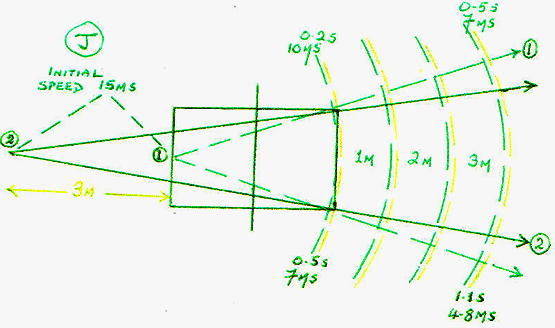
As we can see from (J) there is a big difference looping close to the table and executing a similar stroke three metres back. If we feed in an initial speed of 15 m/second, ball (1) will reach the other end of the table in 0.2 of a second or slightly less and will then have a speed of 10 m/second - ball (2) on the other hand will take around 0.5 of a second and the speed will have dropped to 7.0 m/second. We must also bear in mind that even at relatively slow speeds, say an average of 40 kph, the ball will cover the length of the table in about 0.25 of a second which is just within the limit of human reaction time for the average player.
In our sport the importance of ‘reading the play’, of seeing what is happening as the opponent plays the ball (or in fact 5/6 centimetres before ball contact) is absolutely critical. We must use all possible cues (body and arm action etc) in order to give us every possible advantage.
It is also true to say that our sport is becoming faster and faster and as a result technique (and the economy and streamlining of all technical movements) becomes more and more important. Balance and ‘retained square-ness’ are especially vital. Because much of our technique has to be automated and because we play best when we react subconsciously, we have to make sure that the automated reflexes are absolutely flawless. With today’s time restrictions there is no room for manoeuvre.
Above all training must provide continuous and evolving possibilities for our athletes to apply a variety of techniques in a realistic and competitive environment. Coaches must ensure that players, as they progress through the learning process, are able to identify the most suitable technique and apply this in a variety of differing situations. In other words because we are facing a rapidly changing situation all the time we play, to cultivate adaptive intelligence is absolutely vital. This is the ability to evaluate a scenario in an instant, take in all the immediately available solutions and then take the best action. Often this is called reactive thinking - the ability to think clearly under pressure and use any available means to hand to resolve the problem.
4. DIMINISHING BALL SPEED
| Metres/Second | Equals | Km/Hour | Speed after 3M | Speed after 6M | Speed after 9M |
| 31 | = | 112 | 20.1 | 13.3 | 8.5 |
| 27 | = | 97.2 | 17.4 | 11.0 | 7.6 |
| 24 | = | 86.4 | 15.0 | 10.0 | 7.0 |
| 21 | = | 75.6 | 13.0 | 8.5 | 6.5 |
| 18 | = | 64.8 | 11.5 | 8.0 | 6.0 |
| 15 | = | 54.0 | 10.0 | 7.0 | 4.8 |
| 12 | = | 43.2 | 8.0 | 6.25 | 4.0 |
| 09 | = | 32.4 | 6.5 | 4.5 | 3.0 |
At what speed does gravity come into effect? With a speed of 8.5 m/second (30.6 k/hour, 19.125 mph.) the air resistance is about equally as strong as gravity. Below this speed the effects of gravity come into play very quickly. Air resistance however increases or decreases by the square of the speed. This means that a doubling of the speed to 17m/second signifies a fourfold increase in air resistance. Halving the speed to 4.25 m/second would bring about a reduction in air resistance to around one quarter of gravity. In the case of fast counter play a normal speed would be in the region of 13 — 15 m/second which means immediately that it’s always the air resistance which is the dominating factor in the early stages of the ball’s trajectory.
We must also bear in mind that even at relatively slow speeds, say an average of 40 kph, the ball will cover the length of the table in about 0.25 of a second which is just within the limit of human reaction time for the average player.
5. THE MECHANICS OF FLIGHT, BATS AND RUBBERS
Mechanics of flight
Once the ball has left the racket, the trajectory and direction is determined by the power and spin fed into the stroke. The trajectory itself is determined by gravity, the air resistance and the influence of the spin. A similar stroke will always produce a similar result in terms of spin, speed and direction.
However significant variations can and do occur. The major one is in air pressure and when we talk about height above sea level. At 1000 metres air pressure sinks by 12% and at 3000 metres by up to 30%! This has a major impact on both the air resistance and the effect of the spin on the ball in flight. A major championship event played for example in Mexico City will result in the ball ‘flying’ in an unusual manner and the players must be ready for this, as the trajectory of the ball will not conform to expected criteria.
Let us look however closely at the ball in the air and before the bounce. What we must first understand is that the ball surface is not smooth and contains pockets of air in the surface which react with the flow of air against the ball. We do know that in the case of the top part of a topspinning ball, this spins against the oncoming air while the bottom part is in the same direction. Therefore we have an area of high turbulence at the top and low turbulence at the bottom. However the air flow round a ball moving at high speed changes from turbulent to laminar as it slows down in the air and this is what causes the ball to dip. Just what do we mean by this?
At the ‘static point’ which is the leading point of the ball at speed there will be an ‘eye’ like at the centre of a hurricane where there is an area of pressure. The flow of air around the ball however will in the initial stages of flight as the ball leaves the racket at speed, be chaotic or ‘turbulent’ in nature. By this we mean there is no smooth pattern of air molecules flowing around the surface of the moving ball.
It is only as the ball slows down that a pattern starts to emerge and the air flow around the ball forms a more ordered outline. We call this a ‘laminar’ effect. It is of course at this stage that the high and low pressure areas forming on different parts of the ball’s surface have a direct effect and as a result the ball is forced upwards or to dip sharply downwards on to the table.
After leaving the racket regardless of the spin, speed or direction, the ball is influenced simply by 3 factors - gravity, air resistance and spin (Magnus effect). In the case of topspin, gravity and the influence of the spin work together giving a more arced trajectory. With backspin gravity and the spin factors work against each other so that the ball will rise initially in a curve before dropping sharply when gravity predominates over the lessening spin. Gravity is always equally strong and always directed downwards. Air resistance is always against the direction of travel and its effect is strongly influenced by the speed of the ball.
But just at what speed does gravity come into effect? With a speed of 8.5 m/second (30.6 k/hour, 19.125 mph.) the air resistance is about equally as strong as gravity. Below this speed the effects of gravity come into play very quickly. Air resistance however increases or decreases by the square of the speed. This means that a doubling of the speed to 17m/second signifies a fourfold increase in air resistance. Halving the speed to 4.25 m/second would bring about a reduction in air resistance to around one quarter of gravity. In the case of fast counter play a normal speed would be in the region of 13 — 15 m/second which means immediately that it’s always the air resistance which is the dominating factor in the early stages of the ball’s trajectory.
Bats, rubbers and sponges
Questions relating to materials and the differing spins and effects can be rather more complicated as the manufacturing companies have not tried to create standardised tests to measure exactly what their products can do. Often experienced players or testers (or in some cases not so experienced) categorise rubbers in terms of spin, speed and control, but obviously these classifications are purely subjective. Different players will for example use rubbers in differing ways and one player will often be capable of getting far more out of a particular rubber than another player would. Such ‘subjective’ testing can give some useful information but helps little in giving any base for objective measurement when comparing products from different manufacturers. Also materials and indeed techniques and tactics are constantly in change - it is necessary that we always have an open mind and are ready to look at new ideas and ways of doing things.
Much of the advertising matter which is written in the various brochures on materials is of very little use to the ordinary player and often misleading. The hardness of the wood and the make-up of the ply, how it is bonded and whether you have carbon fibre or titanium mesh layers will all affect the speed and control. Generally one ply will be more rigid and the ball will kick off the blade quicker, multi-ply will be more flexible with more control and stability. The choosing of a blade is a rather more personal matter than the rest of the equipment and it should feel right to the player. Tests in one or two countries appear to indicate that there is an ideal racket weight for the player at differing stages in his or her development and variation by even a few grams can cause a drastic loss of form.
In the interests of weight reduction, the central core of many modern blades consists of a thick layer of balsa wood and the speed comes from the outer veneers of much harder woods often supported by carbon or glass fibre or titanium mesh layers (these supporting non-wood layers should not be thicker than 7.5% of the total blade thickness or 0.35mm whichever is the smaller). According to the rules at least 85% of the blade by thickness should consist of natural wood.
Most rubber manufacturers use speed, spin and control ratings which are at best misleading — many of the tests they use are very simplistic and bear little or no relationship to how a rubber is used in a match. Players also use the same rubber in different ways and with different feel. Let us examine the characteristics of the rubber as it is this which contacts the ball.
- Dwell time — This is how long the ball stays on the racket during the contact phase of a stroke, (bear in mind this is a mere fraction of a second, if you have ever chalked a ball and thrown it to a player who slow loops and tries to maintain a long contact you find that the mark on the ball is never more than one centimetre). Rubbers have different dwell times for different strokes. The ball will be held longer for a slow loop as opposed to a kill. Some players also ‘carry the ball’ longer than others even for the same stroke. A long dwell time will often benefit spinners and blockers while a short dwell time will suit defenders and hitters. The dwell time is also affected by the blade you use and how the ball comes off the racket depends much on the rubber and sponge and how quickly it penetrates through these to reach the wood layer underneath.
- Resilience — The energy stored in the rubber during the contact phase of the stroke. Some rubber and sponge combinations are much more elastic than others and will hold the ball longer on the surface even at a closed racket angle. This stored energy is converted to produce spin. While elasticity levels will certainly increase we must bear in mind that the sponge cannot create energy, but can only minimize energy losses. Compared to a hard bat a ‘sponge’ bat can be swung in a much flatter plane so giving the ball more forward speed with spin. The sponge in fact helps to lift the ball over the net.
- Impact behaviour — A rubber and sponge can have differing performances at different impact speeds. At a slow speed there may be very little elasticity but you may get very good spin and speed when the ball comes into the racket with more pace. When you achieve maximum impact speed you can swing the racket harder but you will get little or no more effect. Some rubbers are said to have good gearing for spin and speed, which means they produce and maintain good effect over a wide range of impact speeds.
- Throw-angle — The angle of the flight of the ball as it comes off the racket surface in the direction the bat is travelling. Differing blades and rubbers affect the throw-angle considerably as will different strokes (the angles would be very different if you were looping for example with very tacky rubber or with anti-loop). The throw-angle will also vary depending on whether the contact is on the outside of the racket or in the middle, or whether low, in the middle or high on the ball (or whether the racket is more closed or open). High throw-angle rubber generally has a higher ratio of spin than speed, compared to low throw-angle rubber. (Flexible, slower blades typically increase the angle).
- Stall-angle — The contact angle at which the speed/spin of a rubber is dramatically reduced — at certain angles all rubbers will stall and not grab the ball (the ball will just drop off the racket, as it sometimes does when it contacts the outside edge). The stall-angle can be used effectively for dummy loops or short serves. A rubber with a wide range of stall-angles (or used with a badly matching blade) will have little or no control. A stall can also occur when the racket contact speed is too fast at a particular contact angle.
- Friction — The grip of the rubber. Under certain conditions and with certain techniques some super high friction rubbers can give less spin/speed than ones with much lower friction characteristics. Sometimes super-grippy rubbers have less spin at high speed — there is a critical level above which little or nothing is gained. Some very tacky rubbers have the characteristic of slowing the ball dramatically at low impact speeds, a function which is very useful in certain strokes. A low friction rubber has difficulty generating speed at closed racket angles. Remember always the friction of many rubbers is impact dependent, they are more effective when the ball is coming at speed.
- Sponge — Sponge can vary from soft to hard and from about 0.4 mm to 2.8 mm and the density of the sponge contributes to the weight of the racket. The amount of spin generated by a rubber is closely related to the elasticity of the sponge (irrespective of the top sheet of rubber), below a certain critical level for a given sponge, the spin of the rubber will be considerably reduced. This can be improved through the correct use of speed glues which will increase the resilience by up to 30%. Players who glue usually prefer soft or medium sponges.Sponges are manufactured in different thicknesses, from around 0.4 up to about 2.8 mm. According to the rules the pimple layer of a sandwich rubber should not be more than 2.0 mm but modern manufacturing techniques have reduced the rubber layer to a little over 1.0 mm, allowing the sponge thickness to be increased accordingly. Sponges are also made generally in 5 differing hardnesses, 23 - 28 (the softest), 30 - 35, 38 - 43, 40 - 45 and 45 - 50. In very general terms most sponges used by European players are in the 30 - 35 range while Asian players use 40 - 45. Many top players especially in the women’s game (and players using material), experiment with differing sponges until they find the most effective hardness for their particular style and/or a hardness which produces maximum effect when combined with the ‘material’ top sheet.
- Glue — Adhesives and glue sheets are used to put the rubbers on the blade. Speed-glues are used to increase the performance of the rubber in respect of spin, speed, control, throw and stall-angles. It is always recommended that you allow each coat of glue to thoroughly dry before applying the next coat — otherwise you can get a ‘mushy’ effect which seriously affects performance when the glue is a little wet. Properly applied speed-glue can increase the spin and speed capabilities of the rubber by up to 30% (remember however that some glues do not work well with certain sponges, especially most hard and more dense sponges). Also the glue must be regularly ‘removed’ from the rubber sheet and the build-up must not be allowed to become too thick. All rubbers (where speed-glue is used) should be taken off the blade as soon as possible after play so that the tension is released. One interesting characteristic of speed-glued rubber is that it has a very predictable effect over a wide range of strokes. Its ability to store energy is nearly constant over a large range of impact speeds, (in normal rubber the storage of energy bottoms out at higher speeds).
6. RACKET COVERINGS, STANDARDS AND SPONGES
Questions relating to materials and the differing spins and effects can be rather complicated as the manufacturing companies have not tried to create standardised tests to measure exactly what their products can do. To assess spin, speed and control some companies utilise a scale of 1 - 10, others from 1 - 12 and still others measure up to 100%.
Often experienced players or testers (or in some cases not so experienced) categorise rubbers in terms of spin, speed and control, but obviously these classifications are purely subjective. Many of the tests used are very simplistic and bear little or no relation as to how a rubber is used in a match. Different players will also use rubbers in differing ways and one player will often be capable of getting far more out of a particular rubber than another player would. Such ‘subjective’ testing can give some useful information but helps little in giving any base for objective measurement when comparing products from different manufacturers. Also materials and indeed techniques and tactics are constantly in change - it is necessary that we always have an open mind and are ready to look at new ideas and ways of doing things.
Sponge can vary from soft to hard and from about 0.4 mm to 2.8 mm and the density of the sponge contributes to the weight of the racket. The amount of spin generated by a rubber is closely related to the elasticity of the sponge (irrespective of the top sheet of rubber), below a certain critical level for a given sponge, the spin of the rubber will be considerably reduced. This can be improved through the correct use of speed glues which will increase the resilience by up to 30%. Players who glue prefer soft or medium sponges as these usually produce most effect.
Sponges are manufactured in different thicknesses, from around 0.4 up to about 2.8 mm. According to the rules the pimple layer of a sandwich rubber should not be more than 2.0 mm but modern precise manufacturing techniques over the last 5 years have reduced the rubber layer to a little over 1.0 mm, allowing the sponge thickness to be increased accordingly (up to a combined maximum of 4.0 mm). Sponges are also made generally in 5 differing hardnesses, 23 - 28 (the softest), 30 - 35, 38 - 43, 40 - 45 and 45 - 50. In very general terms most sponges used by European players are in the 30 - 35 range while Asian players use 40 - 45. Many top players especially in the women’s game (and players using material), experiment with differing sponges until they find the most effective hardness for their particular style.
The softness of the sponge is particularly important when playing with pimpled rubber and this is something the Asian players especially the women have known for many years. Rubbers and sponges are manufactured and sold separately in Asia and it’s easy to combine suitable sponges and rubber sheets. Only recently has this facility been available in Europe. It’s also interesting to note that rubber manufacturers have had considerable dialogue with the top men in Europe to help develop suitable weaponry to win at world level. There has been little or no discussion with the top women in the world who are primarily from the Asian/Oriental block and the production of pimpled rubbers in the West has more often than not been sub-standard.
7. EUROPEAN WOMEN AT WORLD LEVEL
| World Singles Final | Last European Winner | A Roseanu | 1955 | |
| World Singles Final | Last European in Final | A Grofova | 1973 | |
| World Doubles Final | Last Winning Euro/Pair | Z Rudnova/S Grinberg | 1969 | |
| World Doubles Final | Last European in Final | M Alexandru | 1975 | Also Final ‘73/Japanese
and ‘61/Romanian |
| World Team Final | Last Winning Euro/Team | Russia | 1969 | |
| BRITAIN | ||||
| World Singles FInal | Runner Up | D Gubbins | 1926 | |
| World Singles Final | Runner Up | E Blackbourn | 1947 | |
| World Singles Final | Runner Up | V Thomas | 1948 | |
| World Singles Final | Runner Up | A Haydon | 1957 | 3 Finals/Lost in 5th
in each |
| World Doubles Final | Winners | M Franks/V Thomas | 1948 | |
| World Doubles Final | Winners | H Elliott/(G Farkas) | 1949 | |
| World Doubles Final | Winners | H Elliott/D Beregi | 1950 | |
| World Doubles Final | Winners | D and R Rowe | 1951 | |
| World Doubles Final | Winners | D and R Rowe | 1954 | On 21st birthday |
| World Doubles Final | Runners Up | K Best/A Haydon | 1954 | |
| World Team Final | Winners | England | 1947 | By scoreline 21– 0! |
| World Team Final | Winners | England | 1948 | |
| Euro/Team Final | Winners | England | 1958 | First time held |
8. AUTHORISED RACKET COVERINGS
http://www.ittf.com(equipment/, Racket Coverings)
Dark sponge, (black, blue, brown, green, purple, red,) should not be used under translucent red coverings. This is liable to make the rubber illegal (Law 2.4.3. governs the use of sponge).
Many racket coverings contain additional text on the rubber surface and all text appearing in the authorised list must be there (eg. ‘D13 S’). The ITTF stamp must of course also be plainly visible.
Altogether there are around 850/1000 rubbers on the authorised list from around 75/86 companies. These are split approximately as follows -
| COMPANIES | RUBBERS | JAN/JUNE 2004 | JULY/DECEMBER 2006 |
| PRODUCING | 1 — 5 RUBBERS | 39 | 38 |
| PRODUCING | 6 — 9 RUBBERS | 13 | 17 |
| PRODUCING | 10 — 24 RUBBERS | 11 | 18 |
| PRODUCING | 25 — 35 RUBBERS | 5 | 4 |
| PRODUCING | 36 — 55 RUBBERS | 7 | 9 |
| TOTALS | 75 | 86 |
The major companies are as follows -
| JAN/JUNE 2004 | JULY/DECEMBER 2006 | ||
| COMPANY | NUMBER OF RUBBERS | COMPANY | NUMBER OF RUBBERS |
| BUTTERFLY | 55 | BUTTERFLY | 55 |
| NITTAKU | 53 | DONIC | 55 |
| JOOLA | 44 | DOUBLE HAPPINESS | 50 |
| DOUBLE HAPPINESS | 42 | NITTAKU | 47 |
| YASAKA | 41 | JOOLA | 44 |
| DONIC | 40 | YASAKA | 44 |
| TIBHAR | 38 | TIBHAR | 44 |
| TSP | 33 | TSP | 39 |
| STIGA | 29 | FRIENDSHIP | 37 |
| FRIENDSHIP | 28 | STIGA | 33 |
| ARMSTRONG | 28 | ARMSTRONG | 31 |
| JUIC | 25 | JUIC | 28 |
| CHAMPION | 20 | ANDRO | 25 |
| ANDRO | 19 | BAMCO | 20 |
| BANCO | 19 | CHAMPION | 17 |
| SUNFLEX | 19 | LION | 15 |
| YASHIMA | 16 | SUNFLEX | 15 |
| IMPERIAL | 14 | GLOBE | 14 |
| LION | 12 | PALIO | 14 |
| DOUBLE FISH | 11 | KOKUTAKU | 12 |
| BOMB | 11 | GIANT DRAGON | 12 |
| DONIER | 10 | BOMB | 11 |
| PRASIDHA | 10 | NEUBAUER | 11 |
| IMPERIAL | 11 | ||
| MILKY WAY | 11 | ||
| POINT BLANK | 11 | ||
| PRASIDHA | 11 | ||
| XIOM | 11 | ||
| YASHIMA | 11 | ||
| DAWEI | 10 | ||
| DOUBLE FISH | 10 |
Rubbers are divided into the following categories on the authorised list –
| CATEGORY | JAN/JUNE 2004 | JULY/DECEMBER2006 | PERCENT INCREASE |
| WESTERN REVERSE RUBBERS | 518 | 611 | 18% |
| CHINESE REVERSE RUBBERS | 94 | 127 | 35% |
| ANTI-LOOP | 20 | 17 | -15% |
| SHORT/MEDIUM PIMPLES | 149 | 150 | SAME |
| LONG PIMPLES | 66 | 96 | 45% |
| TOTAL | 847 | 1001 |
NB. In the case of all pimple rubbers there must be no less than 10 pimples to a square centimetre and no more than 30 to a square centimetre. In the case of all long pimple rubbers the aspect ratio (ie. The pimple length divided by the pimple diameter) must be larger than 0.9mm but under no circumstances larger than 1.1mm ie. For pimples with a length of 1.8 the largest permissible diameter would be 2.0 mm).
The 850 or 1000 rubbers on the authorised list are divided percentage-wise approximately as follows –
| CATEGORY | JAN/JUNE 2004 | JULY/DECEMBER 2006 |
| WESTERN REVERSE RUBBERS | 61% | 61% |
| CHINESE REVERSE RUBBERS | 11% | 12.7% |
| ANTI-LOOP | 02% | 01.7% |
| SHORT/MEDIUM PIMPLES | 18% | 15% |
| LONG PIMPLES | 08% | 9.6% |
Probably the most significant increase is in the number of long pimple rubbers on the market, up from 66 to 96, an increase of 45%!
9. RUBBERS – FROM REVERSE TO MATERIAL
There are basically seven differing types of rubber surfaces on the market –
- Reverse (normal rubbers Butterfly, Donic, Stiga, Yasaka, etc.) usually with soft rubber sheets and softish sponge around 35 – 40. Used by top men and women in Europe and by the top men in China on the BH side. Very good for looping and the best control for blocking.
- Tacky reverse (Chinese rubbers DHS, Double Fish, Friendship, Globe, etc.) with sticky rubber sheets and usually a harder sponge (around 39 – 45) than that used by top European players. Mostly used in Asia as a FH rubber for the top men and women. Very few players in Europe use this type of surface, except former Asian players. (Used successfully by Drinkall and Knight in the European Youths).
- Anti-spin (Made mostly in Europe, Butterfly, Donic, Stiga, T.Hold, Yasaka but the odd Chinese specimen such as RITC 804). Anti can come in two types, almost no spin or with a little friction. Usually the rubbers are very slow with good control and the ball is slow off the racket.
- Short pimples are between 0.6 – 1.0 in length (rubber sheet only) and made by both European and Chinese companies, Butterfly, Donic, Friendship, Globe, Neubauer, Stiga, TSP, Yasaka, etc. Short pimples vary very much nowadays and some sheets are capable of creating a great deal of spin while others have much less friction. Generally shorter, broader, grippy pimples will create more spin. For maximum effect very soft sponge is a must (30 – 35 but no harder) and top women normally use a thickness of 1.6 –1.8mm sponge while the men tend to go a little thicker, between 2.0 and 2.3 mm. Men of course hit the ball much harder.
- Medium or half-long pimples vary between 1.1 – 1.4 mm. and are made by both Chinese and European companies, Butterfly, RITC, TSP etc. These pimples too vary in grip (some have a more anti-spin surface). The characteristic of half-long pimples is the ease with which players can open against backspin and yet still play a good counter-hitting game with effect. Usually players use these rubbers for attacking and with thicker sponges, 1.5 – 2.0.
- Long Pimples (with friction) are between 1.5 – 1.8 mm. and are made by both Chinese and European companies, Butterfly, DHS, Donic, Prasidha, RITC, TSP, Yasaka, etc. There is an element of friction with these pimples and they are used by many defensive players the world over usually with a thin sponge varying between 0.6 – 1.2. Occasionally attacking players use long pimples with a thicker sponge, Carl Prean, Gary Tendler, Ni Xialan, Deng Yaping.
- Long pimples with an anti-loop effect (between 1.5 – 1.8 mm. too) are made primarily by two companies, Neubauer and Hallmark. These pimples are hard and feel more like plastic than rubber. They have absolutely no friction and all the opponent’s spin is returned.
Maximum spin reversal is achieved by using the rubber sheets without sponge and in the red colour. Spin reversal with a thin sponge (0.4 – 0.6) will be a little less effective for blockers but the thin sponge will give better control with this type of game. Bear in mind that once the player is competent with the long pimples the Ox version will give lower and shorter balls and will add another dimension to the blocking game. In Neubauer’s opinion his Super Block Ox is the rubber which gives maximum spin reversal.
NB. In the case of all pimple rubbers there must be no less than 10 pimples to a square centimetre and no more than 30 to a square centimetre. In the case of all long pimple rubbers the aspect ratio (ie. The pimple length divided by the pimple diameter) must be larger than 0.9mm but under no circumstances larger than 1.1mm). A pimple length of 1.8mm and width of 2.0mm would give a figure of 0.9 – the same length with a width of 1.8 would give a figure of 1.0 – one can therefore say that the purpose of the regulation is to keep long pimples within certain limits and especially not to permit the manufacture of very thin pimples.
If we look at these seven categories in the light of their ability to affect or change the spin on the incoming ball we get results somewhat as follows –
| CATEGORY | PERCENT EFFECT | |
| 1 | WESTERN REVERSE RUBBERS | 100% |
| 2 | CHINESE REVERSE RUBBERS | 100% |
| 3 | ANTI-SPIN RUBBERS | 5 — 12% |
| 4 | SHORT PIMPLE RUBBERS | 75 — 95% |
| 5 | HALF-LONG PIMPLE RUBBERS | 65 — 75% |
| 6 | LONG PIMPLES WITH FRICTION | 30 — 35% |
| 7 | FRICTIONLESS LONG PIMPLES | 0% |
10 RUBBER CATEGORIES
- WESTERN REVERSE
- CHINESE REVERSE
- ANTI-LOOP
- SHORT PIMPLES (0.6 — 1.0mm)
- HALF-LONG PIMPLES (1.1 — 1.4mm)
- LONG PIMPLES WITH FRICTION (1.5– 1.8mm)
- FRICTIONLESS LONG PIMPLES (1.5 — 1.8mm)
Performance Assessment Cards
Rowden Fullen (1980’s)
PERFORMANCE ASSESSMENT CARD
It is a simple matter to draw up an assessment card where you can plot the number of points won or lost on both the BH and FH side and see as a result the patterns that emerge from this exercise.
ATTACK
• Loop
• Topspin
• Drive
CONTROL
• Push
• Block
DEFENCE
• Chop
• Float
SERVE/REC
• Serve
• 3rd Ball
• Receive
• 2nd Ball
UNFORCED ERRORS
• Over the table
• Back from the table
• Others
SERVE/RECEIVE ASSESSMENT
In the same way you can assess how effective your player’s serve and receive are functioning in match-play and where points are won or lost and on which wing.
SERVE
• Short
• Half-long
• Long
RECEIVE
• FH Push
• FH Drop
• FH Flick
• BH Push
• BH Drop
• BH Flick
COMMENTS
8 Prime Points
Rowden March 2019
• Table tennis is all about CONTROLLING the play (basically being consistent) until you can win the point by some form of CHANGE (more power, speed or spin, better placement or angles, softer, shorter balls etc). These combinations of change whatever they may be, are the way our game is going to develop.
• Speed is ALWAYS the single most important factor in any style. Speed includes quickness in all areas, bat and ball, footwork, reactions, thinking and adaptability.
• Serve and receive and short play are an essential ingredient in getting in your own strengths – if you can’t control these areas then you will not be able to reach the higher levels. In Europe we are not precise enough in serve, receive and short play and are limited as a result in what we can do with the subsequent ball. Always look for the opportunity to go on the offensive and try to develop your attack system and your own individual style within the serve and receive scenario.
• If you move faster you are better placed and have a sounder base to attack strongly. There is then a better chance that your first attack will have quality. If you can play quality shots you will get weaker returns and have more chance to dominate.
• Winning the battle of placement enables you to use your tactics to the fullest extent. Any attack should be constant and should keep the opponent under pressure. Bear in mind too that change of tempo can just be as effective as increased power/speed.
• Timing and style will affect stance and movement patterns.
• Sequential play is vital – to connect up the 3rd and 5th shots for example, play sound linking shots and make combinations. Don’t get into the habit of playing weak or safe shots before attack. The mentally strong will win the initiative battles.
• Always consider the differing types of power; these are part of the various forms of change. Power can be:
1) Full (90% sufficient)
2) Medium (60 – 70%)
3) Using the opponent’s force (40 to 50% of own to gain 70 to 80% effect). This is a safe way to be aggressive
4) Absorbing the opponent’s power
Developing Speed for Table Tennis
Extracts from Seminar. Dr Larry Van Such
We have all heard of fast and slow twitch fibres in muscles -- in almost every sport the secret to improving your athletic skill is to make your muscles not only stronger but also faster. Fast muscles give you a big advantage in almost all sport related skills but especially in fast reaction sports.
The fast twitch muscle fibres are responsible for giving the athlete his speed, agility, quickness, and power. Fast twitch fibres are up to 10 times faster than slow fibres. In most muscles, these fibres are intermingled. However, there is usually a predominance of one or the other. In skeletal muscles like those found in the arms and legs, the fast twitch fibres dominate. Fast twitch fibres allow for powerful forces to be generated over a relatively short period of time. Because the fibres are intermingled it is not possible to isolate out a single fibre type during a muscular contraction. All of the fibres contract together, though at times one class of fibre may be dominant during the contraction.
You cannot condition your muscles for speed in the same way you condition your muscles for strength. With isometric training, a muscle opposes some form of resistance and is contracted to a certain length and then held for a certain period of time, usually 10 seconds or more. There are no repetitions required in isometrics as in weight training. The advantage of this type of training for muscle speed is twofold.
• By forcing your muscle to hold a position without changing this for a certain length of time, your body will begin to recruit more and more motor units to help maintain this contraction. Motor units that are rarely exercised within a particular muscle are now brought into use, perhaps for the first time.
• By limiting the amount of time the muscle holds a position, fast twitch muscle fibres can be conditioned for their natural ability of speed and quickness – something that is rarely achieved when using extensive repetitions in your workout routine. While the muscle is held in position against resistance the motor units that are recruited are forced to contract continuously, time after time, until your muscles achieve a state of maximum intensity, safely and effectively. The end result is that the entire muscle matures very quickly.
The resistance band is an outstanding product that has a very unique physical property known as a variable elastic potential. This means that the more you stretch the band the more force you will have to apply to maintain the resistance level. The amount of resistance found within an elastic band is therefore a function of its length when stretched. When the length of the band changes, even if by a small amount, the resistance level changes also.
When holding a position, the resistance band is stretched and is exerting a significant amount of force back into your muscle. After a few seconds, your muscle will naturally start to weaken. When this happens, your muscle will begin to recruit more and more motor units to help keep the arm/leg in a fixed position. When your muscles start to shake keep holding the position.
1. With each ongoing recruitment pattern of motor units a muscle’s weakness and lack of coordination is instantly exposed on a much deeper level than normally experienced. This forces the muscle fibres to immediately get stronger and quicker and with more precision than before. The result is that the muscles are conditioned to contract faster with increased strength, coordination and responsiveness. The athlete will start to notice the difference in his/her athletic performance, often in just a few days.
2. A second benefit of this training strategy is that the muscle does not get a chance to adapt to the force of the resistance and plateau, or level off, at the level of resistance applied. ‘Muscle confusion’ is the term often applied to the idea of keeping the muscle guessing as to what force to expect and this promotes ongoing muscle development.
3. Thirdly, the mass of the muscle typically does not increase with this type of training, which, if it did, could potentially offset speed gains. So, whenever you are able to increase a muscle’s strength and coordination without adding any additional body weight, your speed and quickness will automatically improve.
These are just some of the reasons how and why this type of training works and why athletes often see dramatic results in their sports performance in a short period of time. However many so-called speed training experts, trainers, coaches and athletes never take certain aspects into consideration. When you mention isometrics, they immediately think of using weights for resistance, this won’t work for speed; and, when you mention resistance bands, they immediately think of performing repetitions with them, which again, won’t work either.
Isometric training with weights won’t help you get faster and using resistance bands with a weightlifting strategy (that is, performing repetitions with them) won’t work either. It’s ONLY the combination of isometric training with resistance bands that makes muscles contract faster.
The interesting thing is that when we look into a lot of the different so-called speed training programs on the internet or in books or articles, practically all of them are very similar to strength and endurance programs. Some of them are almost identical. You have to ask yourself, if there are two different fibre types in the body with two different functions, wouldn’t you think there should be at least two different ways to train your muscles?
This is what makes isometrics with the resistance band so vital to speed training. Because the fibres that produce faster muscles respond to this type of training. Fast twitch fibres won’t respond to weight training and they won’t respond to plyometric training. In fact, when you do these types of exercises, you are literally re-training and re-programming your fast twitch fibres to behave like slow twitch fibres. Not only will they not make you faster, they will probably in fact make you slower.
This is why you will always feel wiped out, totally exhausted after doing plyometrics and weight training. These routines strip your muscles of their elastic contracting ability which makes even doing the simplest routines afterwards such as washing your hair or brushing your teeth almost impossible. However, after you train with resistance bands you will immediately start to feel lighter, faster and more responsive. This is the complete opposite of what happens after using strength training programs.
Training Charts
Rowden Fullen(1990’s)

Forms and Questionnaires
Rowden Fullen (2002)
- Training camp report form.
- Player’s evaluation form.
- Training questionnaire.
- Innovation assessment form.
- Attitude and development questionnaire.
- Assessment and marking of attitude and development questionnaire.
- Girls – big ball questionnaire.
- The player’s development.
- Stroke correction techniques.
- Style profile.
1. Training camp report form.
Name Age Club
Stroke Production
Movement
Serve/Receive
Mental Approach
Style Development
Comments
Course Director Date
2. Player’s evaluation and feedback form.
NAME:
CLUB:
- Which stroke do you think is your greatest strength?
- What is the biggest weakness in your game?
- Which type of player causes you most problems?
- How is training here different from your own club?
- What have you liked most about the training?
- What else would you like included in the programme?
- Do you think you have improved and learned anything?
- How would you rate your service game out of 10?
- How would you rate your receives out of 10?
- Are you physically fit enough for table tennis?
- How much do you train in your own club?
3. Training questionnaire.
- How does the session differ from those you normally attend?
- Do you think one/two day/one week camps like this are good? Why? Do they benefit you in your play? How?
- Is the content satisfactory for you? What else would you like included?
- Do you find the work-load too hard? Too easy? About right?
- Do you relate to the coaches involved?
- Do you prefer all girl camps? Some boys? About 50/50? Why?
- Was enough time spent on serve/receive? Do you need more personal help in this area?
- In which areas does your own game need attention? Spin? Movement? Stroke play technique? Power? Change of speed? Others — give details.
- Do you feel coaching development is good in your club/area/district? Can you become a top player just by training in your area?
- Is the girls’ game declining and standards falling? What do you think are the reasons for this?
- What do you think is the ideal coach/player ratio for a session/camp like this?
- How do you think the training could be improved?
- What would you personally like to be included to benefit your own style development?
- Do you think that your style is being developed and guided towards the senior game?
- What is your ultimate aim in table tennis? At what level for example will you be playing at 16, 23 and 32 years?
- Which do you consider most important while you are young (15 years or younger), tournaments or training? Why?
- Why do you play table tennis?
4. Innovation assessment form.
- Do I want to be the best I can and reach my fullest potential?
- Am I negative in certain parts of my game? Do I for example win points or do I wait for my opponent to make mistakes.
- If I am negative, how long have I been negative? Six months, one year?
- Just when am I going to do something about it?
- What new serves do I have in the last six months, one year?
- What different receives do I have in the last six months, one year?
- What new strokes or tactics do I have in the last six months, one year?
- Am I prepared to listen to new ideas and to try different ways of doing things?
- If I am not prepared to change do I understand that my development is finished? That I am not going to get any better and I am going to stay at the level I am now?
- Do I understand and accept that without change there is no progress?
5. Attitude and development questionnaire.
- When I lose to a player I should never lose to, am I prepared to talk about it —
- a) Immediately after.
- b) After 3 or 4 hours.
- c) Never.
- The opponent pushes all the time to my back- hand. It’s 9 — 9 in the 5th.
Do I — - a) Open direct.
- b) Only open when I am sure I can win the point.
- c) Wait for her to open.
- Do I have any new strokes or tactics in the last months?– a) Six months. b) One year. c) None.
- Do I understand and accept that without change there is no development? a) Yes. b) No. c) Don’t know.
- On the backhand wing do I usually open up and attack–
- a) After I – 2 pushes.
- b) After 3 – 4 or more.
- c) Never.
- Am I prepared to listen to new ideas and to try new things? — a) Always. b) Sometimes. c) Never.
- Do I have any new serves in the last — a) Six months? b) One year? c) None.
- If the opponent pushes long to my forehand, do I open on the — a) First push? b)The second? c) Earliest the third?
- Do I have new ways of receiving the serve over the last — a) Six months? b) One year? c) No.
- Do I ever push high balls on the backhand?
- a) Never.
- b) Sometimes.
- c) Always.
6. Assessment and marking for attitude and development questionnaire
1.
- a = 5
- b = 2
- c = 0
2.
- a = 5
- b = 3
- c = 0
3.
- a = 5
- b = 3
- c = 0
4.
- a = 10
- b = 0
- c = 0
5.
- a = 5
- b = 3
- c = 0
6.
- a = 5
- b = 2
- c = 0
7.
- a = 5
- b = 3
- c = 0
8.
- a = 5
- b = 3
- c = 0
9.
- a = 5
- b = 3
- c = 0
10.
- a = 5
- b = 2
- c = 0
A 36 – 55 Positive and developing.
B 22 – 35 Development starting to stagnate, needs to be more positive.
C 0 – 21 Negative, no development.
7. Girls – Big ball questionnaire.
8. The player’s development
During a player’s development the coach has to be active in a large number of areas and he/she has to be quite precise in trying to direct the player towards the most suitable end-style for him/her as an individual.
TECHNIQUE – In this area the various strokes will be assessed to see where the player is naturally proficient and this will be done on both BH and FH.
• DRIVE – Early, ‘peak’.
• TOPSPIN -- Slow, fast, sidespin.
• SMASH – Early, ‘peak’, late, topspin.
• BLOCKS – Soft, forcing, ‘stop’, topspin, sidespin.
• DROP BALL – Short, angled.
• PUSHES – Chop, float, early ball.
• FLICKS – Early, ‘peak’, late.
• DEFENCE – Chop, float, fishing and lobbing.
SERVE/RECEIVE AND NEXT BALLS – This is such a vital area that it should be treated separately. The whole serve and receive area must, even from an early age, be geared to the player’s style. How is this player, with his/her style, going to win points? Which serves/receives will fit in with the style and which tactics will be most suitable on the next couple of balls?
• SERVE – Short, half-long, long.
• RECEIVE – Short drop, long push, flick, slow roll, chop, float.
• 2nd, 3rd, 4th and 5th balls.
APPROACH – It is also important to assess what the player can do with the ball in more general terms and from differing areas and lengths.
• CONTROL
• ACCURACY
• CONSISTENCY
• FEELING
MOVEMENT – This is of course crucial and players need to be assessed early on to see which patterns they will need for their style to be effective.
• READY POSITION
• MOVEMENT – In and out, side to side, diagonal.
USE OF THE TABLE – This is also vital. Does the player do things instinctively or does he/she need to be programmed?
• ANGLES
• STRAIGHT BALLS
• CHANGE OF SPIN
• CHANGE OF SPEED
• DECEPTION
QUALITIES OF THE PLAYER – The person is above all important and the physical and mental attributes should be evaluated early.
• PHYSICAL – Condition, speed, strength, flexibility, feeling.
• MENTAL – Willpower, fighting spirit, ability to focus, work-rate, confidence, self-belief, positive thinking.
• ADAPTIVE INTELLIGENCE – The ability to adapt to new situations and quickly’.
EQUIPMENT/BACKING – Does the player have access to a robot, good multi-ball training, varied sparring, is his/her home life stable and is there good support in this area? Is there enough financial support?
IN THE FINAL ANALYSIS – No player is ever going to become great without harnessing his/her own talents and abilities and without doing what he/she does best. Unless the coach directs the player into the right channels to make the most of natural talents, the greatest potential can be wasted.
9. STROKE CORRECTION TECHNIQUES.
- Stance.
- Body Action.
- Length.
- Timing.
- Table Position.
- FreeArm.
- Bat Arm
.
10. Style profile.
- What % F.H./B.H. strokes do you play in a game? 70 – 30%, 50 – 50%, why?
- What are your main strokes on each wing? If more than one list in % of use.
- What blade (in terms of speed) and rubbers (sponge thickness) do you use? Do you use glue? Do these help your prime strokes and why?
- Do you think you have the physical requirements to play the game you want to play? Speed round the table, reactions etc?
- At what depth from the table do you normally play? Close, mid-area (3 – 4 feet) or deeper? If you change and play from varying distances try to breakdown in percentage.
- Do your strokes alter in overall quality/strength over varying depths? Is one wing weaker close or back? Why?
- Is your general game unbalanced? One wing stronger close and one stronger deep? Which is the main strength?
- Do your serves fit in and help you gain advantage in terms of your overall style? Which is your best serve?
- How would you describe yourself? Blocker, drive player, loop player, defender, all-rounder? What is your prime strength?
- Can you impose your game on your opponent however he/she plays?
- Do you feel looking ahead to the senior game that you should be thinking of making any changes in the way you play? F.H./B.H. split, playing depth, stroke development, tactics etc?
- Are you on the whole happy inside with the type of game you play or are you dissatisfied with the way you win? What type of opponent really frustrates you?
Training Exercises
Exercise 1
Warm-ups 15 mins
- X’s and H’s Controlled knocking-up
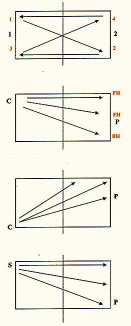
A)
- C to middle/BH regular. P plays BH/FH
- C one/two to BH, 1 to middle
- C one/two to BH, then middle or FH
- C 1/2 to BH, 1/2 to middle or FH
B)
- FH to FH corner, C plays angle
- FH to FH, C plays to middle or random angle
- C anywhere in FH half, random angle play
C)
- Fast serve, no spin, from BH to FH/middle/BH
- P controls with slow returns. Examine alternatives
D)
- Games to 11 up.
Excercise 2 Warm-ups 10 mins
| Knock-up 3 ball | 1BH - 1FH | 2BH - 1FH | 3BH - 1FH |
| control from the | 1BH - 2FH | 2BH - 2FH | 3BH - 2FH |
| BH corner | 1BH - 3FH | 2BH - 3FH | 3BH - 3FH |
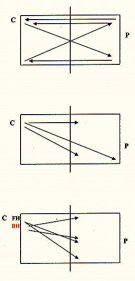
A)
- P topspins 2 straight, C plays to the BH, P straight, C to the FH, continue
- After P plays BH straight, C to initiate free play
- C switches anywhere after first 1 - 2 FH topspins from P and initiates free play
B)
- BH to BH slow/fast, long/short
- As 1. but C short to FH at random, play free
- As 1. but C at random plays anywhere short, free play
C) Backspin serve short
- BH to FH or middle
- FH to middle or BH
- All returns - push short/long, play free
D)
- Games to 11 up, starting from 5 - 5
Exercise 3 Warm-ups 15 mins

- Control exercise straight, narrow channel, 10 - 15 cms
A)
- Line play to P’s BH, C switches to FH and sometimes angles ball. 2 to BH and 1 to FH
- 2 or 3 line balls, then 1 to FH
- 2 to 5 line balls, 1 or 2 to FH
- Line play 2 - 5, switch, then free play
B)
- Backspin or float serves, short or half-long. Use same action but different parts of the racket
- Flick/open or drop short, play free
C) Games to 15 up, three serves each
Exercise 4 Warm-ups 10mins
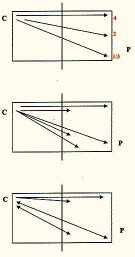
- 4 Ball, BH, middle, BH, FH
A)
- BH - BH slow/fast,long/short + angle
- As 1) 3 times, short/long to FH, play free
- As 1) 1 - 3 times, to FH short/long, free
B)
- BH - BH variation, mix topspin,chop/sidespin block, experiment to find what suits you.
- BH - BH 1 - 3 balls, chop-block, spin to FH, play free
C)
BH Serve - variations
D)
Games to 11 up starting from 7 - 8 and serving
Exercise 5 Warm-ups 15mins

- X’s and H’s
- 4 Ball, BH, middle, BH, FH
A)
- C plays BH/middle, BH/FH
- First 3 one ball, last to FH 1 or 2
- BH/middle 1 or 2, BH/FH 1 or 2
- BH 1 or 2, middle or FH
B)
- Topspin to block
- Blocker hits/forces right ball
C)
BH serve, high throw, side, topspin or chop
D)
Games to 11
Exercise 6 Warm-ups 15mins
- Control 5 ball
| BH | FH | BH | FH | BH | FH | BH | FH | BH | FH |
| 1 | 1 | 2 | 1 | 3 | 1 | 4 | 1 | 5 | 1 |
| 2 | 2 | 2 | 2 | 2 | |||||
| 3 | 3 | 3 | 3 | 3 | |||||
| 4 | 4 | 4 | 4 | 4 | |||||
| 5 | 5 | 5 | 5 | 5 |

A)
- Reverse Falkenberg - small
- And large
- FH middle, 1 or 2 from FH, BH from BH
- As 3. but 1 or 2 from BH
B)
- Backspin serve short/half-long, push long to BH, open
- Same serve, push long to FH, open
- Push return to FH/BH, open
C)
Games to 11 up, from 8 - 8
Exercise 7 Warm-ups 10 mins

- Control 5 ball, BH/middle/FH/middle/BH
A)
- BH/middle, BH/FH. Control with FH, P plays BH/FH alternately.
- First 3 one ball, to FH 1 or 2
- BH 1 or 2, middle, BH 1 or 2, FH 1
B)
- Start with drive, loop to loop or drive FH from deep
- As 1. but random ball to BH side

C)
FH axe serve with both top and backspin (+ side)
D)
Games to 11 up from 5 - 5
Exercise 8 Warm-ups 10mins
- Control 5 ball
| Knock-up 3 ball | 1BH - 1FH | 2BH - 1FH | 3BH - 1FH |
| control from the | 1BH - 2FH | 2BH - 2FH | 3BH - 2FH |
| BH corner | 1BH - 3FH | 2BH - 3FH | 3BH - 3FH |
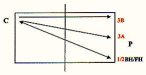
A)
- Falkenberg - small 3A
- Falkenberg - large 3B
- Either small/large
B)
- Small F, spin first FH from BH, drive next from middle
- 1 - 3 to BH corner, then into Falkenberg small/large
- Large F, play second FH free
C)
Smash to lob
D)
Long, fast serve, play free
E)
Games from 8 - 8 to 11 up
Exercise 9 Warm-ups 15mins
- Knock-up - X’s and H’s play 2 diagonal before switch

A)
- P plays 2 FH’s from BH corner, C plays straight to P’s FH
- As 1. but C plays 1 - 2 to P’s FH
- C plays 1 - 3 to P’s BH, then 1 - 2 to FH
- C plays 1- 3 to P’s BH, then to middle/FH and free play
B)
- C - short serve to FH
- P - long push or flick straight
- C - slow topspin with FH/BH straight twice
- C - fast topspin or drive to P’s BH
- P - straight, free play
C)
- Reverse spin serve, long to BH/middle, or short to middle/FH
D)
- Games to 11 up
Exercise 10 Warm-ups 15mins
- Knock-up 5 ball 1BH - 1-5FH, 2BH - 1-5FH, 3BH - 1-5FH, 4BH - 1-5FH, 5BH - 1-5FH
- Control

A)
- C short serve, middle or BH. P returns half-long to FH. C topspins/drives wide to P’s FH side, free play
- As 1. but C topspins/drives to P’s BH, free play
- As 1. but C plays anywhere, free play
B)
- C - one ball to middle, 1 to FH, then middle and BH
- C - alternate balls to the middle then to BH/FH
- C - alternate balls to the middle then 1 - 2 to BH/FH
- C - 1 - 2 to middle then 1 - 2 to BH/FH
C)
- Sidespin, float or chop serve with FH. Work at variation with same action
D)
- Games to 7 points, only one serve each
Exercise 11 Warm-ups 10mins
- Control - FH/FH from FH to middle, then FH from BH to the middle

A)
- P topspins 4 - 5 slow with FH to block on BH diagonal
- As 1. with control to varied block
- After 4 balls C plays to P’s FH, free play
- C plays to FH at random, free play
B)
- P topspins fast 2 - 4 FH to FH, C drives later with control
- P topspins fast 2 - 4 FH to FH, C drives 1 - 2 then counter-topspins
- As 2. but C topspins down line, free play
- As 3. but C topspins down line, then wide to FH, free play
C)
- Reverse spin serves - test both arcs
D)
- Games to 11 up, 3 serves each
Exercise 12 Warm-ups 15mins
- Control 3 ball, but BH from BH corner, FH from FH corner

A)
- P topspins BH straight, C blocks
- As 1. but C uses varied blocks
- Any time after 2nd topspin, C plays to FH and P continues straight to C’s BH.
- As 3. but free play after C plays to FH
B)
- P spins and drives with BH to block
- As 1. but C mixes returns, block, drive and spin
- Either player switches to FH then free play
C)
- Axe and reverse axe serves, with backspin, topspin and sidespin
D)
- Games to 11 up from 9 all, both as server and receiver
Exercise 13 Warm-ups 15mins
- Control FH from middle to BH, then middle to FH
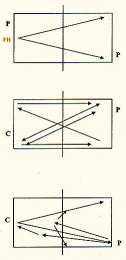
A)
- FH/FH topspin to block, after 3 balls C plays line, P diagonal, C straight, repeat
- As 1. then free play
- After P plays diagonal BH, C plays either to FH/BH, then free play
B)
- Short or half-long serve, C drops short or pushes long to FH. P opens or pushes short or long
- As 1. but C short or long to BH
- C short or long to BH or FH
C)
- Short play training, from short serve situation both players play several short balls in succession
D)
- Matches to 13 all, short backspin serve to FH/middle or long, fast serve to middle/BH. 3 serves each
Exercise 14 Warm-ups 10mins
- Control straight, short and long

A)
- C short serve to BH
- P flick/push to BH
- C FH slow spin diagonal twice
- P then blocks straight
- C slow topspin to FH 2 - 3 times, switches middle/BH, free play
B)
- C short serve to FH
- P drops short or flicks to C’s FH
- C topspins 2 - 3 slow to FH or flicks then topspins
- C then topspins slow to P’s BH
- P blocks diagonally to C’s BH, free play
C)
- Short backspin/float serves to the middle or FH, flick return
D)
- Games to 11 up
Exercise 15 Warm-ups 10mins
- 1 BH from BH,1 FH from FH
- 2 BH from BH, 2 FH from FH/Middle
- 3 BH from BH, 3 FH from FH/Middle/FH
- 4 BH from BH, 4 FH from FH/Middle/FH/Middle
- 5 BH from BH, 5 FH from FH/Middle/FH/Middle/FH

A)
- Drive play BH/BH 2 to 4 balls, C topspins FH line, P returns to middle, C topspins to BH. Repeat
- As 1. but play free after P's return to middle
- Reversed, C topspins to P's BH, P returns to middle, C topspins to P's FH, P straight, repeat.
- As 3. but free play after P returns straight
- As 3. but free after C topspins to P's FH
B)
- Long serve to the middle, return to BH, 3rd ball to BH
- Long serve to BH, return to BH, 3rd ball to middle
- Serve either to BH/middle, return FH, 3rd ball to corners
- As 3. but 3rd ball to the body
C)
- Fast serve float/spin to body or corners
D)
- Games to 15 up. Three serves
Exercise 16 Warm-ups 15mins
- Control 1BH - 1FH from FH, 2BH - 1FH from FH, 3BH - 1FH from FH
- 2BH - 1FH from FH, 2BH - 2FH from FH, 2BH - 3FH from FH
- 3BH - 1FH from FH, 3BH - 2FH from FH, 3BH - 3FH from FH
All BH's from BH, all FH's from FH
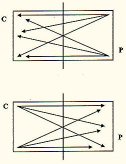
A)
- P FH topspin from BH corner to BH/middle/FH
- Same from FH corner
- To 3 areas from BH then from FH
- Emphasis on CONTROL
B)
- From BH to BH and middle then random to FH
- From BH to FH and middle then random to BH
- From BH to BH and FH then random to middle
- From FH to BH and FH then random to middle
- From FH to FH and middle then random to BH
C)
- FH serve with chop, sidespin and float
D)
- Games to 11 up
Exercise 17 Warm-ups 10mins
- C to BH/middle then to BH/FH. Control from FH

A)
- FH topspin/drive from middle to FH/BH
- As 1. but 1 - 2 to BH and 1 - 2 to FH
- As 2. but random ball to body
B)
- FH topspin to counter-topspin training
- FH topspin to drive counter (both players in mid-area)
- FH topspin to BH counter on diagonal from back
- FH topspin diagonal, random switch to middle
- FH topspin diagonal to BH, random switch to middle
C)
- BH serve to middle or FH, short or half-long, drop short, flick or push long (Examine differing timing points)
D)
- Games to 11 up from 7 all
Exercise 18 Warm-ups 15mins
- From middle with FH to middle/FH then middle/BH
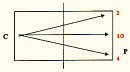
A)
- FH topspin or drive alternately from FH/BH to middle
- C 1 or 2 to FH and 1 to BH
- C 1 or 2 to BH and 1 to FH
- C 1 or 2 to BH or FH
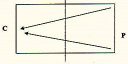
B)
- Chop defence v loop or drive
Explore differing methods of attacking, loop, slow or fast, drive, punch, sidespin etc. Also look at different timing points and the option of dropping short.
C)
- Serve training - short to FH/middle, long to corners/middle
D)
- Games to 11 up
Exercise 19 Warm-ups 15mins
- BH/middle, FH/middle, FH/BH control from BH
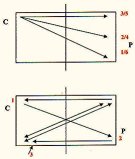
A)
- FH to FH, C plays 2 balls, P topspins line, C blocks on diagonal, P drives straight, repeat
- Start FH/FH but between 2 - 4 balls, then continue as 1.
- FH/FH 2 - 3 balls, P topspins down line 1 - 2, continue as 1.
- Play free after 1,2 or 3.
B)
- Receive training - against sidespin serves with backspin and topspin, train to play with and against the spin. Work also to leave the server’s spin on the ball at times and return it to him or her
C)
- Games to 11 up, only the receiver can win points. If he wins on receive he carries on receiving, if he loses then he must serve
Exercise 20 Warm-ups 10mins
- FH to FH/middle, then BH/middle, then BH/FH
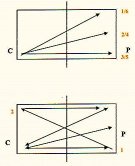
A)
- C to middle/FH 3 times, switch straight, P diagonal, C straight, repeat
- C switches 2 straight, continue
- C switches 1 or 2 straight, continue
- P plays 1 or 2 diagonal, continue
- C plays any number to middle/FH, then switches into exercise
- Any time after first or 2nd switch, free play
B)
- Varied serves and spin - BH, axe, FH and reverse, short and long. Work at differing timing against the short serves and to play with, against or return the spin. Against the long serves train to play positively but do not overlook the control element and the value of playing the slower ball at times with less pace.
C)
- Games to 11 up but only the server can win points. The server carries on serving as long as he/she wins the point
Exercise 21 Warm-ups 10mins
- Diagonal control, alternately short/long

A)
- C/P drive or spin on BH diagonal between 2 - 6 balls
- P plays FH on BH diagonal, then FH straight
- C plays diagonal and P straight. Repeat.
- P plays 1 or 2 diagonal, continue
- At any time after 1, 2 or 3 free play

B)
- FH/FH P loops to block 3 - 6 balls. C then drops back and counter-topspins
- As 1. but after 2 - 3 counters C plays to middle/BH then free play
- As 1. but C topspins alternately to BH/FH
- As 1. but C topspins 1 - 2 to BH, 1 - 2 to FH
- As 1. but C topspins to BH or FH, then free play
C)
- Short serve to middle or angles, long to corners
D)
- Games from 8 - 8, 8 - 9 and 8 - 10 and serving
Exercise 22 Warm-ups 15mins
- Control FH from middle to BH, then middle to FH
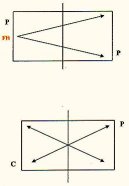
A)
- C topspins 1 chops 1 on FH diagonal, P blocks 1 and topspins 1, C blocks and P chops and so on (both play with control and keep changing).
- Same on BH diagonal
- C topspins on FH diagonal, P blocks straight, C chops on BH diagonal, P topspins straight, C blocks on FH diagonal, P chops straight etc.
- C straight, P on diagonal
B)
- High throw BH serve from middle, with sidespin or side and chop to FH short or long. Same serve with topspin long to the BH corner
C)
- Serve games from 8 -8, only server can win points
Articles
International Training
Michel Gadal (2005)
Michel feels that the training components necessary to achieve the highest performance are technical/tactical, physical and mental preparation and that at the top level it is the mental side that makes all the difference. There are certain basic areas in which players must be competent.
ADAPTABILITY
is one of the fundamental elements required to reach world class levels (players need to learn techniques to adapt to any given situation, whether these be material combinations, differing styles or methods of play, or unusual tactical ploys).
ANTICIPATION
is vital, the concept of ‘knowing’ and watching the opponent rather than focusing on yourself and what you are doing. In practice for example too many players tend to focus too much on themselves.
SPEED
covers a number of areas – the need to be fast, to create speed on the ball, to take it early, between the bounce and ‘peak’ and the ability to move fast, which should be taught in the early stages of a player’s career. If you play line balls at speed be aware too that 80% will be returned in the same direction.
PRECISION
and the ability to use the table are important. Top players use the corners, the lines and wide angles and hit to the crossover – weaker players play mainly to the middle. A study in 1989 indicated that it was better to play the ball 20% slower but deeper, right on the white line. This opens up the match, gives much better results and creates more opportunities to gain a real advantage.
CONCENTRATION
– table tennis is after all a competition between two brains! You need to be able to focus on the right elements and learn not to be distracted and also practise maintaining focus during the non-playing time.
Each time a coach is coaching he should ask himself whether he is including at least one of these 5 elements (Adaptability, anticipation, speed, precision, concentration). Coaches often know much about technique but not enough about the game. THE GAME IS MORE IMPORTANT THAN TECHNIQUE — YOU ADAPT YOUR TECHNIQUES TO THE GAME. Speed and accuracy should be increased together. In the case of service teach the various spins with at first wrist only. The appropriate service should be used according to the player’s own style and the game situation.
ADAPTABILITY
– a player must be able to give a good/appropriate response, preferably topspin with speed, to any ball. The technique may be with the whole body if there is time, or just with the wrist and elbow. The player should at all times train for the game. Practice should be aimed at the game situation. Sometimes it is more important for a player to adopt his own tactics and to learn from his mistakes. TRAIN FOR COURAGE – TABLE TENNIS IS A VERY RISKY GAME. Many coaches tell players not to take risks, but from the beginning we should train players to think for themselves, take risks and play in an unexpected manner and when the situation is tight to do a little more ( but without going crazy).
COACH FOR THE FUTURE.
The player should practise the game – his game – for the match and at the same intensity as match play. HE SHOULD TRY TO WIN EVERY SINGLE POINT.
The training hall is where players learn their trade. In practice partners can fulfil different functions, being at first totally cooperative, then 50% cooperative and finally competitive/difficult all of the time. Partners should be changed every exercise (around 30 – 40 minutes per exercise) so as to adapt to different playing styles. If a player is making less than 4 successful routines out of 10 then the exercise is too difficult but 8 out of 10 then it’s too easy. Make the exercises easier or more difficult but do not accept the player making too many mistakes. Also in practice teach refocusing in non-playing time to break the sequence of a high level of mistakes.
Regarding duration of exercises it’s good to change and not to be too rigid in timing. Be open to what is happening, listen to players and be flexible. Let players try things out in games and learn from their own experience. Before competition train as you would do in competition and schedule in breaks between exercises so that the players learn to wait between matches.
Technique should be taught for use in different situations. With young players first teach – ‘What should I do with the ball?’ Maybe it’s an arm action first, starting with the wrist and building up with the forearm, whole arm and then whole body (upper and lower body for power). (When the player is inconsistent use the whole body). Let players find their own movement and tempo. A soft hand is important for returning short service. Start with early timing even though this is more difficult. Start playing slow and build up to fast, rather than fast to slow. The timing is slightly later for the slow ball. Teach difficult techniques – what is hardest to learn – early. Young players are able to absorb advanced aspects more easily than you might think. The best age to begin learning is around 7/8 years. Build on something good or new in the player’s game and always be positive. A challenge needs to be given to the more talented player, possibly a more difficult task within the same exercise (playing to only half of the table instead of the whole).
Regarding competition players should always have a reasonable chance to win or at least to put up a fight. Players learn from playing from 9 – 9. Speed glue can be used by young players provided that they are training often – practice only 3 times per week no glue, train 12 to 15 hours use glue. Also let players try out different rubbers, perhaps 20 – 30 minutes per week in match play. In this way they will develop a better understanding of how to play against different material. Be flexible in teaching the flick – the timing and the action. There are a number of different possibilities.
Above all remember it is the player who plays, who wins and who loses. The coach should be ready to stay in the background.
Develop a Winning Playing Style
Carl Danner (2007)
So you’ve taken your table tennis seriously for a while and started to develop some reasonable strokes. But in matches you struggle to win points by any means possible and never achieve the flowing game the better players seem to have. What you need is a winning playing style – both to raise your playing level and to make your matches more enjoyable.
Indeed, there is an interesting contradiction evident in top world-class play. On the one hand, such players can presumably execute any stroke, probably quite well. Their choice of shots would appear limitless. On the other hand, world-class players use distinct styles that depend on the repeated execution of a few key strokes they seem to have mastered. How they decide what those shots are and how they compel their opponents to allow them to make those shots, are the key elements that they (and you) need to address in developing a style that will deliver more wins and fun.
Let’s go through the process of developing a playing style. These basics are useful both for relative newcomers trying to get started in the sport, as well as for intermediate or advanced players who aspire to further improvement. Even experienced tournament players sometimes have trouble putting it all together, and might benefit from a refresher.
1. What is a playing style, and how does it work?
Generally, a style has two parts. First, a style is built around a particular, reliable way to win points. It might be, for example, a strong forehand loop. It might be consistent backspin (or “chopping”) defence to force opponents into errors. Perhaps you want to throw repeated topspins at your opponents until they miss. Because modern table tennis rackets let players hit a wide variety of shots, there are numerous ways in which points can be won – a subject we address further below. But for an effective style, you need to pick one shot (or shot sequence) as your goal for how most points should end.
Secondly, a style uses all the shots you hit in a point to encourage your opponent to feed into your point-winning play. Conversely, a style also eliminates from your game other shots that encourage returns from your opponent that don’t feed into your winning approach. For example, if you prefer to attack your opponents’ topspin shots, then you will want to use serves that encourage such returns – and perhaps even give up the use of other serves that don’t, even if those serves sometimes win points outright. Likewise, a looper who wants backspin pushes to attack is better off serving low and short, rather than using deeper serves that will let your opponent topspin first.
2. Choosing a style to develop
For some players a style seems to develop on its own, while others may have to make a conscious choice of which one to use. Either way, at some stage it will benefit you as a player to decide what your style is, or should be. As a starting point, consider a winning stroke that’s already comfortable for you. Perhaps you have a strong loop, when you get a chance to use it. Maybe fast hands make your backhand counter-play solid. Some players take pleasure in manoeuvring their opponents around with steady shots that are hard to attack. Defence is still a viable option in the era of the bigger ball. Chances are that some combination of your best current shots and your personal preferences (how you really want to play) will make a good starting point for your style. Your regular opponents are another source of information about which aspects of your game seem promising, or hard for others to handle.
Here are some typical point-winning plays which top players have used as the foundation of a winning style:
- Looping forehands for winners;
- Counter-hitting steadily until opponents make errors;
- Quick, well-placed blocking;
- Top-spinning consistently from both forehand and backhand sides to outlast opponents;
- Outlasting opponents through consistent, passive defence (retrieving);
- Aggressive defence using spinny chops and aggressive counter-loops;
- Pips-out flat hitting;
- Looping aggressively (off the bounce) at the table for winners from both forehand and backhand sides;
- Counter-hitting to set up a consistent forehand smash;
- ‘Twiddling’ (using a combination racket with one dead and one spinny side) for a mix of defence and offence.
How can you choose from so many interesting possibilities? Physically, the relative quickness of your hands and feet are important. Quick hands are good for the close-to-the-table work of styles such as counter-hitting, flat hitting, or quick off-the-bounce looping. By contrast, fast feet are a necessity for a big forehand loop, any kind of defence, and consistent top-spinning. You should enjoy your preferred style, just for the fun of it and to help motivate the practice needed to pull the pieces together. So again, feel free to pick one you like.
3. Turning style into strength
Having chosen a style, it’s time to build it into a winning approach. To do so requires you to develop and perfect your weapon(s) of choice, while constructing the rest of your game to create opportunities to use that weapon. Let’s start with your winning play before turning to the other shots and rallying techniques that will let you use that play as often as possible.
Refining your weapon
It’s critical to develop your winning shot, or sequence of shots, into reliable weapons. It is important to develop tactics around the first three to seven strokes of any point as most rallies end within this number of strokes. Opponents around your playing level should almost always lose the point if they fall (or can be pushed) into the shot(s) you want to play. This means that your winners should not just be powerful, but also that they must be highly dependable. Remember – top players rarely miss their signature shots! For example, you should be able to make your loop kill or forehand smash (to use two possible examples) virtually every time they are available. As another example, if defence is your game, then your chopping, retrieving and/or pick hitting must be rock solid against the normal kinds of attacking shots you might encourage from opponents. By contrast, many players overlook the importance of reliability, and take high risks in trying for winners. A big swing that misses is no threat, just a lost point.
To build a consistent weapon requires an unusual kind of practice – that of hitting repeated winners, or playing repeated winning sequences. For example, a looper should practice looping pushes and service returns for winners, a hitter should smash numerous forehands, a steady spinner should play long topspin rallies to conclusion and so on. Or if serve and attack is part of your strategy, a significant part of your practice time should be spent serving and looping winners off the returns. Executing your winning shot or play should become second nature and should be practised frequently. Because so many points end just a few shots after the serve, it’s helpful to start practice points with a serious serve and return. Handling the transition from a serve and/or return into your attacking shots is a critical part of the modern game. The little touch shots that go along with this effort (such as a short return of serve, or a flick shot against a short serve or push) are also important to start the attack and to keep your opponent from starting his. Such “short game” skills often determine the outcome of matches between highly-skilled opponents.
This is also an area where good coaching can be important. It’s worth making sure of your technique for your winning shot, including paying an expert coach from time to time for a tune-up. If such assistance is not available in your area, consider approaching a top coach for some help during a free moment at a regional or national tournament.
Who opens, and how
To “open” in a rally means to hit the first offensive shot (usually with topspin). For some styles, it’s critical to open first. Strong loopers, for example, want to take the first swing, as do most hitters. By contrast, counter-hitters and defenders may prefer opponents to open, albeit against balls that can’t be hit for immediate winners. Players with quick hands may even invite attacking shots which they can block back forcefully.
In any event, you need to decide which player you want to open first, given your style. If it’s you, then you need to emphasize short, low serves and service returns, a good short game in general, and learning to attack every long serve (i.e., one that doesn’t bounce twice). If it’s just as well for your opponent to open first, then you can use more long serves (and long topspin serves especially), push a little deeper to your opponent’s weaker wing and learn to roll the ball (a gentle topspin) deep to the location from which you would like your opponent to make a topspin return.
By contrast, many problems occur if there’s a clash between your style and your strategy for opening points. For example, a blocker with a weak loop may not want to serve backspin or push very much, because it just sets up opponents to tee off on big shots. Instead, blockers might want to serve topspin to start their kind of rally immediately. As another example also noted above, a looper usually should serve and push short and refrain from serves or deep pushes that let their opponents open first.
Beyond these basics, there are many fine points of matching style and opening that can best be learned by watching high-level play. Select a top player or two who uses your preferred style and observe carefully how he or she serves (and opens) to get the most helpful returns. It’s even worth taping some matches so you can go back to verify, as questions arise, how a player of your style should handle a given shot.
Regaining control of the rally
Anything can happen when a rally gets going and you can’t always play points the way you would like. But you can try to force the flow of the point back into your strengths.
Basically, you have three choices when your opponent succeeds in starting the type of rally he/she wants (as opposed to the one you want). First, you can escalate your shots and try to win the point immediately. Secondly, you can play along and hope to prevail even on your opponent’s terms. Thirdly, you can try to reset the point, using a neutralizing shot to shut down the rally and let you try again for the opening play you prefer.
Of these options, the first can be worth trying if your opponent is very consistent, and highly likely to earn points played according to his/her style. In that case, you might have to take your first decent shot at a winner, even if the percentages are not favourable. More often, however, it’s better to de-escalate the rally through a neutralizing shot – such as a low soft block, a deep consistent topspin to your opponent’s weaker wing, or even a simple chop that forces your opponent to open again or push. That way, you can slow things down and give yourself another chance to get in position and bring your weapons into play.
As with the above discussion of opening, space doesn’t permit a full description of how players of different styles can use neutralizing shots. But watching how they regain control of rallies is another key technique to observe among top players who play the style you want to learn.
4. Conclusion: Pulling it all together
If you have followed the steps described above, you will have chosen your preferred style and method of winning points; you will have practised your best shots until they are highly reliable and you will have structured your serve, short game and recovery shots to promote the kinds of returns you want in order to execute your preferred tactics. These elements of a winning playing style should let you approach matches at any level (basement, club, or tournament) with the confidence of having a plan and the means to carry it out.
Indeed, if you are like most players, you may find yourself spending many months or years working on your personal style, picking up tips from like-minded competitors and even debating the merits of various styles with your friends. It’s all part of a varied and interesting sport, so have fun with it!
Moving Up a Level
Larry Hodges (2007)
What does it mean to move up a level in table tennis? I’d define two players to be on different levels if it would be a major upset if one defeated the other. Another way of looking at it would be to say that if the stronger player plays his normal level, he would win nearly every time.
Based on this, I’d say that a level in table tennis (using the USATT rating system) ranges from about 300 points at the lower levels (under 1000) to about 100 points at the higher levels (over 2500). For most USATT players, a level would be about 200 points. How can you move up a level? By improving all parts of your game, because one weak link in your game is like a weak link in a chain. You could work hard, dramatically improve one aspect of your game, and hope to move up a level. But it’s not that simple. Suppose you develop a really nice forehand loop. With this weapon, you would think that your level would go up dramatically. And sure enough, you will do better against players around your own level.
But when you play players at a level higher, their level is far enough ahead of yours that they’ll simply do something to disarm your new weapon. They may serve or push short, push very heavy, throw spinny or fast serves at you, use ball placement, block well, force backhand exchanges, play quick shots, or simply attack first to take your weapon (in this case your forehand loop) away. Often, stronger players will seem to win on one of their strengths, when in fact they are winning by exploiting a weakness of yours that allows them to use their strength. A strength in your game can compensate for a weakness, but only to a certain extent. A stronger player will simply set up his strengths by going at your weaknesses.
The lesson is that to move up a level, you need to improve your game overall, not just one aspect. A player who is a level stronger than you rarely defeats you with one aspect of his game; he does so by using the overall level of his game. There are, of course, players who have improved all but one aspect of their game and by improving that one final aspect, suddenly go up the coveted level! So how do you go about moving your game up a level? You have to be able to match the higher-level players on five key things:
- Returning your opponent’s serves as well as they return yours.
- Either rally as fast as your opponents do, or force your opponents to rally at your pace (by slowing the pace down with pushes, slow loops, controlled drives, etc.). Rallying at their pace can also mean reacting to their pace (i.e. blocking or chopping), because “pace” means both speed and quickness.
- Reacting to your opponent’s rallying spins (loops, pushes, chops, lobs, spins returned by long pips, etc.) as well as they react to yours.
- Ending the point (i.e. smashing or loop killing) as well as your opponents do. This can also mean stopping them from ending the point effectively or consistently by not giving them easy shots, or it can mean a series of strong shots that win the point.
- And finally, possessing at least one strength which threatens your opponents as much as their strengths threaten you. This includes having a way to get your strength(s) into play.
You may have noted that tactics is not one of the five “keys.” This is because tactics is part of all five keys. Stronger/weaker tactics simply make you stronger/weaker in each key. If you can do some (but not all) of the above five keys, your performance in a tournament will go up some, perhaps half a level, but not a full level. Developing a single “overpowering” strength won’t raise your level as much as you’d think, as opponents a level higher will beat you on the less developed parts of your game. Even players at your “previous” level will still often beat you by exploiting these weaknesses. But … if you work to improve all five of these keys, you may find yourself going up dramatically.
What’s stronger, a chain with four powerful links and one weak one, or a chain with five pretty strong ones?
Ten Tips for Future Champions
J.O. Waldner (2005)
Ten Tips for Future Champions , By Jan-Ove Waldner 1989 & 1997 World Men’s Singles Champion, 4-time World Men’s Team Champion, 1992 Olympic Men’s Singles Champion, 7-time European Top Twelve Men’s Singles Champion and many other titles. He is considered by many to be the greatest table tennis champion ever. Excerpt from book “J-O Waldner: When the Feeling Decides,” by Jens Fellke, sold by Pioneers (www.ping-pong.com) and American Table Tennis (www.americantabletennis.com)
1. Become a complete player
In order to win big titles, you must master play against all playing styles. Therefore, you must regularly practice and compete against players of different styles. The most important styles to embrace are loopers (maximum topspin), attackers (maximum speed) and choppers (maximum backspin).Another important aspect is play against left-handed players. I would like to remind you that both right and left-handed players spend 85% of their time playing against right-handed players.
To be successful against both right- and left-handed players requires well-developed technique and very good balance. I have had the advantage of practising a lot with left-handed players, e.g. Mikael Appelgren and Ulf Thorsell in my first club Spårvägen. Later on, in the Swedish national team, left-handed players were well represented: Appelgren again, Stellan Bengtsson, Erik Lindh, Ulf Bengtsson, Thomas von Scheele and Peter Nilsson.
2. Acquire point-winning weapons
Table tennis is a tough sport, exercised under a high level of stress. Often you have to play many matches per day. Therefore, it is important to be able to win simple and quick points. I have always been able to rely upon my serves, frequently directly point-winning. I have furthermore worked hard to follow up my serves with a varying forehand stroke. Spend some time analyzing which point-winning weapons you already possess. And remember that new weapons can be developed!
3. Develop a relaxed technique
Table tennis requires a tremendous amount of practice. Always try to play as relaxed as possible. This will increase your chances to play relaxed even in tight situations and at the same time decrease your susceptibility for injuries. Personally, I have managed to avoid lengthy injuries, which is one of the reasons why I have been able to remain at the top for so many years.
4. Play a lot while young
Table tennis requires advanced motor coordination and dexterity. It is therefore important that you learn technically as much as possible before the age of about 13. As long as you still have fun, practise and compete as often as possible. Use your imagination by continuously trying out new strokes, even during matches. Try a new strategy in the middle of a game. Consider a deuce in the deciding game as a challenge to test your most effective serve, or a new type of serve return.
Remember that your career in table tennis is quite long. When feeling bad about a loss, try to think instead about the next tournament and how you can improve.
5. Master three distances
Many players master play from only one or two distances. My recommendation is that you consciously practise play from all three distances after the bounce as indicated below:
- Distance 1 - ball on its way up: You must hit the ball before it reaches its highest point after the bounce. You should learn to use short and quick strokes with little backswing.
- Distance 2 - ball at its highest point: You should learn to use a relaxed technique when hitting the ball at its highest point after the bounce. A large variety of strokes can be successfully applied at this distance.
- Distance 3 – ball on its way down: You hit the ball after it has reached its highest point after the bounce and on its way down. This distance requires a technique where you use a large forearm movement before ball impact.
6. Study good players
Watch as much table tennis as possible. Study video recordings, both of yourself and world class players. In particular, I used to study the Hungarian player Tibor Klampar. His wrist movements and ball hits were of extraordinary quality. By studying a number of Chinese players, I learned to appreciate the importance of developing effective serves.
Try to imitate certain players in order to get a better understanding of advantages and disadvantages of different playing styles, racket grips, movement patterns, etc. In the Swedish national team, we have throughout the years very much enjoyed mimicking different players. Erik Lindh is a master at imitating many of our opponents.
7. Analyze your opponents
Only when you are up against a player the first time can you get an appreciation of, for instance, the quality of his or her forehand loop. Therefore, enlist the help of those of your pals who have played the person in question. Bring forward to discussion all relevant details. Remember that there are many ways to win matches in table tennis. The better prepared you are, the greater are your chances. The margins in this game sometimes appear minuscule, but it is always the best and most professional player who profits from them.
8. Use your head
Mental strength is a vast and important subject and perhaps the most difficult characteristic to develop through training. Personally, I have developed a way to think and act that I believe suits my personality. The starting point must be yourself, in my opinion.
Mental strength is based on experience and acquired knowledge about your sport. Listen to the advice of others who you trust but remember that, in the final analysis, you must rely upon your own judgment. When I was younger, I studied in detail many successful Swedish athletes, including Björn Borg (tennis) and Ingemar Stenmark (alpine skiing). I was impressed by their calmness when competing. Over the years, I have learned to analyze my losses and then forget them as quickly as possible. To the contrary, I do carry around memories of my victories in order to boost my self-confidence.
9. Be respectful
A table tennis match is decided in a short time and it does not take much to lose by underestimating your opponent. It is important to graciously accept losses and to show respect for your opponent. Whether I win or not, my strategy has always been to keep a low profile.
10. Think long-term
To conclude, I would like to emphasize that it takes a long time to become a good table tennis player. There are always new things to learn. Try to think long-term and avoid focusing too much on results when you are young.
If you aspire to compete with the best, you must walk a narrow road. You must realize that only a large amount of training and tough training, will lead to the goal. The principle applies both to training at the table and to physical conditioning. However, don’t forget to now and then have some fun and experiment a bit. Occasionally, you will discover something that will be useful in match play.
Good Luck!
What it takes to be a Champion
Sean O’Neill (2007)
Does it take determination, discipline, desire, or maybe God-given talent, superior genes, the perfect playing environment and just a little luck? No single component by itself will make you a champion, but clearly the more key ingredients you possess, the brighter you will shine in table tennis and in life.
You have no control over who your parents are, so there is little benefit in spending time worrying about your genetics. For most American players, having an Olympic-level coach or full-time club in your backyard is unlikely, so there is not much point in being upset if you don’t have these. Good-luck charms or being Irish won’t suffice either, so what can you do?
The good news is that you do have control over many of the ingredients that help create a champion. A burning desire to succeed, the love of competition, an eagerness to improve and an understanding that each match possesses golden nuggets of knowledge that you can learn from are all important pieces of the puzzle. Remember, becoming a champion isn’t a part-time job, but a full-time commitment to excellence.
The pursuit of excellence is the fuel that champions rely on to push themselves to higher levels of play. It is said that it takes a something extra to make a champion and this is true. For those who would like to take the journey to the top of the mountain, here are ten winning traits to keep in mind. No one is born a champion. It requires many years of hard work and dedication. The journey begins with one small step and a belief that “I can and I will.”
1. Champions enjoy hard work
Serve practice, multi-ball, footwork drills, running, weightlifting and video analysis aren’t always the most fun activities, especially after a tough loss. However, approaching these tasks with vigour will provide a springboard that will let you leapfrog the competition. Champions use tournament results as feedback to adjust their workouts and goals. The day after a rough tournament, don’t be surprised to see a champion be the first to arrive at practice and the last to leave. During practice, each point should be treated with value and nothing should be taken for granted.
2. Champions plan for success
Remember that failing to prepare is preparing to fail. But, what is your plan for success? Do you intend to cram on Friday night before a tournament or hope to “get hot” in the final in order to achieve success? Champions don’t hope for victory, they plan for it. Becoming a champion takes time and requires thoughtful planning. Create measurable goals with timelines that are realistic based on your performance and rate of improvement. Write down your daily, monthly, and yearly goals, and place them in your racket case to review before and after each time you play.
3. Champions are confident and optimistic.
We play the ultimate individual sport: there is no one to hit a homer while you are on base or sink a free throw while you are on the bench; the ball is in your hands and hopefully on your racket during each rally. You must believe in yourself, if you expect to succeed. Champions know that with proper preparation they will play their best and thus they can rightfully believe they can come out on top. When the score looks bleak, they know it only takes one point to start a great comeback. If someone just pulled off an upset, interact with them. Ask them how they did it. Their positive energy will be contagious. At practice, look to associate with players who have self-confidence and high expectations. Negative thinkers and pessimists are powerful energy zappers who should be avoided at all costs at tournaments.
4. Champions visualize success
If you can imagine it, you can achieve it! Champions understand the importance of mental imagery and visualization. This is a common skill most youngsters have until adults begin to tell them that they can’t do something. Prior to practice and competition, it is prudent to daydream about the perfect performance. Find a quiet place to relax and close your eyes. Imagine hitting that winning shot against Waldner or beating an upcoming opponent. The more vivid the imagery, the more powerful the impact. Your subconscious mind doesn’t know the difference between real and imagined events.
5. Champions are consistent
Champions know that success is the direct result of commitment and discipline. After a successful tournament, when it would be easy to take it easy, champions don’t break their stride and often take it up a notch. During events, champions know how to run their own mental program during matches and don’t wait until it is too late to make adjustments. Champions don’t get too excited when they perform their best nor get too nervous when they aren’t playing well. The key to being consistent is playing within oneself and not attempting risky moves that aren’t dependable at crunch time.
6. Champions are focused
Champions know that you can train hard and prepare well, but if you don’t have 100% concentration during competition, the chance for success will be haphazard. Before important matches, leave the building, take a break, clear your mind, and start to get focused for a point-by-point war. If you can win the battle of minds, you can play relaxed and at ease, but your attention must be on the task at hand. When your mind starts to wander, use a dependable technique like breathing control to re-focus your attention. Revisiting your written goals on a regular basis will make sure that you are always focused on your long-term success.
7. Champions are creative
Champions understand the need to think outside the box and to create their own unique style and strategy. Always following the lead of others, or becoming a carbon copy, is a recipe for mediocrity. Be original. Have your own set of serves. Learn from the best players. But, modify their skill set to fit your needs. Don’t be afraid to add parts of other games into your own unique style.
8. Champions never quit
Far too many comebacks have been lost when players gave up a point too early. In our new eleven-point scoring system, amazing comebacks are at hand, if one is willing to believe the game is never over. Momentum is huge in table tennis, and failure to give an inch on the final point of a game will often lead to a shift in momentum for the remainder of the match. Regardless of the score, a champion knows anything can happen, in either direction.
9. Champions help others
Champions know that by helping others you are helping the game. Coaching or encouraging others before or during a tournament will only help you in the long run. Don’t be afraid after a match to speak with your opponent or their coach to share thoughts on what happened. While all of us enjoy easy victories, it is the hard-fought matches that stay with us the longest. When practising, much can be gained by working with lesser players in the areas of consistency and control.
10. Champions love the game
The final trait which champions possess is a love and respect for the game. They recognize the past champions for their greatness and look to them for inspiration and guidance. Even when doing something else, champions figure out a way to tie it to the sport and use it to help their skills improve. With a love of the game comes the enjoyment of a difficult challenge. This desire and need to be tested will allow you to be at your best when your best is needed.
The Improvement Pyramid
Richard McAfee (2007)
For any athlete looking to be a champion, it is indeed a long path towards glory. Studies of Olympic Athletes have shown that it takes about ten years of organized training to achieve elite status. Within the Sport of Table Tennis, there is a definite progression of skill development. To help my students understand where they are on this developmental path, I have created a tool called, “The Pyramid of Success.”
The Pyramid shows the nine developmental stages that athletes go through on their journey to becoming a complete player. See if you can locate where you are on your own personal journey towards becoming a champion.

THE STAGES OF ATHLETE DEVELOPMENT
Stage 1 – Basic Stroke Techniques
At this stage, athletes are simply learning the fundamental techniques of the game such as basic strokes, elementary spin theory, simple serve and return and the rules of the game.
Stage 2 – Basic Stroke Combinations
Once the athlete can control the basic strokes, the coach then begins to combine these strokes together to form combinations, bringing together both forehand and backhand techniques. This combining of strokes also requires that the athlete begins to move more and lessons in footwork start at this stage.
Stage 3 – The 5-Point System
When the athlete can control the basic stroke combinations, the focus is turned to learning how to play points. As most points in a game are finished by the fifth stroke, the emphasis is placed on the first five possible strokes of a game. As all points must begin with either a serve or a return, these techniques are stressed during this stage. Third and fifth ball attacks are introduced, as well as fourth ball counter attacks or defence. The goal of this stage is to move the athlete from thinking of executing one stroke at a time, into planning out whole points.
Stage 4 – Style Awareness
During stage three, the athlete’s natural style begins to express itself. It can be seen in how the athlete chooses to begin putting his points together. Does the athlete naturally prefer to hit rather than loop? Does the athlete have natural early or late timing? Does the athlete prefer to play close to the table or at mid-distance? These and other telltale signs start to show as the athlete learns to play whole points. During this stage athletes should be introduced to the basic styles of the game, through written materials and the use of videotapes. He or she should watch the better players at the club and place these players into style categories. Finally, the athlete should write a complete description of his or her own style. An athlete’s style is normally a blend of two of the major styles.
Stage 5 – Advanced Stroke Techniques
Now that the athlete understands what his style will be, he must begin to learn the advanced techniques necessary to complete that style. What these techniques are will vary greatly from style to style. Pips-out hitters, all-round topspin attackers, and choppers all need to learn very different techniques.
Stage 6 – Advanced Stroke Combinations
Once these advanced techniques are learned, they must be combined with the athlete’s existing strokes and blended into the desired style of play. During this stage, the Five-Point System is revisited and practised using the new combination of advanced strokes.
Stage 7 – Self-Awareness
At this stage, the athlete has all the technical tools necessary to execute his desired style of play. The focus at this level of development is on gaining match experience and learning how to use his style to defeat opponents at International Level. As the athlete is still somewhat inexperienced, he is still focused rather more on what he is attempting to do than on what his opponent is doing. The athlete has become self-aware but often cannot focus outwardly towards his opponent.
Stage 8 – Refining Style
As the athlete begins to gather more and more match experience, he will continually be making small corrections and additions to his style of play. Ideally, athletes will return to this stage over and over again throughout their competitive life. When an athlete stops learning and improving his game, his development is over.
Stage 9 – Full Awareness
This is the stage of development that all athletes strive for. It is often called “the peak experience.” During this stage, the athlete is almost totally focused outside himself. Fully aware athletes often report feelings of time moving more slowly, the ball appearing larger and feeling that they can do anything they want to do with the ball. While most athletes experience this “peak experience” at some point in their lives, the fully aware athlete can reproduce this experience much more often.
Important Points
Please remember that an athlete’s development does not follow rigid, set stages. Rather, it flows as a process with each athlete spending more or less time in any one stage, as needed. Movement is not always in an upward direction. Sometimes, an athlete will need to return to a lower stage to correct some problem or learn material that was missed.
Most coaches feel that it takes about ten years of training to take an athlete to the top of their game. Hopefully, the Table Tennis Pyramid of Success will give athletes, coaches, and parents, a guide to understanding the athlete’s journey towards reaching his goals. While many try to become champions, only a few actually make it all the way to Stage 9. In fact, some athletes will stall out at each level. These athletes will make up the majority of players who participate in our sport. For that reason, it is important for everyone involved to understand that “the quality of the journey is more important than the destination.”
The Pyramid of Success not only represents the path of the athlete but also the overall development of our sport. There will always be a smaller number of athletes at each increasing Pyramid Stage. The greater the numbers of athletes entering Stage 1 of the Pyramid, the greater the number of elite athletes produced and the higher their level will be.
The Coach
Clive Woodward (2002)
If you want to compete by playing and thinking differently, you must work with coaches who have a similar mentality.
A good coach opens your mind to new possibilities and plants the idea that to win against the best players in the world needs a whole armoury of playing tactics. Just like there are no rules in business there are no rules in sport. It is all right to question traditional thinking in others, who do things in certain ways because that’s the way they’ve always been done.
Good coaches don’t necessarily take credit for a lot of original thought, they crib and steal and plagiarise wherever necessary. But they know the essentials – if the players cheat in training, they’ll give less than their best in matches and in life in general. The first chance to win is usually the best chance, so the player had better make the most of it.
THINKING LIKE WINNERS
Thinking correctly –
- Make training fun and games enjoyable.
- Have your own style, do things differently and in your own way.
- Build success, build on your strengths when you win, learn from your mistakes when you lose.
Plan, organise –
- Commitment, do players have the same level as the coach?
- Help in key areas, can players organise their own mental and physical preparation?
- Support structures, can other club members and family etc. get involved?
Coach to the player’s individual style –
- Does the player know where he/she is going and how to get there?
- Does training suit the player’s developmental pattern.
- Is there a suitable level of competition and sparring (even if this means working abroad).
When you’re participating, your interest is to become actively involved in a sport or pastime and to enjoy being involved in the game. When you become serious about your game and about securing victories then you have elevated yourself beyond participation to a level of competition. It is only when you begin playing at an elite level compared to those around you, when you become obsessed with doing whatever it takes for victory, only then that you are operating in the realm of winning.
THINKING DIFFERENTLY
Too many people do things using conventional wisdom, ‘because that’s the way it’s always been done’. Inherited thinking is a curse. It’s the biggest impediment to thinking in any organisation. Before we do anything we have to change the way we think. Not just on court but off it too. We have to learn to think differently about every aspect of what we do. One of the toughest skills to teach any athlete is how to think.
There are two parts to this concept – lateral thinking or thinking differently and vertical thinking or thinking detail.
SUCCESS
Hannibal won his wars by doing exactly the opposite to what his enemies thought and to what tradition had always dictated.
Never doubt that a small group of thoughtful, committed people can change the world. Indeed it’s the only thing that ever has.
To create success, everyone’s nose must be pointing in the same direction.
As a player or coach I’ve never seen the benefit, when faced with a powerful opponent, of buying into the ‘mystique’ of their strengths and successes. To focus your attention on your opponent’s strengths leads either to revering or fearing them. You cannot spend enough time analysing your opponents but this needs to create respect and not fear – there is a huge difference. Equally important are your own strengths and addressing your own weaknesses and also finding areas that will set you apart from the opposition.
It’s not all about skills. It’s about attitude and the effect on other players in your squad. One wrong team player can sap the energy from the group.
We are so often let down by our performance under pressure and in our preparation. There seem to be a thousand things to distract us at any one time. We have to improve our efforts in preparation off the court before we can see any consistent improvements on it.
How do you want to be remembered? You are a National elite player. You must take the full responsibility that this honour brings to you. Nothing must be left to chance and absolutely no ‘if onlys’ or excuses are acceptable.
WINNING BEHAVIOUR
- Body language, self-control, handling the pressure.
- Identify opportunities.
- Decisiveness.
- Time management.
- Momentum.
- Work-rate.
- Stubbornness, never give in.
- Think correctly under pressure.
QUOTES
I learn from the past — but I dream of the future, for that is where I want to spend the rest of my life.
Winning is not a sometime thing; it’s an all time thing. You don’t win once in a while; you don’t do things right once in a while; you do things right all the time. Winning is a habit. So, unfortunately, is losing.
In professional sport where winning is the only thing that counts, you cannot compromise on anything you do.
Champions aren’t made in gyms. Champions are made from something they have deep inside them – a desire, a dream, a vision. They have to have the skill and the will. But the will must be stronger than the skill. Muhammad Ali.
Coaching with Carrington
Jack Carrington(1960’s)
Defenders
In match-play a ‘good chopper’ spells certain death to –
- The beginner and intermediate player
- The unskilled player
- The lazy player
- The impatient player
- The gambling player (at least the bad gambler)
- The unfit player
Techniques against chop –You cannot be content with just ‘not losing points’, you must win some points by your own actions. There are a number of different methods of tackling the good defender.
- Drive two or three 80% balls, push or drop one
- Same as 1 but switch to different targets (bear in mind the body is always a good target)
- Play a selection of slow push shots all over the table, then attack hard
- Vary loop (slow more spin) and loop-drives (faster more speed) interspersed with drop shots and hard hits
- Use BH or FH depending on the situation and your own capabilities
Situation Assessment
- At this moment, in this rally, what is my situation? Am I ready for this next ball? With a plan? Balance good? Strength good? Eye clear? Touch good? Confident?
- At this stage of the match what is my situation? Could this be classified as – dominating, advantage, neutral, disadvantage, desperate? Have I a lead in games, or on points in this game? Am I on the upgrade physically and mentally or on the downgrade?
NB. On your answers to the above will depend the degree of risk or enterprise which you can afford for the next ball/points. ‘Dominating’ or ‘Desperate’ are large, dramatic canvasses, painted in bold colours for all to see. It is in the ‘neutral’ situation that most mistakes are made. The ‘neutral’ situation is one in which neither player has any automatic advantage and neither can reach an ‘advantage’ position unless he shows successful enterprise, or his opponent tries to show enterprise but loses. If you are foiled by a superb defensive return or an acute angle, stabilise the situation with neutral play. Another neutral situation occurs when both players are driving fast and it’s difficult to secure an advantage because the rapidity of play prevents you from doing anything clever. In this situation can you angle or slow the ball suddenly or even step back and use the extra space and time to feed in more power or spin? In practice situations train to progress from neutral to advantage. Remember neutral play is only a pause in the main design. Too many ‘top’ young players seem ashamed to resort to neutral play, when even the greatest of champions are seen to accept the necessity of using it from time to time.
Guidelines
- If a ball gives you an advantage – take it
- If a ball puts you at a disadvantage – play for safety
- If a ball is ‘neutral’, play ‘neutral’ or ‘enterprising’
- If a ball puzzles you, play ‘neutral’
- If a ball surprises you – relax body and grip and play light
- If you are desperate – play bold
Defenders
- Long-distance chopped balls
- Long-distance floats
- Close-distance chops/pushes or block/stop-block defence
- Deep topspin defence – long and low (not too fast, use more topspin) or high-lob defence
- Hard counter-drive
- Sidespin returns
- Serve and 3rd ball
- 2nd ball flick/attack
Topspin Timing Points
Of the 5 timing points for topspin only one, E, is below table level. It is necessary to learn to contact the ball at differing stages in the trajectory.
- Against chop in order of – C, D, B, E, A.
- Against topspin (using FH) – C, B, D, A, E.
- Against topspin (using BH) – B, A, C, D, E.
Steady topspin is one you can repeat 100 times with only 5 mistakes or less. When you can spin consistently from each individual timing point the next stage (in 20’s with no mistakes) is to switch from one timing point to another without losing consistency. Use the knees, hips and shoulders to adjust the contact height. Use variation in power with consistency.Use variation in direction with consistency.
Remember fast explosive situations create excitement – excitement creates body tension – body tension is the enemy of soft touch and block strokes and change of pace. Keep body and knees relaxed whenever possible. The coach’s aim is to increase the desirable speed in any of the skills. What is desirable? To the extent that you have control. Control speed is the maximum speed at which you can operate at 85% consistency and still select targets on the table.
Speeds
- Speed of thinking – early recognition of ball or situation
- Speed of thinking – early decision on your action
- Speed of feet – early arrival at good position
- Speed of feet – quick recovery to alert position
- Speed of arm
- controlled speed of arm
- controlled speed of rotation and body weight
- controlled recovery of arm and body
Work on the areas where you are weak.
7 Point Winning Weapons
Rowden October 2015
Many players play, but don't think. To be successful at the higher levels a player needs to know how he/she plays best, which are the best weapons and against which type of opponent.
What works against one opponent may play straight into the hands of the next. No player can play the same against all varied opposition. Each player needs alternatives, the capability to change when his/her usual tactics/strategies don't work. Players will have differing strengths and weaknesses in strokes, serve/receive, movement, will and mental powers etc, but tactics, techniques and strategies will be based on the seven point winning areas. Players need awareness of the areas in which they excel and the capability not only to utilise more than one area effectively, but also the instinct to switch in and out of differing areas as and when applicable.
Speed : This is the first and most important area in table tennis. If you are faster than the opponent in all areas of speed, thought, reactions, movement, stroke and timing and can cope with everything he/she throws at you, then his/her chances of beating you are slim. Unless the opponent changes something. So just what can you do when it's the opposition which is faster? Play short, slow the game down, take time with your serves, try to return the opponent's fast serve/ball with a slow return. Don't be predictable, vary pace, spin and placement, hard and soft, into the body and straight not diagonal, use the angles. A stop/start type of game is much more difficult to adjust to for any opponent. Also use your set pieces, serve and 3rd ball etc. Remember too that the plastic ball slows dramatically and even many top players have problems with the slower, dying ball.
Power: This is particularly important with the plastic ball. Players who have the ability to use real power effectively, rather than just keeping the ball on the table, will have a big advantage with the new ball. Of course this also means being able to keep the ball in play and selecting the right shot at the right time; shot selection assumes rather more importance. Players can still play off the table with topspin but now power comes into the equation more than spin. Playing with plastic, more balls are going to come back and it's important to realise this and to be really effective with the kill shots, both in power and placement. But also the short drop ball is equally very efficient, as the plastic ball dies quickly and this is another good tactic against opponents who want to back away and lob. Against players who are more powerful than you it will be necessary to limit their power or use this against them. You can play faster than them to limit their preparation, make them play more short or over the table, play stop/start or short/long to disrupt their play or return power with speed or lack of speed or more or less spin.
Placement: With placement it's vital to use all the table, short and long, straight and diagonal, to the body and crossover and also to the wide angles. Remember some short shots and extreme angles will need early timing and some feeling (soft hands). Early in the game look for areas where the opponent has problems; into the crossover, straight or wide to FH then back to BH. All players, whatever their level will be less effective and will be weaker against certain serves/strokes or in certain areas of the table or against certain combinations. It's just a matter of identifying these and using them, while avoiding the opponent's strengths. Players who place the ball well are the hardest of all categories to come to terms with. They are able to place the ball so well that often they limit your options to return or make you return to an area of the table where they are waiting. What you need to do is work out how to disrupt the pattern and return the ball where they don’t want it.
Spin: There will be less spin with the plastic ball. The Chinese National Team tested the 38 and 40mm celluloid balls and there was a reduction in spin of some 12% with the larger ball. The 40mm celluloid ball was manufactured within certain parameters between 39.5 and 40.5mm. The plastic ball is 40mm plus up to a maximum of 40.6mm but the polymers are very different and the spin noticeably less, resulting in a further reduction of some 24%. Obviously this impacts on a number of areas in the modern game. The topspin game off the table will be less effective and it's easier to counter with a block or hard hit/drive as the ball comes through slower and tends to ‘sit’ up after the bounce. However the slow spin can be quite effective as the ball drops quickly below table level. It's possible to serve with substantial spin but this is lost quite rapidly as the rally progresses. Against players whose spin causes you problems you have to limit their opportunities to create maximum spin or when they do, use this against them. Play faster and reduce their time frame, play short and over the table, play the stop/start type of game, or block soft (throwing their spin back) or force through the ball giving them little chance to continue spinning.
Control: There are often longer rallies with the plastic ball, due to less speed and spin and a higher bounce. Players will need to focus more on control and shot selection and those who like to finish points quickly in the rally may often try to force the play too early. Control overall will assume a higher priority, especially in the women's game and it will be necessary for players to be able to keep the ball in play while they look at using differing strategies to win points. Against players who have a high level of control, patience is important and the ability to make openings to use power, spin, or slow balls, or to disrupt the play with variations for example in placement, pace or spin. The stop/start type of game is the most difficult for good control players.
Slow Balls: It is a fact with the plastic ball that short returns, slow spins and drop shots over the table tend to slow down or ‘die’. This can be of advantage when slow spinning a backspin serve half-long or when dropping a lob short off the bounce, rolling a slow ball with short pimples or when playing defenders and should not be overlooked within your tactical and strategic planning.
Set Pieces: Serve and receive now have a different emphasis. It is more difficult to serve really short and tight to stop the opponent attacking. Many coaches and top players feel that the service is no longer such a big advantage, or that the balance is even swinging in favour of the good receivers. It is a fact that sidespin is now the most important spin in the server's armoury (often combined with either back or topspin) as this helps to keep the ball lower over the net and after the bounce. Service is also favouring half-long or longer serves as opposed to the very short variations.
Dropping very short from an early timing point is still an option against shorter serves and the flick is also more effective. It is therefore important both in the men's and women's games for all players to upgrade their short play and maintain this at a high level. Aspects such as playing against the sidespin to achieve extreme angles or fading the flick should also be researched.
Serves, in the women's game especially, have always been longer but this will now almost certainly increase as will the focus on third ball play in an attempt to win points earlier. Even against the fast long serves however there needs to be variation in receive, not only in spin but also in speed. Players who use pace on the long serve want pace on the return. The capability to return a slower or shorter ball against a fast serve is a viable option. Receivers must research varying methods of receive and the second and fourth balls will be of particular importance within the framework of the rally.
Summary: What becomes vital if you are to reach the higher levels of our sport is the ability to think strategically. Few players will be equally strong in all seven areas but most top players will be strong in at least four or five. You need to identify which are your best areas, then how and when to user them. Each opponent you face will be strong or stronger in some of the seven areas. You need to identify (and quickly) which are the opponents’ strengths, how to counteract these and then how to use your strengths against them.
Within all of the above it must be considered that at the moment the plastic balls are not uniform either in quality or behaviour. Differing brands of ball behave in different ways and breakages and strange bounces are common. Equally differing brands have different characteristics in terms of spin or control so for players even at quite a high standard we do not yet have a level playing field. The advice has to be, find out which ball will be used at your next event and train with this beforehand.
Excellence
Rowden December 2020
Excellence is not the result of some gene you were born with, some great talent or skill you possess, which you never had to work for; though some athletes do have some marginal physical or mental advantages, better stamina, faster reactions, bigger size, more explosive speed, higher level of concentration, the list can be quite extensive.
The clue is in what Jesse Owen's coach said about him in the 1950's. 'He has probably the greatest athletic talent any coach has ever seen and would have been world champion in some events had he been coached by the local postman. In May 1935 he broke or equalled six World Records in less than one hour. He broke world records in events in which he never normally competed. But it was never the talent which produced such excellence; it was the approach to training, the dedication and work-rate. Jesse would still be out on the track training when everyone else was in the showers and finished for the day!’
To achieve real excellence is never about talent alone, it's about ATTITUDE, how you approach your sport, what time and effort you put in, about who you listen to and how to filter and analyse what you hear to make the best use of it. It's also, whether you understand it or not, about you controlling and developing you in the best way for you, you can't reach the dizzy heights by copying others or working to somebody else's program.
Game Management -- Seminar
Rowden April 2019
‘The ability to adapt and to be effective, whatever the style of the opponent’.
There are 3 main areas to consider:
Mind – Players can react in 3 ways to stress:
● Making excuses and giving up (players find it’s less painful to give in and get off the court, rather than being humiliated). Remember however – ‘It’s not the one who loses who fails, but the one who lies down and gives up’. Try to continue to play for points and to fight and think to try different things. Watch the opponent’s face for signs of weakness.
● Getting angry either with conditions/circumstances or themselves. Anger causes tension and leads to worse shots and restricts logical thinking. There’s no point in getting irritated over aspects beyond your control, you have to accept these and get on with the game. The one thing you can control is you, try to stay calm and direct your focus not internally, but on your opponent.
● Becoming afraid and this often happens when you are ahead in matches and the opponent starts to come back. This is when it’s easy to stop playing or to start playing safe so as not to lose. What you should be doing is thinking – ‘What have I been doing so far to get ahead and why don’t I just continue doing this!’ Interestingly enough this is really the last stage before becoming a winner and you just have to stay calm and get over this last hurdle.
The secret to success is being calm and relaxed, this is the state in which you think clearly and can plan the tactics against the opponent and judge when and what changes are needed in strategy.
Style/Technique
All opponents are different and you have to be able to cope and adapt. There are 2 main aspects to consider:
● There are many differing styles out there and many different rubber combinations to deal with, so how do we go about dealing with this? Because much of our own play is automated it’s vital (as Waldner states in his book) to train against all styles, defenders, blockers, loopers, drive and pimple players, and left-handers.
● As our sport is so fast and much of the play over the table is below normal human reaction time, we all learn to play on autopilot. The one aspect which upsets autopilot is when we come up against something new or different which we don’t fully understand; it’s then that the automatic systems break down and we have to start thinking consciously which is of course much slower. It is therefore most useful to develop new things, serves, receives, strategies which upset the opponent’s rhythm.
Alternatives
The final area to consider in depth is that of alternatives. What answers can we find to cope with the problems already stated? We should of course aim to be less predictable so that opponents have more difficulty coming to terms with the way we play! We can do this in a number of ways.
● Train with varied placement, in:
o Width
o Length
o Tempo
● Use slow balls and sidespin
● Serves – Use many long serves with speed. Against the long serve return with control
● Short serves – Here you need to serve with quality. When returning use all 3 receives, short drop, flick and long push fast and early with or without spin
● Use more long pushes over the table
Plastic Ball
● Stay square to opponent (especially when close to table)
● Use shorter strokes and keep racket up, above table level
● Play strokes forward, go to the ball
● Ball slows over the table, the start of the stroke is more important
● More attention to placement and to in and out movement
● Use more slower/softer balls with spin or float
● More long serves in last 10 cms of the table and with speed
● More long pushes over the table
● Short serves and receives require more quality. On receive flick and drop short from as early a timing point as possible. With the long push use early timing with speed and vary spin
● All expect a faster game so tempo variations are important
● Develop BH strength overall and in case of women use BH from the middle of table in fast play
● Maintain good physical fitness to cope with longer rallies
● Good overall technique with no major weaknesses needed to reach top levels. This applies to all areas, serve/receive, short play, drive, smash and spin production and on both wings
Game Management
Rowden March 2018
In our sport it’s not necessarily the best player who always wins. It is the player who manages the game best and who is able to adapt and change to cope with differing opponents and situations.
To do this effectively requires focus and attention, to actively assess exactly what you have to change to cope with constantly variable circumstances. This means of course that you need to be calm and unruffled in attitude; if you are afraid, irritated, angry or upset it becomes much more difficult to stand back and to estimate objectively which is the most effective course of action that will work to your best advantage.
So what changes may we need to bring in to win games or cause maximum problems for the opposition? For a start what is the style of your opponents and which type of game do they prefer to meet? Do they like a fast game so they can use the speed against you? Do they play steadily and wait for you to open so they can counter? Do they use various spins to create openings so they can kill the ball and win points? And from your side of the table, which parts of your game are they comfortable with and which aspects cause them discomfort? Once you’ve identified how your opponent likes to play and what he/she doesn’t like about your game, then you’re in a position to start to make changes.
So just what types of change are available to you, to create advantage for you and put pressure on the opponent? Placement is of course the obvious choice. Most top players don’t play several balls to the same place, they don’t set up patterns which the opponent can use against them; instead they are unpredictable, wide angled balls off the side of the table, straight balls down the lines, balls to the crossover/body and there is of course constant change of direction so the opponent doesn’t get the opportunity to settle and plan counter-measures. Next is change of pace, hard and soft, short and long, so that opponents are not able to settle to a constant length and instead are obliged to move in and out in relation to their table position. Also do not underestimate the value of sidespin with the plastic ball and consider the use of the slower ball, which often does not come through to the opponent or stops short over the table.
But of course most important of all it is necessary that you have the weapons to be able to change things. If for example your opponent can’t handle short serves this doesn’t give you any advantage unless you are able to actually serve short! It is therefore vital that you have alternatives in all aspects of your game and that you are capable of initiating change when required and have the capability of playing differing types of strategies in differing situations. For example against short serve you will need short touch receives, long quick pushes with and without spin and attacking flicks from differing timing points, against long serves, topspin, drives, the full variety of differing blocks and even some chop returns. Again alternatives are required in the rallies too; against attackers, the ability to counter with topspin or drive, to use varied blocks, sidespin and even chops; against defenders the ability to spin slow or fast, to drive hard or even push off the bounce with or without spin to create openings.
But above all it is more important than anything else that you don’t fall into the habit of playing as you WANT to play: WINNERS do what they NEED to do to win.
Path to the Future You
Rowden June 2021
Habits can be good. In fact over 40% of our actions in any one day are habits not a result of conscious thought.
The brain welcomes habits because they enable us to do simple everyday tasks on autopilot, releasing the brain to focus on more important aspects. The automatization of your actions frees up energy that can be used to focus to other tasks. This can work to your advantage! But problems occur when bad habits become automated and you get locked into actions which are counter-productive.
Our sport of table tennis is largely automated, which it needs to be, as it is too quick for us to have to consciously think of every response to the opponent's actions. But there is danger in this automatization. We become programmed to play in certain ways without enough variety and innovation. If we are not careful not only can the number of alternatives we use become too few and limited and we become predictable and easy to 'read', but the much bigger danger is we stop thinking and become too fixed and narrow in our tactics and strategies.
This mental aspect is particularly crucial in view of the current science of table tennis with the plastic ball, which requires us to be more unpredictable and innovative, but with a lesser number of weapons at our disposal due to the much reduced spin and the ease of coping with the newer ball.
A further problem arises in the case of the developmental system in most National Associations, which removes players from their clubs often at a young age and puts them in high performance centres where they will evolve into top players. Unfortunately the coaches then handling the young stars don't know them, don't understand in detail how they play and often do not have enough table time with the players to form a productive relationship. Every player is of course an individual and should progress in the appropriate direction for their own skills and strengths and this personal indepth focus is quite often lacking at a time when it is most necessary. Or even worse if the current coach has his/her own ideas of how top players should perform, they will be encouraged to play in a counter-productive way which ignores their own strengths and basic instincts. At times too players will even be asked to copy world class stars, when in fact they possess none of the necessary qualities or attributes to perform as these players do.
Young players too are young. This should be obvious but what is not so obvious is that in many cases they understand little of the why and how they should train. The young often seem to have the attitude they are training to beat other little kids (and some coaches are the same), whereas the young player ideally is being given all the tools and weapons to survive and prosper at the senior level, which of course is the end product. Young players should always be taught the 'complete package' even from a very early age then it is not necessary to backtrack and to start learning suitable strategies for each subsequent level as they move on.
Equally youngsters should be instructed in the mental aspects in the early stages. It is very easy for them to find a way of playing which wins matches at their beginner level and they then mentally become locked into this method (which works against the kids) and resist changing it as they think they have reached the final destination and have nothing else to learn. It is only much later that they realise at senior level table tennis is a completely different ball game, where one type of strategy has no chance against older much more experienced players, who keep changing the goal posts. The senior players keep changing all the time and in many different ways, change of placement, change of length and speed, use of angles and straight balls, shots into the body, change of spin, power and lack of power etc. At senior level unpredictability is the norm and players have available many more alternatives to cope with differing situations; as a result the player with only one major strategy has little or no chance.
The unpredictability and the alternatives should therefore also be taught EARLY as should the MENTAL grasp of the crucial nature of the wide-ranging approach to tactics and strategy.
Professional Training
Rowden Fullen (2010)
Professional training is just that – professional and not just part of the time but all of the time. The main difference is the mindset and there are three prerequisites:
• The player has to be mature or prepared to try and be mature
• The player has to be really motivated and to want to get to the top and be prepared to make the necessary sacrifices including moving towards the right kind of life style
• The player has to be prepared to make a major effort and to start thinking for him/herself and to be ready to develop this aspect. No top player is ever going to reach the heights and still be coach ‘reliant’
Once the training starts other factors come into play. The training itself (and this is where many European countries fall down) has to encompass the following aspects:
• It has to be enough in terms of length of time (usually we are talking around a minimum of 25 hours per week)
• It has to be intense enough. No player develops unless the training stretches his/her boundaries all the time
• It has to be individually meaningful. In other words the training has to be aimed specifically at what the player needs to do in order to progress
• It has to embrace both the necessary physical and mental requirements applicable to the particular player’s specific style
• It has to cover a suitable balance of the necessary contributions needed for the player’s total development – training, tournaments of differing types, rest etc
• Over the period of training there has to be a shift from coach responsibility to player responsibility. In other words the player has to take the step of assuming an increasingly larger part of the responsibility for his/her own development
• No development of this complexity can by its very nature be solely sports-oriented. Rather than the moulding of a sporting star we are talking about the expansion and development of the whole person.
In most countries in Europe unfortunately professional training is not engineered precisely enough. Usually the required intensity is lacking and almost always the individual emphasis is non-existent and much of the training is in fact not geared towards what the player needs. Most of the top coaches in Europe are more than a little concerned with the direction and quality of our coaching and three main areas are highlighted:
• The general decrease in the levels of expertise and coaching knowledge
• An increased emphasis on achievement for the young (sometimes the very young) at the expense of senior development and preparation for the senior game
• A growing lack of good coaches in the women’s game and in the overall knowledge of what is required to bring women up to the highest levels
A further comment which has been made in some Table Tennis Magazines in Europe is the lack of ‘substance’ among the top coaches, that they ‘talk’ good coaching but seem unable to produce the goods in terms of results with their players. The consequence is that even a number of the top young players are losing confidence in the ability of their associations to help them achieve the higher levels they aspire to.
I quote from an article in a recent magazine published in one of the top table tennis nations in Europe – ‘How do top juniors have any chance to develop their own game under any form of sensible and understanding leadership? They are expected to follow blindly the trainers’ directives and carry out numerous ‘exercises’ which may or may not suit their playing style. Some years ago the older World Champions in Europe had to develop their own game without the advantages of such detailed exercises and constant direction. This of course is something the current coaches never mention. Top youngsters are heartily fed up with hearing ‘coach speak’ such as ‘I will teach you all about table tennis’ or ‘We have everything you need to get you to the top in Europe’. Blatantly many coaches in the association are unable to produce the results they are paid for and this is quickly obvious to the players’.
In many cases coaches nowadays seem largely deficient in the areas of technical preparation and in understanding technical quality. How many coaches work on the principle that the basic ready position and movement patterns must accord even in the early stages to the performer’s playing style? The basic ready position and footwork play a significant and leading role in table tennis; these are the most basic skills and a crucial part in preparing to hit any ball. And what about the waist? In every technical skill the waist has an especially important function, for correct utilization of the waist is a key element in the coordination of every stroke, this enables fast footwork, increases the power of attacking and the spin in the topspin strokes.
What too about the five elements of technical quality: consistency, speed, spin, power and accuracy? The more of these elements you have in your stroke, the more difficult it will be to return and the higher the quality of the stroke. According to your purpose and the kind of stroke you should be able to hit the ball in different phases also. Independent of your individual style you should master play from differing distances but always bear in mind your predominant distance (the area in which you primarily operate). I could go on at some depth about timing, the flat and brush strokes, contact on differing parts of the ball and racket etc.
What appears to be happening now is that we are in the business of producing ‘clones’ rather than trying to develop a variety of top players. And sadly in many cases we have stopped listening to the players.
Perhaps more coaches should reconsider their own image and what they are trying to achieve. At all times it is the player who should be ‘in focus’. If the coach considers himself in charge and of importance then a certain amount of his energy is directed into maintaining his position and feeding his ego. Therefore not all of his energy is centred only on the player and in giving the player the best of all possible opportunities to reach his/her full potential. In this case it is the coach who is no longer professional.
Many careers nowadays unfortunately are about putting work before anything else. Then if the motivation is about achievement, what matters most are promotion, salary and the annual appraisal. It is the ‘me’ who is in focus. Are we serving the wrong things? If people work as a team, not for themselves but for each other, how much more can be achieved! And then in fact believe it or not, the results would flow!
In the final analysis the coach’s job is to make the player self-reliant and independent so that he/she, the coach, is no longer needed.
Sayings from the Past
J. Carrington (1960’s)
Jack Carrington was one of the greatest coaches of all time and many years ahead of his time in his approach to table tennis
Most players expect the coach to teach them new or better strokes, but the coach could do much more if they would allow him to teach them new or better thoughts.
The importance of BH/FH practice is that over 50% of all points lost in matches occur on a change of stroke between left and right-side play. This practice reduces the mistakes because it teaches you to be ready to turn. It also teaches you that after each turn there is a fraction of a second to think.
Baseline to baseline and short to short is the golden rule for non-expert players. Long shots need longer strokes, short shots only need short preparation and follow-through.
There is a whole family of push strokes – the push is a preparation for many other skills. Conversion is also a whole new field but don’t neglect the conversion of slow push to fast push.
In attacking shots the body weight should be moving upward and forward at the moment of contact – in defensive shots downwards.
There is a topspin answer for every ball, but it’s not always the best answer. Training for advanced players should include –
- Discipline Tasks
- Skill Tasks
- Speed or speeding-up tasks
- Ingenuity Tasks
‘Soft-touch’ skills are important, but possessing the skills is not enough, using them sensibly is what makes you advance in match-play. In classic defence the intention is to recover some time – recovering time is important to both defensive and attacking players. If attackers are blocked wide they too must know how to take the next ball later. Anticipation depends on watching what is happening at the other side of the table, good judgement, alertness and rapid movement into position.
A quick take-off to any position is something every player can train for until it is automatic. In advanced stages a very quick retreat over a short distance is often more effective than waiting a long way back.
It is in the field of mobility that the biggest advances can and must be made. Improve your mobility by 15% and this will immediately lift your game by one or two levels. Make it a habit to move somewhere, even if it’s just a few inches, immediately after each stroke. This creates an automatic ‘rebalancing’.
The Battle, Weapons and Alternatives
Rowden January 2015
Battles are won by having the right weapons, by using suitable tactics, but above all having the will, the desire and toughness to win. Heavy weapons usually prevail over light ones, the wrong tactics can turn victory into defeat, but without the will any sustained conflict is doomed to failure. What must also be understood is that new weapons and tactics are being developed year by year and time does not stand still. Our sport of table tennis is very similar to warfare.
Above all else each player must know how he/she performs best and how to be most effective, which are the best weapons and which is the best way to use them. In addition no individual can stagnate or be satisfied with current levels. Change is the essence of all existence and in sport we must move forward and keep bringing new aspects into our game. Equally we are all individuals and must find our own way to success; no two players perform in the same way. Finally we have to find the most suitable tactics to beat the opponent, what is effective against four players may fail miserably against the fifth. We must have alternatives and be aware of when and how to use these.
What many of us fail to understand is the need for differing alternatives to cope with differing situations. Not only do we need to develop the right weapons for us as individuals but we need as many alternatives as we can get, because this means we are more able to handle a bigger variety of strategies more easily. Also of course we need to be able to use different tactics against some players as we will always on occasion meet players who cope easily with our strongest shots. This is when we need the alternatives and to be able to think and act ‘outside the box’.
The aspect of minimizing one’s weaknesses is important: the expert opponent will very quickly take advantage of major areas of weakness and all top players are ‘complete’, in that they have no real holes in their game. However even more crucial is to focus primarily on developing one’s strengths: players only achieve their fullest potential by evolving in a way that their own natural strengths blossom and come to fruition. It is only by refining these individual specialties that you will reach the peak of performance because only in this way do you develop weapons which are both unusual and particular to you. Against such weapons there is no easy method of defence.
But in the final analysis as in any battle the mental aspect, the will is of paramount importance. Players must believe in themselves and their training; if they have good training and development and understand how they perform best, then nothing is impossible. In many contests there are in fact only very small margins between top players; technically and physically the differences will be minimal. The winner is in fact often determined not by these technical and physical factors but by attitudes, mental strength and self-belief!
The Vital Factors of Early Development
Rowden Fullen (2010)
We must be aware from the very start that there are two basic coaching styles throughout Europe:
• The countries which have a quite rigid, basic framework within which players are expected to develop their technical skills
• The countries which place less value on a framework and more on the player and coach finding ways to develop their individual talents
Sweden is one of the leading exponents of individual development but it’s interesting to note that there are strong similarities in the way the Chinese and Swedish coach their young players. As von Scheele, the Swedish Junior Captain stresses: ‘The key phrases are responsibility for own development and driving force/motivation. To be a top player requires from an early age that you assume responsibility for solving your own problems in sport. Coaches in Europe help their players too much, they should pull back and teach more self-sufficiency’.
The Chinese basically combine the two systems. Although they are strong on the technical side and spend much time making sure that from a young age players have no weaknesses in technique, they are also always on the lookout for what they call the ‘specialty’. Some ability, tactic or playing style which makes the individual different and much more difficult to beat. In other words they look specifically for individual characteristics.
Too often we see the table tennis player as developing in steps, where we pass him/her on to more experienced coaches at higher levels, such as High-Performance, Regional or National Centres. Unfortunately however throughout Europe many of these ‘centres’ have fallen in level and are often no longer staffed by coaches who possess the required developmental skills and experience. Without some form of continuity this sort of system just doesn’t work. Do the coaches of today understand playing styles and the crucial importance of certain base techniques?
Too often too the men’s and women’s games are not seen as ‘two completely different sports’ and this is the main reason why women’s play is currently at such a low level throughout Europe. In the women’s game it is almost always speed which wins over spin, which is exactly the opposite of what happens with the men. There are also many more material players among the ranks of the women and coaches must be more fully informed as to the why, the how and the what. Many countries are quite backward in the coaching of girls and not much thought goes into their development. Girls must have a training programme which allows them to ‘get closest to their full potential’.
The trainer’s early focus in the first stages of development is particularly crucial and embraces a number of aspects, which the player must understand:
• Each technique should be as economical and as simple as possible
• In matches many techniques will be combined – this means knowledge of coordination, balance and automated footwork patterns
• Balance depends on rhythm and equal weight on both legs (both feet on the ground as much as possible)
Top coaches understand that certain factors, even in the very early stages of growth, have a direct bearing on style development:
• The grip influences from the start just what you can do with the ball, which strokes are more effective and from what distance
• The ready position is closely connected to the player’s style and influences balance, reach, the movement patterns which can be used and which type of strokes can be effectively played
• Rotation is particularly vital and should be developed prior to the stroke
• Movement and the correct movement patterns (for your particular style) are crucial as these allow you to ‘come right to the ball’ and play stronger shots. Even at the beginner stage, players should not play strokes from a static position but should learn to move and hit the ball
It is interesting to note that both the Swedish and Chinese coaching systems are in agreement with the importance of these factors in the early stages of development. But of course they must also be understood when the player moves on to various coaching groups at higher levels. All coaches must be aware that a forehand ready position leads to certain playing styles as a square ready position leads to very different styles. Also the movement patterns from differing ready positions will often be radically different. A very simple change, such as moving a foot back a few inches can dramatically alter just how efficient the player will be as he/she is no longer operating from the most effective position for his/her game.
This type of awareness is often less prevalent in Europe nowadays as many top trainers increasingly come from the ranks of the players and do not have an in-depth coaching background. Often too their understanding of a variety of playing styles is limited. They can be over-convinced as to the value of their own style and that this should perhaps be promoted at the expense of others which they don’t fully understand.
In fact many coach educators are increasingly concerned that top athletes are pushed into coaching roles without adequate preparation. They also feel that top athletes do not necessarily make top coaches and that their single-minded goal of pursuing personal excellence in one way of playing does not qualify them to advise others, who may have considerably different playing styles and physical and mental characteristics. In many cases too unfortunately the communication and people skills of top players are less than adequate.
What is required in Europe is a more in-depth understanding of ‘the whole coaching picture’. Coaching development is not something which occurs in stages, step by step and should not be seen like this. Trainee coaches must be made aware right from the very beginning of the crucial importance of many of the early factors of growth in directing the player towards the right path for him/her. Also coaches must understand the close relationship between techniques and tactics and that the appropriate techniques must be cultivated and refined so that the player is more easily able to execute the tactics suitable to his/her end style.
Does the Top Player make the Top Coach?
D. Turner(2009)
(Dave Turner is a principal lecturer in sports coaching at the University of Hertfordshire).
Quite a number of our top coaches and other individuals occupying top positions in the Association (selection for example) are ex-players and have been very good performers in their time. No-one would argue with this. What however we can take issue with is whether or not the top performer is the person best suited to take on the mantle of the top coach. It seems unlikely that the superstar acquires huge communication skills during his single-minded quest for gold medals or even the abilities to effectively cope with recalcitrant teenagers. Nor does it seem likely that a strong male, topspin player will have vast experience in coaching and developing female defenders or ‘funny’ bat players. Perhaps selection of those who will handle the development of our young potential requires rather more attention to detail than we may have thought in the past.
Rather than exceptional athletes being regarded as having potential for coaching roles – being effectively fast-tracked through coach education programmes and swiftly elevated to high profile positions – perhaps they should be recognised as requiring extra support in making the transition to thinking like a coach, with more comprehensive input from coach education and the accumulation of coaching experience in minor coaching roles. We certainly need a more sophisticated talent identification process for prospective coaches than athletic achievement alone; it takes a good coach educator to keep the player at the top.
Coaching is well recognised as a cognitive endeavour, as opposed to the predominantly physical nature of athletic participation. Coaching and performing are distinct undertakings and a period of learning and apprenticeship is required in each. Decision making is arguably the most important skill for coaches ahead of communication (you have to decide what to communicate first!).
In a recent research article on the origins of elite coaching knowledge, the majority of participating coaches believed that less naturally talented competitors would experience a smoother transition to coaching, simply because they had to think twice as hard and analyse more.
Talented ex-performers may well be more familiar with how the skills, techniques and tactics of the sport feel and are experienced by athletes. They may also intimately understand the pressures involved at elite level and may be able to inspire athletes with competitive examples of excellence. However in a study of successful high-school coaches, the breadth and extent of previous athletic experience was implicated as more important in development than great athletic ability. In respect of coaching, athletic ability may in some cases be an advantage, but it’s certainly not a necessity.
Some years ago while gathering research data from athletics’ coaches; I came across the following quote with regards to the achievement of athletic potential.
‘It is often the B+ and not the A-grade people who will eventually come through. You can get so far on natural ability, but if you’re not bothered to train or if things come too easily it takes a good coach to keep you at the top’.
This resonated with some of my coaching observations. Some novices would quickly take to the skills and techniques with apparent ease and experience much early success. However it often transpired that these early learners dropped out in the longer term and those, who had encountered initial difficulties would persist, work through problems and eventually flourish.
Over time I reflected on the above and began thinking that a parallel may exist with sports coaches. Might it be that coaches, who have endured adversity as athletes could exhibit a greater potential for coaching, compared to exceptionally gifted sports people, to whom success has come much more easily? Are effective coaches more likely to have been merely adequate or good athletes, rather than excellent ones?
Of England’s 1966 World Cup-winning team only Jack Charlton went on to achieve any degree of coaching success, taking the Republic of Ireland to two World Cups in 1990 and 1994. In contrast many contemporary foreign coaches working in English football have very humble playing backgrounds, yet far more impressive coaching records (eg. Arsene Wenger). Similarly, former coaches of the highest world-ranked test cricket sides – John Buchanan of Australia and England’s Duncan Fletcher – had never played test cricket. To be a good coach and to understand things technically you don’t have to have played at the highest level. Sometimes you can introduce better plans having viewed everything from afar, looking in, rather than being in it. It can well be that when you haven’t been there and haven’t done it, that you learn and understand the game more than those who have always taken it for granted and are completely natural players.
Straightforward athletic success as a competitor may result in a lack of compassion and empathic understanding towards the problems experienced by others, which is critical within coaching. Some qualities associated with a number of elite or high-performance athletes, such as selfishness or egotism, can be a major drawback in trying to selflessly help others to reach full potential.
The message is quite clear; while perfection is unattainable in coaching, striving for perfection is an essential prerequisite for effectiveness and/or excellence. As a coach you have to assiduously develop self-awareness, work hard through times of adversity and conscientiously endeavour to improve. Success will not just happen because of natural qualities or the accumulation of experience alone.
Despite the above, the tendency in European Associations is for ex-players to go into coaching or into the official structure in one capacity or another. So the system becomes self-perpetuating and it then becomes unlikely that anything new or innovative will occur. Perhaps it is felt that young ex-players have the right ‘image’ for public consumption.
Yet when you look at the top countries in the world such as China, yes they have their young ex-player coaches such as Liu Guoliang, but also they have the much older coaches in the Association, such as Mr. Li, who has been involved in women’s coaching in China for decades. Also in their Provincial Centres they have many older coaches involved in the development of young players. In fact the latest innovation from China, the reverse pen-hold backhand, was not ‘discovered’ by a player but came from an ‘older’ coach in the Harbin Provincial Centre.