Technical 2
Movement Patterns
Rowden Fullen (Late 1990’s)
The ultimate style of the player will dictate which type of movement patterns he or she should use. Close to the table blockers will use many one-step movements or small jump steps. Strong loop players will inevitably use the cross-step to reach the wide ball and defenders should train at moving in and out. However with the modern game both close and deep, movements which retain squareness are preferable. Movement is one of the most critical parts of any young player’s development and yet very few countries in Europe work constructively with footwork patterns at an early age. It is particularly important that you establish a pattern with a young player that can grow with the player, (can a sidestep pattern be easily developed into a cross-step?). It is also a priority in the ‘modern’ game, where we have limited time that footwork is economical, one big step is preferable to many small ones.
ONE-STEP IN OR OUT
The one-step in or out is important for depth play close to the table, especially to the short balls and to make room to use the forehand from the middle. For the right-hander note that the prime mobility function is on the right foot (the left may be sometimes be pulled in after). This gives better coverage of the table with the forehand for the next stroke and is why you see many top players using forehand push from the backhand court. Care not to put the foot too far under the table, you must retain upper body mobility. If you watch young players especially girls, many often change feet, sometimes right, sometimes left under the table.
ONE-STEP SIDEWAYS
This can be either short or long and is important for balls on the forehand wing. It’s also important that you think body turn as you move, so that you are in a position to feed power into the forehand stroke. If you just reach you have very limited capacity for power or spin. In the case of wider movement to the forehand side, the left foot will be dragged after — the pattern can therefore be easily developed into a cross-step.
TWO (THREE) STEPS SIDEWAYS
Especially in the girls’ game you will often have a two or three step pattern to the forehand side, either left/right or a small movement of the right then left/right. Again it is important that you turn the body as you move. Girls often play closer to the table and like to face the play. Also consider two additional aspects. Extra steps are not to be encouraged in modern table tennis (economy first). When establishing patterns with a young player try to avoid sometimes commencing sequences with the left foot and sometimes the right. This pattern is not suitable for girls who play a strong loop game.
JUMP STEP (SHORT OR LONG)
The small jump step, where you adjust position with a little hop and where both feet are in the air at the same time, is one of the most frequently used steps in table tennis. A long jump step is used mostly by Asian men players. They turn the right foot and bring it back at the same time pulling the left over and jumping to the forehand side. The body will turn prior to contact with the ball, which can occur with both feet still in the air.
CROSS-STEP
Many trainers in Europe still don’t seem to be aware of the necessity of crossing the legs to reach the wide ball. Coaches from as diverse cultures as France, Poland, England and Sweden all tell me the same - ‘Face the play, never cross the legs.’ The Chinese coaches however say — ‘If you know a way to reach the wide ball quickly, without crossing the legs, please share the secret, we would like to know.’ It should be quite obvious in the case of the really wide ball that players have very little choice — if you have just played a forehand from the backhand corner and the opponent blocks you wide out to the forehand how else can you move? The mechanics of the cross-step are that the right foot will turn first, so that the left can be brought quickly over and across. Quite often in match play, a one-step short or long is converted to a cross-step as necessary. If you study film of players at world level as diverse as Gatien and Deng Yaping you will see that they all use the cross-step.
PIVOT STEP
This occurs when you wish to play a forehand stroke from the backhand corner. There are two different ways to accomplish this. Some players bring the right foot round behind the left and then adjust the left. Others move the left first a little out and then bring the right round after.
POSTURAL
Movement of the trunk, the upper body. Although not strictly a movement pattern we must also consider such movements, where the player with limited time and sometimes not much other alternative, bends the body sideways or backwards to play a forehand stroke (sometimes combined with a one-step short).
MANIPULATIVE
Movement of the arm, hand or fingers. Particularly useful when changing direction and disguising where you intend to play.
Critical Features of the Forehand Topspin
Rowden Fullen (1990’s)
MOVEMENT OF THE ARM -- SKILL BREAKDOWN
| The amount of backswing | 1 |
| The speed of the backswing | 1 |
| The length and plane of the arm | 1 |
| The power and impetus from the shoulder | 2 |
| The speed of the forearm fold | 2 |
| The angle and use of the wrist | 2 |
| The contact point in terms of time and place | 3 |
| The angle of the racket at contact | 3 |
| The optimum area of contact on the racket | 3 |
| The follow through of the arm | 4 |
MOVEMENT OF THE LEGS -- SKILL BREAKDOWN
| Flexion of both legs but especially left knee (for a right-hander) | 1 |
| Strong extension of the right knee | 1 |
ROTATION OF THE BODY -- SKILL BREAKDOWN
| Rotate right side of body backwards (for right-hander) in preparation | 1 |
| Start rotation with left elbow (for right-hander) | 2 |
| Strong rotation of the body, both hips and shoulders (Use hip area more, centre of gravity) | 2 |
| Stomach muscles, tensed at the start of the movement, relax 5 - 10 contimetres before ball contact | 2 |
SYNTHESIS OF THE WHOLE MOVEMENT
- Begin and end with balance.
- Begin and end with recovery.
PARTS OF THE SKILL -- BREAKDOWN
| 1.Backswing or recovery | |
| 2.Force producing movements | |
| 3.Critical impact instant | |
| 4.Follow through |
Table Tennis without Glue or Boosters
2008 — 2009
Coaches
R. Prause
Players will try to use the whole table more and tactical placement of the ball will be used more often in the rallies and will become more important. With less speed and spin on the ball the player will compensate with placement.
N. Cegnar
Men play on average 40% of balls from a distance, women only about 15%. As it is more difficult to play from a distance without glue this will be a bigger handicap for the men. Without glue there will be better control in return of serve and in active and passive play near the table, which women mostly do. Against defenders it is now more difficult for attackers to win points by smashing. It is necessary to prepare special fitness programmes to help the players meet the new demands.
A. Petkevich
Without glue players like Samsonov have better control in passive play and in return of serve and can create very good counter-attacks. It’s only with topspin that some problems are present.
Players
M. Freitas
We have to work much more on fitness. I had especially big problems playing topspin from a distance. Now I have to be in a perfect position if I want to hit the ball properly. This is why I have to improve my footwork significantly.
S. Paovic
For me it is now easier to control the ball when returning the service, I have better short play and can create heavy backspin on the long push. However I still find it difficult to find the right angle of the racket when blocking.
J. Hadacova
I have had heavy muscle inflammation due to changes in my stroke technique. Now I have to go to the gym more often as I will need more power to perform as I did before. I see that girls playing with pimples now have some advantage as the ball is slower and with less rotation. When they stay close they have more time and better control in the block strokes.
S. Grujic
Players with better technical abilities will find solutions for their game more easily. There is now less speed and rotation in the game, all my colleagues share this opinion.
L. Pistej
Without gluing I have a problem with my topspin; I have to execute my swing in a more upwards direction.
L. Blasczyk
I immediately had muscle inflammation as I was using techniques, which I wasn’t used to. I saw that the ball trajectory is quite different than with the speed glue and is much more even. The player has to start the topspin stroke much lower and execute it more upwards and less forwards. When the ball has a different trajectory or bounces unexpectedly, then you try often to change your stroke in a very short time and try to change direction abruptly this brings the danger of injury. When a player has a good first, slow topspin attack it is now extremely difficult to do much with this ball.
P. Korbel
We need to be much more athletic. You have to be perfectly positioned when hitting each ball and use much more power in the strokes. There is not so big a difference when you play up to the table but this increases as you get further away. Without glue there is no difference when playing short, but when you try to force the block the ball ends up in the net. It’s much safer to give the ball some rotation than just to hit it.
Y. Zmudenko
I have to focus much more on precise technique in stroke-play.
T. Apolonia
The technique of the strokes will change and as the game is already slower we have to play closer to the table. It is more difficult to play topspin from a distance but I have less difficulty in controlling the ball when the opponent attacks first.
V. Samsonov
The game is slower and with less rotation on the ball. It is more difficult to hit the ball hard and you always have to be in a perfect position. If you are just a bit late the ball is in the net. Footwork is even more important than before.
Z. Primorac
Most players complain they have to change their habits and technique and that the risk of injury is much greater.
Ver. Pavlovich
I have to change many details in my stroke technique and footwork. The biggest problem is to perform a good topspin attack.
Summary of Main Points
Almost all the men and some of the women emphasise the difficulty of playing topspin and especially back from the table. It would appear that to play several successive topspin balls in a row is now more difficult as this requires a different position (closer to the table), a different stroke (more upwards and less forwards) and a bigger power input. Hitting the ball with full power results in more errors while at 80% input it would appear that the ball is on the table all the time. Safer play would seem to be better. Players also emphasise the importance of better technique and better footwork, the days of reaching for the ball and letting the bat do the work are over. These factors obviously have a much bigger impact on the men’s game and the women’s game will in most cases (because of styles of play and distance from the table) be less affected. However even the women complain of the lack of quality in their first attacking stroke.
Some coaches feel that players will try to use the whole table to more effect and tactical placement of the ball will be used more often in the rallies and will become more important. With less speed and spin on the ball the player will compensate with placement. Placement, use of angles and long and short balls have always been part of the women’s game at top level but perhaps these will now be used to a greater extent in the men’s game too.
There is also the feeling that without glue there is rather better control in return of serve, in short play, and in active and passive play near the table, which women mostly do. Some players feel they can create more backspin in the pushing situation over the table. Players also mention the ease of counter-attacking and of controlling the opponent’s attack (as opposed to counter-topspin from a deeper position) except in the case of the much slower loop ball (this is probably coming through with much less pace and dropping sharply). The point is made that girls playing with pimples now have some advantage as the ball is slower and with less rotation. When they stay close they have more time and better control in the block strokes. The only problem appears to be when players try to play the ‘forcing’ blocks which because of less racket speed often end up in the net. But this is largely a matter of finding the right racket angle.
We also hear the view that it is now more difficult for attackers to win points by smashing against defenders. In fact Dirk Schimmelpfennig, the German Table Tennis Sports Director, considers that one of the most important training priorities in 2009 for the top German National players at all levels is to improve smash techniques. He explains that it is now necessary to learn to play using the whole body and that the FH technique depends now not only on the hitting arm but also on body rotation and if playing from back on the player’s weight being shifted forwards in the direction of the shot.
The lesser power in smashes may well also have a knock-on effect with block techniques. In the past a straightforward normal block would result in a smash from the opponent. Therefore the normal block was replaced by a variety of spin-blocks, ‘stop’ blocks or forcing blocks. Now however the normal, controlled block can be used again more often, especially in response to an opponent’s opening shot with topspin.
One area however in which everyone is in agreement, both the coaches and the players, is that the game without glue demands much higher fitness levels and that specific programmes must be developed to prepare players to cope with these new demands.
Beginner/ Intermediate Points to Remember
Rowden Fullen 2009
- Rotate the body on the FH.
- Take the playing-arm shoulder back prior to executing the FH.
- Drop the racket arm to topspin.
- Generally play the ball in front of the body on both FH and BH.
- Have bat, ball and head close together in the drive situation.
- When it is necessary to smash get the bat up first.
- Always end up square to the opponent.
- Keep the free and bat hand at approximately the same level.
- Start and finish the stroke with the racket in a central recovery position.
- Keep the bat arm elbow down between shots.
- Don’t cramp either elbow.
- Don’t move the hand/fingers too much on the racket. If you have to move something move the thumb rather than the forefinger.
- Don’t run away from the table.
- Relax the free hand.
- Relax the forearm.
- Relax the face.
- Use the legs in the spin strokes.
- Don’t reach, move.
- Limit the stroke length, especially close to the table.
- See the ball earlier, play your stroke, watch the opponent.
- Habits are difficult to change form good ones rather than bad.
- Take the ball in front of yourself when pushing.
- Take the ball earlier when pushing.
- Use the forearm when pushing, not the wrist.
- On the FH push the pressure of the forefinger is important in achieving the correct action.
- Achieve different spins with differing bat angles.
- Use differing areas of the racket to achieve different spins.
- Achieve different lengths with differing touch.
Modern Table Tennis
Biggest difference over the last 2/3 years is that the minimal speed in table tennis has increased noticeably.
Ready position square
Many still have left foot forward on FH or right on BH. Balls to the middle then cause problems. It is same if you keep the shoulder forward you then create a weakness. If you move in (say to the short ball) it’s important that you move back in the same movement.
Finish all strokes square
It is vital that players stay more square and are ready for the next stroke. Distance from the table is now nearer, it's harder to win points from back with the big ball (due to lesser spin and no glue assist). Even defenders chop and move forward to be ready for the shorter ball.
Movement
Now one big step not several small, speed of the essence. Most players are standing wider so that less movement is needed.
Backhand from Middle
BH from middle is now common, many top men are following the women and using their tactics, using the BH much more from the middle, both against the serve and in the rallies. (Maze, Bentsen, Schlager, Cioti, Crisnan, Kreanga, Chuan, Chen Qi, Boll)
Table Manufacture
Nearly all tables now have a composite surface and are not made fully of wood. As a result the ball doesn’t bounce and tends to slide it is therefore very difficult to judge the ‘peak’ of the bounce and this particularly affects the women’s game as they drive more than spin and in consequence need to take the ball at the top of the bounce latest, or preferably 2/3 centimetres before.
The big ball and glue (or boosters)
or in future pre-glued rubbers It’s much more difficult to play float or no spin balls with a glued up racket. Spin tends to give some measure of control to the shot. The fast loop glue players tend to have problems against defenders who can float well and servers who use long, fast float serves or serve or play short with topspin. The float ball tends to just spring off the racket.
Stroke Analysis
Rowden Fullen (1990’s)
In trying to learn a new skill we must endeavour to be as systematic as possible. Try to break down and isolate the different areas of the stroke — in this way it’s much easier to single out which aspects are causing problems.
- Preparation — the stance, the position of the feet and the body, the back-swing. Look at the preparation particularly in terms of results and economy. Are we achieving the required effect, but are there extra, unnecessary movements in the build-up? Is there enough movement so that we utilize elastic energy to the full? Modern table tennis is such a fast sport both in terms of reaction time and movement that there is just no time for superfluous components and balance at all times is a priority. The content and method of training of players assume rather more importance than we may have initially thought, especially in the formative years. It is vital that the ‘automatic’ reflexes, the conditioned responses, that the player has to work so hard to build up, cover as large a series of actions as possible. In this way it is easier for the player to establish a valid pattern and to have the capability to adapt to new situations as they arise.
- The instant of contact – the use of the body and legs, length and position of the bat arm, the timing and the angle of the racket. Are we achieving maximum effect from the contact and are we combining the movements of the legs, body and arms and in the right way? Are we applying the force in the right way and in the right direction?
- Follow-through – the length, trajectory, use of body, transfer of weight. Do we retain balance at all times, is there enough follow-through to achieve good effect with the stroke or does the manner of follow-through limit stroke effect and development or even recovery to the next ball?
- Recovery – to the ready position, position of playing arm, balance, coordination. Does the player react to the next angle of play? Is he or she always ready to play the next shot? Are the feet and racket well placed for the next ball? Recovery is what links one stroke to the next and gives control of the table.
Prime Themes
Rowden Fullen (1990’s)
- Short play and midfield, the objective should be variation not safety, to create openings so that you can win the point.
- Fast recovery and balance at all times, always ready to play the next ball.
- No easy balls to the opponent — be unpredictable.
- Each player should have a forté, a way to win points.
- Good movement is the key to the future.
- Spin can unlock many doors, but how you use it is important.
- Even at the highest level change of speed will create many openings.
- Power, be ready to use it when you have the chance.
- Always calm and in control.
Line of Play
Rowden Fullen (1970’s)

Just what is ‘the line of play’? We have been talking about this in our coaching courses right back to the 1960s or even earlier. It’s not a phrase that many coaches in Europe or the Asian countries use for example (more often than not it’s ‘the opponent’ or ‘the incoming/outgoing ball’). How many aspiring coaches or players in England can explain just what ‘the line of play’ is? Certainly in my experience there are not many players who understand just what the phrase means.
Early in the 1970s I was taking a coaching course and one of the older trainees happened to be a professor of physics working with the Ministry of Defence in the area of ballistics and the trajectory of naval projectiles. He immediately took me up on this magic expression ‘the line of play’. As he said, you can’t really use this phrase, it’s not precise or specific enough and will only confuse players. The immediate problem is that there exist at any one moment many ‘lines of play’. Your outgoing line of play becomes your opponent’s incoming one.
Which ‘line of play’ are we talking about? Should we be square to the opponent’s outgoing one, (i.e. our incoming one) or square to our outgoing line of play? Differing lines of play will in fact apply in different circumstances. You the coach may understand, but does the player? Even square to the opponent is not really precise enough, you can face the opponent’s body but he can contact the ball with his racket some distance away from the torso. The most precise description would be square to ‘the incoming/outgoing ball’ or even better, square to the ‘point of contact between the opponent’s racket and the ball’.
What we must of course bear in mind is that ‘lines of play’ can refer to totally different things. ‘To take the serve stand square to the line of play’ would mean stand square to the incoming ball. ‘Finish your stroke square to the line of play’ would of course mean finish square to the outgoing ball!
This is the reason why for many years I have used the phrase ‘square to the incoming ball’ or ‘square to the outgoing ball’ which I feel is rather simpler for any young player to understand, when we are talking about close to the table play.
It is interesting to note however in all of this that (after the serve or receive) quite a few of the top women actually stand ‘square to the table’ when in a close position. If you watch European women such as Pota (former junior champion) or Steff, European number 2 this fact is patently obvious; the same even applies to Asian top 10 world players such as Guo Yan. So are their coaches doing a terrible job and don’t know what they are doing? Extremely unlikely as these players have over the years been very successful.
The answer is quite simple. In most cases women play more down the middle of the table and don’t use extreme angles. If you play like this then ‘square to the table’ and ‘square to the incoming/outgoing ball’ are in actual fact very much the same. Even playing strokes on the diagonals will often entail being square to the table.
This perhaps underlines the fact that we cannot just coach in ‘theory’ and that what we are involved in always has practical applications. These practical aspects are often best observed by watching the world’s best players in action, which is something we don’t usually have the chance to do in many European countries.
One final observation - many of the world’s top men, especially the juniors and those at the younger end of the scale are adopting a squarer stance!
Technique and Improvisation
Rowden Fullen (2005)
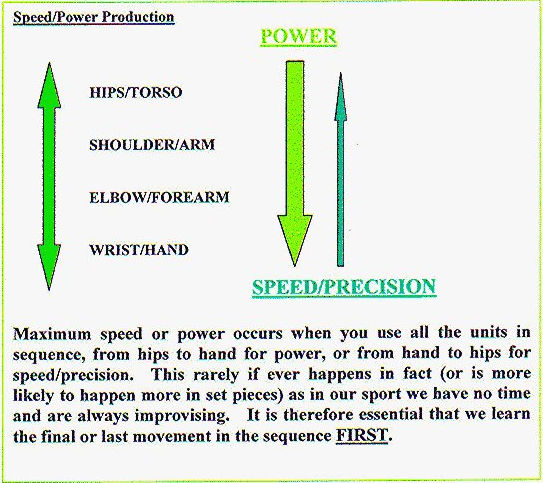
If you watch top performers in the major events, Worlds, Olympics, Europeans etc. how often do you see players almost falling over, hitting the ball at full stretch or bending backwards at impossible angles to make the return. Our sport of table tennis is now faster than it ever was and the bigger ball has brought even the men closer to the table than ever before. There is just no time to go through the full gamut of preparatory movements to play each shot. More and more, players are having to improvise, to try not just to get the ball back (because at top level this is not enough), but to make a ‘winner’ from a difficult if not impossible position.
Often in fact it is only in the ‘set pieces’, the serve and receive for example, that you have the time to stay with your technique, for these are the few situations where you have a measure of control. Even here however risk-taking is prevalent with players coming round ‘blind’ to use the forehand from the backhand corner to try to win the point direct or to gain an advantage. In fact many national coaches worldwide are realizing the need to revise the risk-taking policy of their National Teams. This is moving up the scale from a medium risk approach to the higher risk areas. It is no longer an option to play safe however good your game may be.
It is often no longer possible now to play in measured fashion, to set the feet and begin the stroke through the hips and torso rotation. Many top players, even the men, stand closer to the table and quite square. As a result a response to the increased speed of the game is more often than not, an attempt to get the torso out of the way and at the same time commence the return stroke from what is usually the wrong end of the sequence. This occurs particularly with the power strokes and many such shots are initiated from the hand/wrist rather than the hips and body.
One of the reasons why it is possible to do this is that players are facing increased speed. Our game of table tennis is faster than ever before, much faster than 10 years ago, faster than 5 years ago. Most players even in the men’s game are standing closer to the table and taking the ball earlier. To retreat is more often than not a recipe for disaster. But all of this means that players are facing increased pace from a closer-to-table position. They often don’t need to initiate, rather they need to respond — reaction not action. Instead of feeding in spin and power they are using the speed already on the ball.
So many top performers are playing like this that we must really train in the same way and encourage our players to work at increased speeds and to bring more improvisation to the training hall. Virtually all movement patterns are now reduced to one big step rather than for example a number of smaller steps purely because of the speed of the modern game and the lack of time. We may well find over the next few years that extemporization will take over from a stable technical base in many coaching areas.
One final point that we must emphasize in all our training sessions is the importance of the initial strong attack in today’s game. It is the first player who gets in with a good ball who forces the opponent to react and who puts them under real pressure. Action is always preferable to reaction.
High Level Performance (Summary)
Rowden 2011
The 7 essential aspects of top-level table tennis:
• Receive of Serve
• First 3 Balls
• Opening
• Effective Pushing over the Table
• Control of the Rally
• Ball Placement, the Special Areas
• The Specialty
THE FUNDAMENTAL QUALITY OF A PLAYER IS REVEALED BY THE WAY HE/SHE HANDLES THE SAFE PLAY PRIOR TO MAKING THE ‘OPENING’.
High Level Performance
Rowden 2011
High-performance athletes are able to assess the quality of a shot much more effectively than lesser players and also can more easily predict the advantage or disadvantage arising from a ball which just has been hit by an opponent. This major difference between players of different skill-levels is applicable significantly to the first three strokes of a rally.
• The return of serve is the most important shot in table tennis. Statistics confirm the assumption that the quality of the return is significant in influencing whether a top player will advance to the final stages of the world championships or will fail in the earlier rounds ie. whether the player is exceptional or just good.
Be aware of the implications. Consider the up-and-coming young player who might be set the task by his coach of practising hundreds of serves. This player would almost certainly be better off asking his coach to halve the practise time on serve in order to have more time to practise the more important receive of serve. Serve-return-drills are the single most important training area targeted by the top players in the world.
• Another aspect we should stress is the great significance of the first three shots in any rally. There is hard data which confirms that about 54 percent of all faults occur while serving, returning or playing the third ball or have their ‘source’ in this stage at the very beginning of a rally.
• Topspin against push is also an area which requires attention. Studies of top players show that the efficiency of attacking a push ball is poor compared to ‘open’ techniques against block, counter and topspin. Many players perhaps get into certain habits and think as follows: ‘The main thing is that I am the one who attacks first (even if it´s not the right ball and of poor quality). Action first must be my priority!’ What of course they should be thinking is: ‘Effective action and only effective action must be my priority!’
• Likewise, it´s quite interesting that (not flicking but) pushing is quantitatively seen more often in the first three shots of the rally. There is perhaps a strong argument for training the backspin aspect more frequently and systematically so as to stop the opponent getting in.
• Let us now look at the next skill: top players select effective/different techniques when they are not able to win the point quickly and early in the rally. They are able to keep control of the rally until they see an opportunity to change something which will give them an advantage.
But getting the advantage should not entail a risky return. Quite the opposite. Athletes participating in the final levels of a world championship often rather tend to play risk-free. Playing safe is accomplished by ball placement until the player can manoeuvre some advantage. The player keeps his adversary on the backhand or reacts in a ‘non-forceful’ manner, i.e., he/she returns the ball with enough pace or good enough placement so the opponent has no chance to play power.
The real quality of a player is in the way he/she handles the safe play prior to creating openings.
• Studying ball placement gives further interesting results. More than half of all immediate shot connections (back and forth) are played either repeatedly backhand to backhand or cross-court backhand to backhand followed by an ‘opening’ down the line. Moreover high-quality shots from the opponent (which give him/her an advantage) are mainly returned by using quite risky placement. In many cases a good shot by the opponent is returned to his/her forehand – and not to the backhand.
• Furthermore, analysis shows that strokes which are non-textbook as well as special placements are highly efficient. By the term ‘non-textbook strokes’ we mean shots like a backhand stop- or sidespin-block, a forehand soft block or fade. The notion of ‘special placement’ means playing the ball long into the opponent’s forehand or deep backhand, placing the ball at the crossover point between forehand and backhand (the ‘area of indecision’) or playing against the direction of the opponent’s movement (where the player is moving from).
One thing is clear that observing how the opponent prepares for the stroke and the change of position during a rally has to be integrated into the player’s training sooner rather than later.
Long-term Athlete Development
Rowden August 2012
LTAD is basically a model which looks at an in-depth and long-term approach to maximising the potential of an individual and helping him/her to tailor the developmental program to suit the stages of physical and mental growth. It is also intended to encourage and motivate the athlete to be involved lifelong in his/her sport. The model is split into a number of stages taking the child from simple, generic movements to more complex, sport specific skills and building a pathway.
So LTAD is a sports framework that is based on human growth and development. It is about adopting an athlete-centred approach to development. There are critical periods in the life of a young person at which time the effects of training can be maximised. Young people should in fact be exposed to specific types of training during periods of rapid growth and the type of training should change with the pattern of growth.
For most sports a five stage framework can be utilised:
• FUNdamental – basic movement literacy, boys 6 – 9, girls 5 -- 8
• Skills – building technique, boys 9 – 12, girls 8 -- 11
• Training to train – building the engine, boys 12 – 16, girls 11 -- 15
• Training to compete – optimising the engine, boys 16 – 18, girls 15 -- 17
• Training to win – maximising the engine, boys 18+, girls 17+
In the final stage of athletic preparation the emphasis will be on specialisation and performance enhancement. All the basics will be fully established and the focus shifts totally to the optimisation of performance. Athletes will be trained to peak for specific competitions and major events. Therefore all aspects of training will be individualised and tailored not only to the athlete but to the specific event. There will be either double, triple or multiple periodisation, depending on the events being trained for. Training even at this advanced stage will continue to develop strength, core body strength and maintain suppleness.
At all times it should be appreciated that LTAD is an approach to athlete development that puts the athlete, rather than the system, at its centre. It can provide a means of developing an integrated, systematic methodology which will ensure that all athletes are able to achieve their full potential and help foster long-term involvement. The principle need in sport is to identify and address the inconsistencies in how young players are developed and to encourage the widespread adoption of agreed good practices. There is also a clear need to address the lack of training culture in sport in many countries in Europe. Unfortunately at the moment many players who achieve international recognition do so in spite of the system rather than because of it – this has to change. Other talented players are unable to access the support and coaching required to enable them reach their full potential and are lost to the sport at the higher levels.
Currently many young sports persons undertake a large amount of training and competition but is this always in the right direction? Often there is rarely a single plan for their sporting development and conflicts and overplaying can easily arise without the appropriate guidance. For this reason efforts should be made to manage the individual player’s sporting, academic and social commitments in order to achieve balance. This is particularly important for talented players who may be accessing coaching via a number of differing sources. There must be one overall controlling and directing figure in whom the athlete has complete trust and to whom the athlete can refer at any time.
National Coaches often seem to forget that most of the player’s development is in his/her own club and not on a few training camps. Any National Coach, who does not control the player’s development, does not have control over all the aspects that go into creating success and doesn’t have the input time with the players, cannot hope to produce world-class performers. Winning against other countries and in major events will therefore be, not because of the system, but in spite of the system. Also however if groups work against the system can they succeed? As Jacques de Molay, Grand Master of the Templars stated around 700 years ago: ‘Success will only be achieved if everyone works together. Small groups without uniformity of purpose or the agreement of a clearly defined target will fail’.
It is necessary too that the controlling and directing figure, whoever this may be, has the appropriate in-depth experience in the development of a variety of styles and also the ability and knowledge to set the right standards during the early stages of development. If the critical periods in the life of a young person, at which time the effects of training can be maximised, are not utilised to the full, then this can significantly reduce the performer’s chances of ever reaching full potential.
We must talent-spot and select a small number of players in the expectation that almost all will succeed: find the talent, polish it and turn it into gold. The old methods of mass participation and mass failure must be consigned to the scrapheap. If the overall system does not allow or cater for the athlete-centred approach then the likelihood of producing high-level performers, who will achieve their maximum, will be severely limited or will rarely if ever happen.
Modern Cross-step
Rowden Fullen (2005)
Obviously there are times when most players have to use a cross-step to reach extreme balls, for example when they have played a forehand from the backhand corner and the opponent angles them out to their forehand side.
There are however a number of different approaches and possibilities which players can adopt. A number of top women players (Ni Xialan for example) feel that they never need to use the cross-step, as they stand close to the table at all times and have good enough tactical play that opponents have difficulty in catching them out with extreme angles. Most women do in fact stand closer to the table and prefer to face the play at all times — many even continue to play square when they back away from the table.
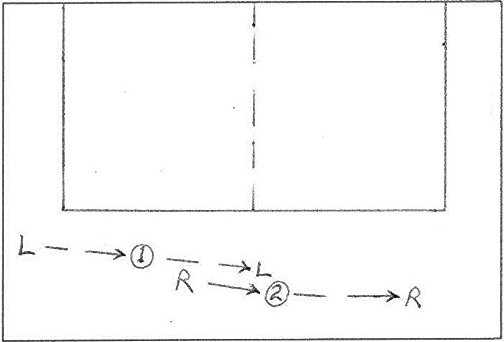
Other players use the older two step crossing movement as in diagram A, where they bring the left foot across the right then extend the right to ensure a stable position with good balance to both play the wide ball and recover well for the next shot. The only problem with this is that our sport is so fast in these modern times that many players will just not have the time to do this.
Diagram A
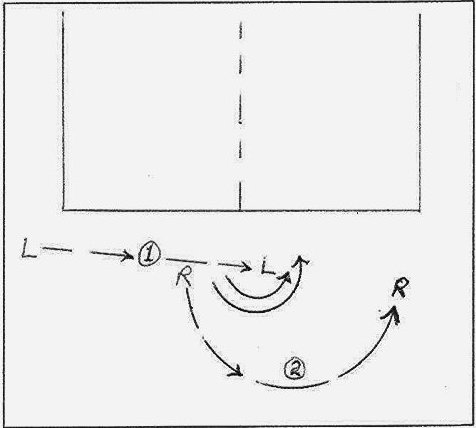
Is there another alternative? There is and it’s one used by many Asian and especially pen-hold players as in diagram B. Cross over with the left foot in a one-step movement and then use the left foot as a pivot, striking the ball as you rotate the upper torso and bringing the right leg round at the same time.
This may lead to a slightly worse recovery position on the next shot, but it’s relatively easy to play one backhand if the opponent plays back into the body and this in fact is what many top players do. This whole action is in line with modern table tennis strategy, where the thinking is to economize on movement and strike the ball first, rather than paying too much attention to getting the feet in the right position.
Diagram B
Modern Techniques -- Tips
Rowden October 2017
Playing Systems and Tactics
Playing Systems
● A playing system can be active or passive, or a blend of both
● At the top level individual active systems are clearly dominant
● Offensive players can still be very different in their individual playing systems
● The current tendency towards more speed will continue
● The playing system of a player demonstrates both his/her understanding of the game and of the way in which he/she individually performs to best effect
Tactics
● Tactical understanding is often visible early in a player’s career
● In table tennis tactics are essential
● With the speed of today’s game and the small margins at top level tactical intuition becomes more important
● Tactical ability is determined by the technical ability and mental strength of the player
● It is vital that the player has enough alternatives to apply and execute the necessary tactics
Technique and Science
Technique
● The more efficient my stroke and footwork technique, the more physical energy I can save.
● The more techniques I can master, the better I am prepared to meet new and different challenges from the opposition
● Table tennis is developing from long movements away from the table, to short movements closer to the table
● Having the perfect technique doesn’t make you the best player. The technique must be effective and work for you
● Technique is even more important with the plastic ball
Science
● To improve technically, you must understand and acknowledge the problem, identify it and find a solution
● The most time-consuming aspect is the adaptation of the solution to you and your personal game. We are all individuals
● You need alternatives, probably at least three to deal with every situation you face in the game
● Not only do you need to look at techniques in serve/receive, strokes and movement, you need to examine distance
● Every top player reaches the higher levels not through technique but by his/her individuality
Serve and Receive
Serve
● The serve is a formidable weapon; use it in this way
● Have total focus with each serve action
● Think in this manner. Which serve gives me an advantage –
o against my current opponent?
o for my next stroke?
● If you miss a serve, breathe deeply and think:
o Don’t lose your nerve now
o What do I need to do differently?
● When it’s 15 – 15, serve as if it’s 3 – 3. Adopt this mindset
Receive
● Be totally ready and prepared for any serve
● If you don’t return 2 serves in a row, stop, think and change something
● Before assuming your receive position breathe deeply
● If you can’t receive short serves effectively and with differing alternatives you can’t play at any level
● Long, fast serves are dangerous!
Flick and Block
Flick
● If you flick well over the whole width of the table, you have a clear tactical advantage
● With the plastic ball the flick is more important than ever
● To flick at the right moment often means a direct point
● To use the BH flick over three quarters of the table width is a modern tactic which works
● Train to flick at differing speeds and different timing points, from early to very late
Block
● Blocking is an important part of the modern game with the plastic ball
● The block enables you to throw back the opponent’s speed, spin and power
● There are many different blocking actions; soft, forcing, sidespin, stop and chop-blocks.
● You should experiment to discover which types of block suit your game tactically
● Good blocking opens up many attacking opportunities
Push and Chop
Push
● The push is a vital stroke in table tennis, both in a receive situation and as a link shot in rallies
● It is vital to be able to use all variations of push: short, dead drop ball, long, fast early timed float push and heavy backspin from early to even late timing
● The push is underestimated in top table tennis
● It is most important to be able to push consistently
● If you don’t push well you must have a very good flick and be able to use this all over the table
Chop
● Many attacking players cannot assess backspin defence correctly
● Choppers prefer to meet the hard, fast loop
● The flat drive or slow spin will often create problems for defenders
● Slow roll shots or sidespin win points against even good choppers
● Beware defenders who topspin or hit, especially on both wings
Topspin
Forehand
● You won’t get far at top level without being able to play topspin
● You need fast legs for FH topspin, footwork is everything in preparing for this stroke
● At higher levels you need to be able to vary topspin from slow roll to heavy spin and also incorporate sidespin into the equation
● Modern players take the FH topspin ball in front of themselves
● Good FH topspin creates many openings to win points
Backhand
● Backhand topspin is a point winner
● BH topspin down the line or into the body creates openings
● Because of the use of wrist and forearm in the BH topspin and the ease of playing ‘round’ the ball, it is often very difficult to read the direction and spin of this stroke
● BH topspin is a potent weapon v long backspin serves/shots to this wing
● You also have the option on this wing of playing the ‘inside out’ and ‘hooked’ BH topspins
Smash and Drive
Smash
● If you don’t enjoy smashing, you don’t enjoy anything
● If you can smash well you will have a clear advantage
● If you can smash at early timing or kill the rising ball you will win points much more easily
● Should you ever miss a smash, this should be a complete surprise
● If you can smash with your backhand, this will immediately take your game to a different level
Drive
● The drive stroke is now more important with the plastic ball
● The drive is a crucial and staple element in women’s play
● The timing of the modern drive should be early, or on the rise but before ‘peak’
● The drive can also be used off-the table with power in the women’s game (even as a substitute for the spin ball)
● The backhand drive can be very effective as it’s much more difficult to read
Alternatives
Serve/Receive
● The ability to serve short and wide using side-spin
● The ability in short receive to drop short, push long and fast with float and backspin and flick hard and soft with early and late timing
● The ability to serve deep and fast with varied spins, float, side-spin with chop or topspin to both wings and to the crossover
● The ability to vary long receives, block (including chop and side-spin options) and drive, topspin or even chop
● The ability to constantly vary serves, no two the same and to use all the opponent’s half of the table
Rallies
● The ability to change placement and use the opponent’s half of the table to the full
● The ability to change speed, long and short, hard and soft
● The ability to change spin with both timing and varying power input
● The ability to play the angles and to play straight down the lines
● The ability to play slower balls
Mental Strength/Nerves and Concentration/Willpower
Mental Strength/Nerves
● Nerves before any match are normal
● Down 0 – 4? Nothing is decided, think, change something and focus harder
● 10 – 10 in the final set? This should be 5 – 5 in your head
● You miss the serve at 15 – 15, look ahead and focus
● 5 – 0 up and opponent gets back to 5 – 5! Change something and relish the contest. There’s an exciting end-game ahead!
Concentration/Willpower
● Thinking about past and future, what has happened or will happen is of little help and can demotivate
● Think only about the here and now and focus one point at a time
● Talk and think to yourself. Immediate mental analysis after a rally is of value
● Do not allow things you cannot control (luck, bad umpiring decisions, poor playing conditions etc) upset your concentration. Only focus on what you can control
● During a time of absolute concentration you perform ‘in the zone’, more like an observer rather than a player in action
Physical Elements
Endurance
● If you don’t train endurance, running, swimming, cycling, you don’t understand anything about modern table tennis
● General endurance is a prerequisite for high-level performance
● You must improve either general endurance or your efficiency of movement
● The future of table tennis is more speed. This demands improvement in physical aspects
● Shorter training sessions but more often and with more intensity are the way forward. This is also in keeping with the shorter more intense games in our sport
Power
● Training in strength aspects when young will avoid pain and setbacks when older
● Nothing works without strength and this is more important with the plastic ball
● Balance is crucial in the development of strength and the stability of the spine vital. There should be equal development of the non-playing side
● Powerful legs are the basis for any top athlete
● Non-specific strength development is not needed for the playing arm as this impacts negatively on touch and fine control
Speed
● Use resistance bands for quick twitch muscle development
● Multi-ball increases overall speed and reactions
● Work at relaxed, interconnecting stroke play. When one stroke flows into the next this saves energy and makes the whole event faster.
● In order to lead into the next shot the path and finishing position of the racket after the previous stroke is crucial
● Anticipate better, watch the opponent, not only the contact on the ball, but the preparation of the body and the movement prior to the shot
Flexibility (Agility)
● Be precise even in the service throw and learn to use the whole body in the action of service
● Serve training is a prime example of optimizing body movement and utilizing many variations with the same basic action
● Use of the free arm is more important than most players think
● Rotation is vital in shot production and maximizing power
● The legs are a crucial part in the overall agility program
Coordination
● You have to find the balance between automatic responses and controlled reactions. This balance will often determine whether you play well or poorly
● Too much conscious thinking reduces the flow of the game and the quality of the balls played
● Find time for consistency and tactical decisions
● Every irregular exercise improves anticipation and well- coordinated responses
● Always search after the optimal relationship between conscious and unconscious actions
Training
● If you don’t warm up you’ll almost always play below par
● Too much training is as bad as too little
● Much training = good performance? Not true
● Meaningful training is only possible with full concentration
● All training should be geared to your individual development. Not only is the quality of training vital but the direction. Is it leading you to where you want to go?
Training Themes
Rowden February 2021
Speed -- Emphasise 3 speeds, off the racket, through the air. and after the bounce and how to change each.
Look at how the power input and timing can change the form of the rally, the differences between using 90% power, 55% power or merely using the opponent's power to return the ball. Bear in mind we are not looking just at speed, but at lack of speed and there is a big difference in what happens with the ball between hard drive, slow roll, soft or forcing or stop and sidespin blocks.
Movement -- Examine first which is the most effective playing distance from the table for each individual player and does he or she spend most playing time in this area? If forced away from the best area does the player have the right weapons and movement patterns to return to this distance quickly and without problems. All players must be efficient in 'short and over-the-table play'. We must look at side to side patterns and also in and out, bearing in mind that movement must be economical incorporating as few steps as possible.
Opening -- Being able to open effectively and get on the attack is crucial, especially in the women's game. Players must be able to do this, both close to the net and in 'over-the-table' play, as well as at the end and when back some distance. Having the capability especially to open effectively against backspin and in differing ways is a game-changer; flick, fast and slow topspin, slow roll, sidespin loop, hard, early-ball drive or flat hit. Statistics taken at World Championships have shown women are much more comfortable in fast play and make more mistakes when trying to open.
Length -- This is critical in the modern game and with the plastic ball. A ball that bounces mid-table is easy for the opponent to attack, a ball that hits the table in the last 5 - 10 centimetres, especially if this arrives very quickly, is much more difficult. Also balls targeted at or along the side lines, cause all sorts of problems. The length criteria don't only just apply in rallies but are absolutely crucial in service. The serve which hits the end white line at speed and also with varied spin and placement, can either be a winner or open up attacking opportunities.
Placement -- There are a number of obvious targets to aim for, the opponent's crossover area, particularly from a right-hander's BH to another right-hander's body. Also the table corners and down the line shots. Bear in mind to use the table effectively when meeting left-handers. Above all look at the major benefits of changing pace and length, hard and soft, short and long. If most of your play is either very short or very long, you will certainly pressure your opponent.
Spin -- This is of course less effective with the plastic ball; the small ball as tested by the Chinese National Team achieved at maximum around 150 revolutions per second. This has just about halved with the plastic ball, but also in addition the new ball loses spin much more rapidly through the air due to the larger size and the different polymers used in construction. But all is not bad news. Tests in a number differing countries have shown that sidespin is still very effective with the plastic, whether combined with another spin in serve or with another stroke in rallies. It can be very useful for example to loop to your opponent's FH with heavy sidespin, which pulls him or her wide to the FH side, or to push very early and quickly with sidespin against a backspin ball. The BH 'banana' flick over the table can be equally effective.
Serve and 3rd Ball -- As we stated under 'Length', this is critical. Long serves should be both very fast and very long, in the last 5 -- 10 centimetres of the opponent's half, with varied spin, directed at key areas, corners, crossover, with as deceptive service action as possible. The opponent should find it difficult from your action to determine whether the serve is topspin or backspin (with sidespin) or just float and equally exactly where the serve will be directed. Try also to use a very similar grip. Experiment with the high throw, with these it's difficult to see direction especially if service action is very quick. Don't neglect very fast float combined with some topspin and the shorter very wide serves off the side of the table.
Short serves should also be very short and with plastic are best directed spinning out and away from the opponent, using predominantly sidespin, to pull them out wide on BH or FH. Bear in mind that short serves to the middle are more easily attacked with the opponent's BH. Half-long serves mainly backspin and sidespin can still be effective, particularly if they 2nd bounce on the white line. Try too to shorten the service action so that there is minimal time between the movement of the racket, the contact on the ball and the contact on the table. This gives the opponent less time to evaluate what is happening.
All serves should occur with a purpose -- winning the point. You should always be ready and eager to be positive on the 3rd ball. You should also have a good idea to which part of the table your serves are normally returned and be able to attack strongly. However also train with your sparring partners to return to unexpected areas so you can handle the unforeseen situations. Bear in mind too that we are not always attacking hard. The short drop shot, the slow roll, playing against the spin, the long push, can all open up attacking opportunities. One cap does not fit all.
Receive -- The key theme here is to take the initiative away from the server and gain control of the point. One critically important aspect here is to have alternatives. Against the short serve not only the capability to flick strongly over the table, but to drop short or push long with differing spin. Against the long serve not only looping hard but at times driving, blocking (even stop or sidespin variations), rolling slow or chopping. Sidespin is particularly effective with the plastic ball.
Bear in mind too that it is easier to attack over the table with the plastic, especially with the BH wing. All players now need to be proficient in the two areas, both over and off the table.
Use the Whole Table
Rowden June 2021
Most players appreciate that with the plastic ball the science of our sport has changed.
Coaches too, readily understand the most obvious areas where changes need to be made: serve, receive, short play, more change of pace and unpredictability, with less spin power is more important, more symmetrical play and earlier timing, but above all the will to change and to execute this first. However have players and coaches registered the need to use the whole table, to do this more effectively and how to best achieve this?
Examine the following series of exercises and understand the relevance:
• Player executes between 1 to 3 strokes down the FH line then switches to the middle or diagonal, either to the body, corner or wide to the short angle, thus using alternatives.
• Player executes between 1 to 3 strokes down the BH line then switches to the middle or diagonal, either to the body, corner or wide to the short angle, thus using alternatives.
• Player executes between 1 and 3 strokes on the FH diagonal then switches to the middle, straight or to the wide short diagonal, thus using alternatives.
• Player executes between 1 and 3 strokes on the BH diagonal then switches to the middle, straight or to the wide short diagonal, thus using alternatives.
• Player executes between 1 and 3 strokes from the FH corner to the middle, then switches straight down the line, to the diagonal corner or to the wide short angle, thus using alternatives.
• Player executes between 1 and 3 strokes from the BH corner to the middle, then switches straight down the line, to the diagonal corner or to the wide short angle, thus using alternatives.
Consider also that the player can use differing alternatives in the stroke-play within each sequence in the six exercises, for example drive, spin, varied blocks, sidespin loop and in such a way the boundaries of the rally and responses can be increased dramatically.
Bear in mind too that the player as well as varying the stroke-play can vary the speed and the length to further increase the scope of the exercises. It’s all about using the whole table area to gain an advantage; coaches also should devise more exercises, they know their own players best and are in the ideal situation to devise those most suited to their own player’s style.
Economy of Movement: the Key to Speed
Rowden Fullen (2006)
Explosive speed is an inherited characteristic and players who don’t have it are rather limited in what they can do to train up this aspect. However there is nothing to stop any player only using those patterns which give most economy of movement. It’s elementary for example to understand that quick play requires short strokes so that you can recover for the next ball (not so short however that you fail to play ‘through’ the ball). If in our modern fast game however you are attacked hard and have no time, then you must often be satisfied with the block return. Bear in mind however that there are a considerable number of differing ways of blocking, from taking the pace off the ball, to dramatically changing the spin, to increasing the speed and also a large variety of timing points which can be used.
Racket recovery is particularly crucial and it’s vital that the racket returns to the neutral position after each stroke so that you are ready to play FH or BH on the next ball. It is equally vital that the elbow drops down after the stroke (especially the BH counter) so that the forearm is in the best possible position to move in either direction.
The ultimate style of the player will dictate which type of movement patterns he or she should use. Close to the table blockers will use many one-step movements or small jump steps. Strong loop players will inevitably use the cross-step to reach the wide ball (pivoting on the left foot for a RH player) and defenders should train at moving in and out. However with the modern game both close and deep, movements which retain a square position are preferable. Movement is one of the most critical parts of any young player’s development and yet very few countries in Europe work constructively with footwork patterns at an early age. It is particularly important that you establish a pattern with a young player that can grow with the player, (can a sidestep pattern be easily developed into a cross-step?). It is also a priority in the ‘modern’ game, where we have limited time that footwork is economical, one big step is preferable to many small ones.
Among the world’s elite (especially the Asian players) the FH is still the dominant stroke and many men players will still move more in order to bring this wing into play. (Among the top European men because of the increase in the basic minimal speed many now use the BH from the middle or even from the FH side against the serve. It will be interesting to see if this tactic, which has been common amongst the women for many years, will become the norm in the men’s game).
Perhaps here a warning should be issued to women trying to use the FH over the whole table as some top men do. The women’s game is rather faster as they stand closer to the table, hit the ball earlier and flatter. Often they have less time to move and to react between shots. Also overall their physical capabilities can be reckoned as between 15 – 30% lower than the male. These factors can make the difference between success and failure at top level when women try to emulate the men.
For a top player to execute strong topspin from FH and BH corners with FH and BH consecutively takes around 0.6 of a second. However to do the same with just the FH wing will take almost 1.0 second. This is quite a big time difference at top level. FH play over the whole table is also asymmetrical (by this we mean one-sided and unbalanced movement). Symmetrical play is clearly superior from the point of view of economy of movement, the only downside being that the BH topspin is generally less powerful than the FH.
A change to more symmetrical play requires that the BH topspin be of the same quality as the FH. This can be achieved by use of what we call the tennis BH. Here with a quarter rotation backwards, taking the ball off the left hip, leading with the right elbow and using good rotation and very fast forearm action, the stroke can be upgraded to a similar power and speed as the FH. Certainly in the future it is becoming obvious that in the light of the speed of the modern game, play will become more and more ‘symmetrical’ and that this will be the way forward.