Coaching Development Course 2
Rowden Fullen (1990’s)
- Warm-ups: stretching.
- Movement: introduction.
- Training requirements.
- Training of players.
- Development: beginners, intermediates, advanced.
- Power and levers.
- Communication.
- Be professional.
- Topspin and backspin.
- Bats and rubbers.
1. WARM—UPS: STRETCHING.
- Prevention of injury.
- Preparation — physically and mentally.
- To increase flexibility.
Players should have the attitude that warm-ups and stretching are a natural part of their sport and should feel absolutely no embarrassment over doing these. Warm-ups are an important part of preparing to play and stretching equally important in winding down after play.
Coaches should beware of excessive physical work, weight training etc., especially with young players. The bones and joints are still growing and most of the major epiphyses do not close before around 17 – 20 years (1 – 3 years earlier in the female). Before closure the strength of the fibrous capsule and the ligaments surrounding a joint are two to five times greater than the strength of the metaphyseal – epiphyseal junction (the fresh growing area at the end of the long bone).
Any exercise programme must be structured to cater for different fitness areas.
- Cardio-vascular — the heart and lungs.
- Flexibility — twisting and stretching.
- Strength — legs and (bat) arms.
- Specific areas for table tennis — back and stomach, especially in the case of female players.
- Loosening up and relaxation.
In any exercise programme also remember the differences between girls and boys — strength, speed, lung capacity, inclination of the arm, bone growth, age of bone closure, joint stress limits. Also bear in mind the social aspects — it does nothing to help girls’ confidence if they have to compete with boys in physical areas, especially if they are in a big minority, only one or two in the group.
2. MOVEMENT — INTRODUCTION.
First you achieve a level of control from a static position, then in a moving situation. (Recovery should be built into all movement patterns, both in the case of recovery of body and racket and the players should above all aim to move with good balance at all times). In the early stages aim at about 75% width (side to side) and only 25% depth (in and out).
A) Movement
- Can be footwork of one type or another.
- Postural, body action, pivoting or twisting of the trunk.
- Manipulative, bat arm, the three joints, shoulder, elbow, wrist or even fingers.
B) Types of footwork
- Close to the table (nearest foot to the ball?) Stepping or jumping.
- Away from the table (crossing legs at times). Running or jumping.
C) More than one reason for not reaching a ball.
- Physical fitness.
- Poor footwork patterns.
- Recovery.
- Anticipation.
Always bear in mind that the more you retreat from the table, the bigger the angle you have to cover and the more you will have to move.
Footwork exercises.
- Regular, set pattern, conditioned response.
- Irregular (no pattern), ball not expected.
3. Training Requirements
Technical.
Basic skills
- control
- consistency
- accuracy
- touch
Advanced skills
- kill through loop
- loop to loop
- stop block
- short play
- early ball play
Tactical.
Experience
- league play
- camps
- tournaments
- positive play
Strategy
- variation
- angles
- timing
Movement
Style development
PHYSICAL
- speed
- stamina
- strength
- flexibility
- feeling
- relaxation
PSYCHOLOGICAL
- work-rate
- will/motivation
- self control
- confidence
- concentration
- mental toughness
- clarity of mind
- competitiveness
- innovation
Glue — When to use and why.
How it affects technique and tactics.
OPTIMAL MENTAL STIMULUS
The basic principle of table tennis training.
TRAINING IS ONLY
- REPETITION IN THE RIGHT ENVIRONMENT!
- WITH THE RIGHT ATTITUDE!
4. TRAINING OF PLAYERS.
A) Basic phase One 8 - 11 years.
- All strokes even up to topspin and backspin (but without excessive spin or power). Good basic control, consistency and accuracy. Work as much as possible from drive to spin.
- Footwork — Not too wide at first and no forehand from the backhand corner. Work at establishing a base from which you can move forward with the player and on to more advanced footwork at a later date. Try to evaluate the end style so that you can judge which type of movement the player needs to develop.
- Some tactical (but keep low profile).
- Always bear in mind the vital importance of good technique with balance. Technique can be very difficult to change later on in a player’s career.
Depending on how early the player starts, the critical stages for development are usually around the following ages — Girls 8 - 12 Boys 8 - 14
FACTORS TO CONSIDER
The coordination of the player, the development of the body, the reactions, the speed of the hands and feet, the level and duration of concentration, the ability to comprehend and understand, the natural strengths and gifts (speed, movement, talent).
The facilities available, organization of time, parents’ involvement, the player’s own time, commitment and mental approach.
At this age try to keep competition at a low level and geared to the training situation. There is always the danger of ‘burning out’ players at a young age. (This happened with a number of young girls at the top in tennis some years ago).
B) Basic phase Two 11 - 17 years.
- Consider in detail the individual style of players. Where are they strong, what is their best playing position relative to the table, how much of the table should they cover with forehand, backhand, should they spin or drive, block or chop, is their movement right for their way of playing and above all are they mentally in tune with the direction they are going towards? Look also at which materials may help your players.
- Refine the movement patterns so they will suit the players’ end style and tactics.
- Keep the technical base moving forward, gradually introducing more advanced techniques.
- Develop tactical awareness and the ability to play against all different styles and materials.
- Upgrade physical levels.
- Strengthen mental areas.
- Above all teach players that development means change and if they don’t keep changing they stop moving forward and remain as they were!
- Look to the individual needs of the player.
FACTORS TO CONSIDER
Bear in mind that the growth of the player will affect technique (if they suddenly shoot up 12 - 15 centimetres perhaps they are no longer getting down enough.) Make sure there are no inhibiting factors in technique or movement or tactics, which will have a limiting effect on the player’s ultimate level of play. Keep the player moving forward, teach him or her to handle the stress of competition, to think positively at all times and above all to be flexible in the mind. Try not to take short cuts — aim to release the full potential of the player at senior level.
Consider too that many players may come to you partially developed or with major faults. The longer a player has played, the harder it is to make big changes and often you will only be able to make small adjustments here and there to make him or her more effective. However often players have never really been taught how to use their own strengths and even what works best for them. Here you can help them.
5. DEVELOPMENT.
Beginners
Control and Accuracy
- correct techniques.
- understanding of grip and stance.
- most economical body movement.
- appreciate what each part of the body does.
- arm movement alone not enough.
- no excessive movement of feet (economy of movement).
- speed and spin negligible.
- diagonal first, then straight, diagonal from the middle,lastly forehand from the backhand corner.
- same timing point ( 1 - 2 centimetres before peak),except block — early.
- learn one stroke, do not combine in same rally with others.
- slightly better, alternate same stroke, forehand and backhand but regular.
- slightly better, use earlier/later timing, shorter or longer stroke.
- slightly better, use more change of pace, slower/faster speed.
N.B. The ability to play the basic strokes (drive, block, push) with good control from a static position, characterizes the well-taught beginner.
Intermediates
Consistency at Varied Speeds
Style Development
- train regular movement, side to side, in and out, on the diagonal.
- train serve and receive.
- differing timing points.
- vary speed, slow medium, fast.
- vary spin, light, medium, heavy and also float.
- train spin/stroke alteration within the rally, push/drive, block/chop.
- train in and out movement with variation in speed and timing.
- slightly better more irregular movement.
- slightly better, more work on power/spin.
- technical advancement, looping and chopping and
different techniques. - introduction to serve and 3rd ball techniques and to
set pieces. - introduction to 2nd/4th ball techniques.
- introduction to mental development.
N.B. A good intermediate has the ability to play all the strokes normal to his or her style within a game situation (moving) and with absolute consistency.
Advanced
mental strength development.
Irregular Movement
Refining of Style
- irregularity the theme in all exercises.
- vary stroke, timing, direction, length, speed, spin and tactics.
- concentration on serve and receive.
- 2nd, 3rd, 4th ball training to be positive and attack.
- set pieces, sequence play to suit the style of the player,
- build up strengths and minimize weaknesses.
- power and pressure play.
- use of professional tools, multi-ball, robots, professional physical or mental instructors.
- physical, stamina development in accordance with the style of the player.
- teach player to assess own game and to be able to think tactics as he or she plays.
- involve player in periodization.
- train against all types of opponents.
- innovation, above all make sure the player is flexible in the mind and understands the necessity of keeping his or her game fresh and alive.
- never forget that top players are above all unpredictable in the way they play, this is one of the keys to success at top level.
N.B. The advanced player can vary his own play to cope with the demands of the game situation. He or she reads the situation and adapts.
Thinking points
- Consider the importance of the basics, accuracy, consistency and control. Top players use immense spin and speed but within a framework of control. Many young players want to play too hard and too fast.
- Think of variation within the basics, speed, spin, timing and contact points, length, angles and table areas.
- Always look at balance — with the modern game the weight is going forward all the time, there must be more emphasis on good balance and good recovery, good footwork patterns and the use of the body and the various levers.
- Control the ball, the table, the opponent but most of all yourself.
6. POWER AND LEVERS.
Power
- Travel faster.
- Spin more.
- Any combination.
Power is generated by three components –
- Acceleration such as bat speed, use of shoulder, elbow, wrist. (Rather like a motor-cycle).
- The use of elastic energy (explain how to play the strokes to make maximum use of this).
- Body weight travelling along the line of play (rather like a large truck) or uncoiling (like a spring).
Racket Swing.
- Pre-contact longer (but not too long, too long gives no room for manoeuvre, you are committed from the outset).
- Follow through short and along the line of play.
- 120 degree elbow for spin, 90 degrees for drive.
- Elbow not tucked in or too far forward (inhibits spin development).
- Peak of bounce timing (or 1 - 2 centimetres before/after). Below the table, more spin but less speed.
Mass.
- From a little back use side to square stance, with the weight coming from back to front and a little up using the legs.
- Rotation of hips and shoulders
- Rocking of the shoulders
- These last two depend on the incoming ball and the type of loop.
- Leading foot pivots pointing to where the ball is going.
Levers.
Examine the principles of rotation.
Angular velocity
- The centre of gravity of the arm (the elbow area) covers a certain distance in a given time period, this distance is constant, the Law of Conservation of Angular Momentum. If the arm is shortened it must therefore move faster to cover the same distance. This is a valuable principle to remember when coaching girls or younger, weaker players, especially when considering the value of shorter arm strokes (looping for example).
- Lever length — If a player has the strength the longer the lever, the more power it is possible to achieve (Jonyer, Hungary 1975) (also example of wheel nuts on a car and the length of the lever, much more pressure). Assess the player, age and physique and beware of too much loading on the shoulder.
- Body use in play – It is quite normal in Asia to use tensioning and relaxing of the stomach in stroke play to increase striking power. (Explain).
7. COMMUNICATION
Clarity
- get the message across, you say something, but just what do people actually see and hear?
- the pupil learns aurally, visually and physically (by feeling and doing.)
Communicate
- ask relevant questions.
- listen to answers.
- treat pupils as people.
- get tuned in (on the same wavelength).
- speak the same language.
Priorities
- nice to know.
- should know.
- must know.
Enthusiasm sells.
- it is contagious.
- gets others going (you energize others).
- is a reflection of your inner self, if you are not inspired how can you ‘sell’ to others?
Speak Show Keep it simple
You cannot motivate, you can only affect the motivation of others!
8. BE A PROFESSIONAL.
Table tennis is a multi-skilled game, different from other ball sports. It is important to cultivate the right attitudes and as soon as the player is past the beginner stage and secure in basic strokes, to handle him or her as professionally as possible.
Do not train by competition (many young players compete too much and train too little, the training hall is very important). Development sessions should be without pressure and the player should have confidence that his or her development is based on a sound training programme.
Every training session should have a purpose, working on strengths, weaknesses, movement, consistency, change of speed, angles, opening, topspin etc. Of course within every session you can have a progression, a development, introducing serve and receive, 2nd and 3rd ball or some competition. Players should have both group and individual coaching as these serve different purposes in their development. It is hard to work on mental aspects, style development, serve techniques etc. in a large group, but the player does need the variety and the inter-action of training against other players (the variation in serve for example even when every player is trying to serve the same, the small differences develop your player’s receive talents much more than receiving from even the same good player all the time).
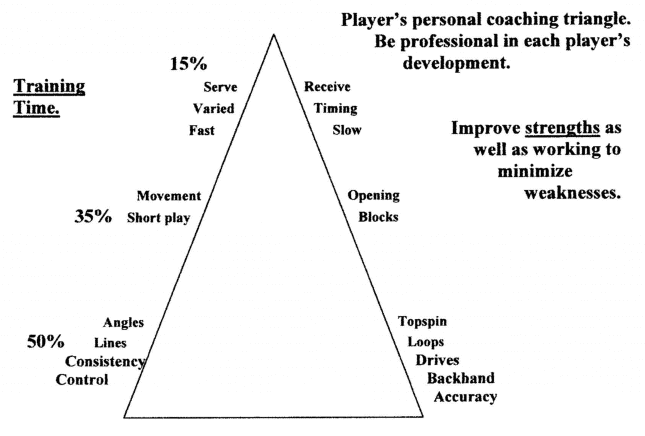
Plan also the player’s week, year, competitions and match play levels and always remember that the player needs rest and relaxation.
Example of a week.
| Mon. | Tues | Wed | Thurs | Fri | Sat | Sun |
| Rest | 2.5 | Phys. | 2.5 | Rest | 3 | Comp |
9. TOPSPIN AND BACKSPIN.
With the many varying rubbers on the market it is not always possible to rely on the stroke action. (e.g. a push against backspin may be backspin, float or topspin!).
Try to read the spin by the sound (as the ball strikes the opponent’s racket), by the flight through the air (watch for the trademark on the ball 3 — 8 centimetres before it hits the table on your side) and by the bounce (what the ball does after hitting the table).
Topspin
— Explain with diagrams, the turbulence and high pressure -on the top side of the ball, the low pressure on the bottom side. Air pressure forces the ball downwards. The topspin ball is faster through the air and dips and shoots forward after bouncing. The incoming angle is greater than the outgoing angle.
Backspin
–The backspin ball has low pressure on the top side, turbulence and high pressure below. Air pressure forces the ball upwards. The backspin ball is slower through the air, carries a little longer in flight and kicks up after bouncing. The incoming angle is less than the outgoing.
Points to consider
— Your opponent’s topspin spins towards you, his backspin away from you. When your opponent plays with your topspin the ball is returned with backspin, when he plays against your topspin he returns the ball with his topspin, (the opponent reverses the spin). However this may not apply if he or she is using long pimple or antiloop where he or she cannot or can only partially reverse the spin.
Let us look a little at spin, what it is and how it affects the ball, because we need to know a little about the basics before we can cope with playing against different rubber combinations. Most players and coaches will be aware of what is known in physics as the Magnus effect. In many countries in Europe it is taught in the first coaching stage on trainers’ courses. The important point is that both backspin and topspin cause the ball to deviate in flight. Test this for yourself. In your own training hall loop the ball hard and long with much topspin — it will dip quickly to the floor during flight then after bouncing will spin forward and run on to the end of the hall. The backspin ball will veer upwards before dropping down, will run forward only a little, then will spin back towards you and can end up spinning back past you. Not only does the type of spin affect the ball in the air but it also affects the way the ball behaves after the bounce.
- No spin — same angle in and out. (physics, angle of incidence = angle of reflection.) This rarely happens in table tennis, test for yourself by throwing a no-spin ball forward, the ball acquires topspin after bouncing because the bottom of the ball is held momentarily by the floor and the top moves forward. (If a topspin ball hits the net, the bottom of the ball is held and even more topspin is created.)
- Topspin has a smaller angle after the bounce and the ball shoots forward low and fast. However if you have a high, very slow loop with much spin, because the main impetus is down the ball will often kick up a little, then drop down very quickly. This is why this type of loop is very useful against defence players.
- Backspin has the bigger angle after the bounce, the ball slows and kicks up sometimes quite sharply. Why many players have problems against backspin is that they don’t understand this slowing-down effect, that the ball doesn’t come to them. They must move forward, lower the centre of gravity and get under the ball.
Topspin is of vital importance in modern table tennis. Without topspin it would be quite impossible to hit the ball as hard as we would like to. When we for example hit a ball which is below net height, gravity is not enough to bring the ball down on the other side of the table, especially if it is travelling fast. Another force is required and this is provided by topspin which causes the ball to dip sharply downwards. Thus the harder we hit, the more topspin we need to bring the ball down on the other side of the table. Our modern reverse rubbers give us great help in hitting the ball very hard from below net height, because they are capable of imparting very much topspin. This has an additional advantage in that the ball shoots off the table very fast after the bounce.
But why does spin cause the ball to deviate in flight and why do we sometimes have unusual, unpredictable effects after the bounce? This is in fact to do with the interaction of the spinning ball as it moves through the air against the flow of air molecules. (We have all felt air, when we stick our hand out of a car window moving at speed we can feel that air is rather more solid than we thought). As the ball moves through the air different areas of the surface are subject to lesser or greater resistance, the Magnus effect. Topspin forces the ball down, backspin conversely forces it up. If we take a topspin ball for example, the fast moving area at the top of the ball opposes the air flow and we get resistance or high pressure. However at the bottom, the fast moving area of the surface moves with the air flow, the air molecules speed up and you get low pressure. As a result the ball is forced downwards. At the bounce the bottom of the heavily spinning ball is held, topspin increases and the ball shoots forwards very quickly.
Sometimes the ball behaves in a different way and not as the laws tell us it should. In fact at times it can behave exactly the opposite to what we are led to believe — a topspin can jump up and a chop can skid low under certain circumstances. This is because of what occurs in the last 20 - 25 centimetres of flight, just before the ball actually strikes the table, (this is also a time when few if any players watch the ball.) A skidding chop occurs when a ball comes through low with very much backspin, (often for example when a defender takes the ball early when it is still rising) — the spin tries to make the ball rise during the last few centimetres of its travel and hit the table with a shallower angle than usual, but also the faster speed gives a lower trajectory. What ends up happening is that the ball skids through quite fast and low after bouncing. Equally a slow loop with a great deal of topspin and a high arc, will dip sharply at the end of its flight and hit the table at a steeper angle than normal. Its downward velocity is increased and it has a higher impact speed so often the ball will kick steeply upwards after bouncing before dropping sharply.
10. BATS AND RUBBERS.
Much of the advertising material which is written in the various brochures on materials is of very little use to the ordinary player and often misleading. The hardness of the wood and the make-up of the ply, how it is bonded and whether you have carbon fibre or titanium mesh layers will all affect the speed and control. Generally one ply will be more rigid and the ball will kick off the blade quicker, multi-ply will be more flexible with more control and stability. The choosing of a blade is a rather more personal matter than the rest of the equipment and it should feel right to the player. Tests in one or two countries appear to indicate that there is an ideal racket weight for the player at differing stages in his or her development and variation by even a few grams can cause a drastic loss of form.
Most rubber manufacturers use speed, spin and control ratings which are at best misleading — many of the tests they use are very simplistic and bear little or no relation to how a rubber is used in a match. Players also use the same rubber in different ways and with different feeling.
Let us examine the characteristics of the rubber as it is this which contacts the ball.
Dwell time
— This is how long the ball stays on the racket during the contact phase of a stroke, (bear in mind this is a mere fraction of a second, if you have ever chalked a ball and thrown it to a player who slow loops and tries to maintain a long contact you find that the mark on the ball is never more than one centimetre). Rubbers have different dwell times for different strokes. The ball will be held longer for a slow loop as opposed to a kill. Some players also ‘carry the ball’ longer than others even for the same stroke. A long dwell time will often benefit spinners and blockers while a short dwell time will suit defenders and hitters. The dwell time is also affected by the blade you use and how the ball comes off the racket depends much on the rubber and sponge and how quickly it penetrates through these to reach the wood layer underneath.
Resilience
— The energy stored in the rubber during the contact phase of the stroke. Some rubber and sponge combinations are much more elastic than others and will hold the ball longer on the surface at a closed racket angle. This stored energy is converted to produce spin. While elasticity levels will certainly increase we must bear in mind that the sponge cannot create energy, but only minimize energy loss. Compared to a hard bat a ‘sponge’ bat can be swung in a much flatter plane so giving the ball more forward speed and spin. The sponge helps to lift the ball over the net.
Impact behaviour
— A rubber and sponge can have differing performances at different impact speeds. At a slow speed there may be very little elasticity but you may get very good spin and speed when the ball comes into the racket with more pace. When you achieve maximum impact speed you can swing the racket harder but you will get little or no more effect. Some rubbers are said to have good gearing for spin and speed, which means they produce and maintain good effect over a wide range of impact speeds.
Throw-angle
— The angle of the flight of the ball as it comes off the racket surface in the direction the bat is travelling. Differing blades and rubbers affect the throw-angle considerably as will different strokes (the angles would be very different if you were looping for example with very tacky rubber or with antiloop). The throw-angle will also vary depending on whether the contact is on the outside of the racket or in the middle, or whether low, in the middle or high on the ball (or whether the racket is more closed or open). High throw-angle rubber generally has a higher ratio of spin than speed, compared to low throw-angle rubber. (Flexible, slower blades typically increase the angle).
Stall-angle
— The contact angle at which speed/spin of a rubber is dramatically reduced — at certain angles all rubbers will stall and not store energy (the ball will just drop off the racket, as it sometimes does when it contacts the outside edge). The stall-angle can be used effectively for dummy loops or short serves. A rubber with a wide range of stall-angles (or used with a badly matching blade) will have little or no control. A stall can also occur when the racket contact speed is too fast at a particular contact angle.
Friction
— The grip of the rubber. Under certain conditions and with certain techniques some super high friction rubbers can give less spin/speed than ones with much lower friction characteristics. Sometimes super-grippy rubbers have less spin at high speed — there is a critical level above which little or nothing is gained. Some very tacky rubbers have the characteristic of slowing the ball dramatically at low impact speeds, a function which is very useful in certain strokes. A low friction rubber has difficulty generating speed at closed racket angles. Remember always the friction of many rubbers is impact-dependent, they are more effective when the ball is coming at speed.
Sponge
— Sponge can vary from soft to hard and from about 0.4 mm to 2.5 mm and the density of the sponge contributes to the weight of the racket. The amount of spin generated by a rubber is closely related to the elasticity of the sponge (irrespective of the top sheet of rubber), below a certain critical level for a given sponge, the spin of the rubber will be considerably reduced. This can be improved through the correct use of speed glues or optimisers which will increase the resilience by up to 30%. Players who glue usually prefer soft or medium sponges.
Glue
— Adhesives and glue sheets are used to put the rubbers on the blade. Speed-glues or optimisers are used to increase the performance of the rubber in respect of spin, speed, control, throw and stall-angles. It is always recommended that you allow each coat of glue/optimiser to thoroughly dry before applying the next coat — otherwise you can get a ‘mushy’ effect which seriously affects performance when the glue is a little wet.
Properly applied speed-glues/optimisers can increase the spin and speed capabilities of the rubber by up to 30% (remember however that some additives do not work well with certain sponges, especially most hard and more dense sponges). Also the glue must be regularly ‘removed’ from the rubber sheet and the build-up must not be allowed to become too thick. All rubbers (where speed-glue is used) should be taken off the blade as soon as possible after play so that the tension is released.
One interesting characteristic of speed-glued/optimised rubber is that it has a very predictable effect over a wide range of strokes. Its ability to store energy is nearly constant over a large range of impact speeds, (in normal rubber the storage of energy bottoms out at higher speeds).